


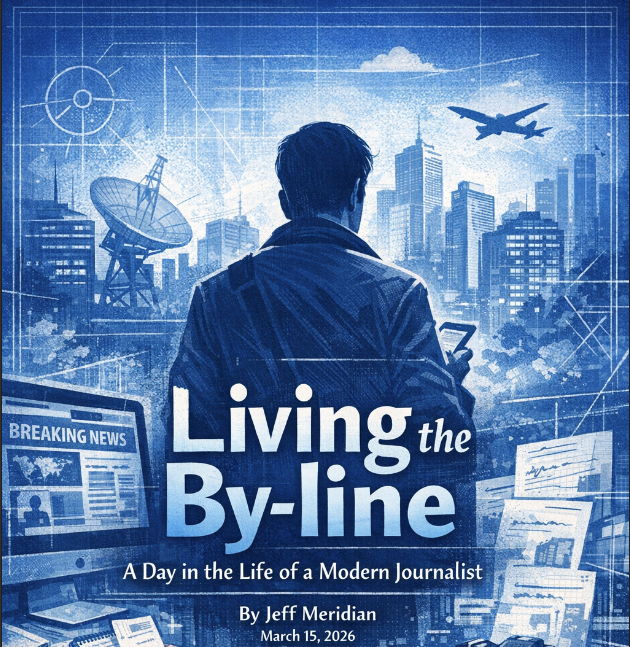
Living the By‑line: A Day in the Life of a Modern author.
When new ideas hum like a living organism, every keystroke feels like a pulse. We’ve become the custodians of stories that sprint across screens, whisper through earbuds, and flicker on subway billboards. So, what does it really feel like to live as an Author in this hyper‑connected age?
The Rush of Real‑Time Reporting
From the moment I sip my coffee, alerts ping from every corner of the globe. A protest erupts in Bangkok, a breakthrough in renewable‑tech lands in Berlin, a viral TikTok trend reshapes cultural dialogue, and all of that unfolds within the same hour. The adrenaline rush of chasing a lead, verifying facts on the fly, and publishing before the story evaporates is intoxicating. It’s a relentless sprint, but each finish line opens a new track.
My mornings now start not with a newsfeed but with a cascade of chat notifications that arrive in rapid succession as the world awakens. The first ping is usually a breaking‑news alert from a trusted service, a flash flood of headlines that demand instant triage. Within minutes, I’m scanning a live‑streamed protest in Bangkok, watching a sea of lanterns rise over the Chao Phraya River, and noting the chants that echo in both Thai and English. Simultaneously, a German energy‑journalist sends a whisper‑fast note about a newly patented solar‑panel coating that could boost efficiency by 20 %. By 8 a.m., a TikTok clip of a teenage dancer in São Paulo has already amassed 3 million views, spawning a new slang term that threatens to rewrite cultural‑lexicon entries.
The thrill comes from turning that raw, chaotic signal into a coherent narrative before the digital tide recedes. I jot down a headline, talk to a fact‑checking Agent, and fire off a quick email to a local activist on the ground, all while the coffee machine gurgles in the background.
Within thirty minutes, the story is live on our site, its URL already circulating on Twitter and Reddit, each share adding a new layer of context. The satisfaction of seeing a piece climb the trending list, of watching the numbers tick up in real time, fuels the next sprint. Yet every sprint ends at a new starting line: the viral TikTok sparked a debate on intellectual property that I’ll need to follow up on tomorrow, while the Berlin tech breakthrough demands a deeper dive into the science behind it. In this perpetual relay race, news feeds feel more like a kinetic organism whose heart beats to the rhythm of global events.
The Double‑Edged Sword of Technology
Smartphones have turned every passerby into a potential source, while AI tools sift through terabytes of data in seconds. I can now transcribe an interview with a click, generate data visualizations overnight, and schedule social‑media teasers while the sun rises. Yet the same tools demand vigilance: deepfakes, bots, and algorithmic echo chambers threaten the integrity we fight to protect. Balancing speed with scrutiny has become the modern journalist’s tightrope walk.
The smartphone in my pocket is no longer just a device for taking calls; it’s a portable newsroom. On a commuter train, a passenger mentions a sudden policy shift at the municipal level, and I immediately capture a voice memo, add a location tag, and upload the raw audio to the cloud for instant transcription. Within seconds, an AI‑powered transcription engine turns that five‑minute monologue into a searchable text file, complete with speaker‑identification timestamps. I later hand that file to a an AI Agent in the data team, who runs a sentiment‑analysis script that highlights the most emotionally charged passages, ready for me to weave into the story.
On the other side of the ledger, sophisticated AI models can comb through millions of public records, extracting patterns that would take a human analyst weeks to discover. Last month, I used an AI‑driven data‑visualization platform to map the spread of a fake news narrative about a vaccine side‑effect. Within an hour, the tool produced an interactive heat map that showed how the rumor traveled from a fringe blog in Italy to mainstream social platforms in the United States, highlighting the nodes where bot activity spiked.
But with that power comes peril. Deepfake videos of politicians delivering fabricated speeches have begun to circulate on encrypted messaging apps, cloaked in the veneer of authenticity. A recent incident saw a synthetic video of a well‑known climate activist urging a boycott of a major airline, which briefly trended before fact‑checkers dismantled it. The speed at which such content spreads forces us to treat every incoming piece of multimedia as a potential threat. We now run every video through a forensic analysis suite that checks for inconsistencies in lighting, audio frequency, and pixelation, an extra step that can add hours to the workflow.
Bots also crowd our feeds, amplifying partisan echo chambers that obscure the true signal. To counteract this, I maintain a live “bot‑detector” dashboard that flags accounts with unusually high posting frequencies or repetitive phrasing. When an account is flagged, an AI Agent is tasked with verifying its authenticity before any quotes are used.
All of these tools, smartphones, AI transcription, automated visualizations, bot‑detectors, are essential , yet they demand a disciplined regimen of verification.
The modern Author walks a tightrope: one foot on the exhilarating speed of technology, the other on the solid ground of rigorous fact‑checking. Every time we cross that line, we reinforce the credibility of our prose while preserving the very speed that makes it possible.
The Community of Storytellers
Collaboration now stretches across continents. A data analyst in Nairobi, a photojournalist in São Paulo, a fact‑checker in Helsinki, together we piece together narratives that no single reporter could accomplish alone. It feels like a global co‑working hub, buzzing with diverse perspectives and spontaneous brainstorms on Zoom, Slack, or a shared Google Doc.
I coordinated a network of specialists Agents spread across four time zones. The data analyst in Nairobi, ingested satellite imagery and sea‑level rise models, producing an interactive map that showed which low‑lying districts in Nairobi, Manila, New Orleans, and Rotterdam faced imminent flooding within the next decade. Meanwhile, a photojournalist based in São Paulo, captured on‑the‑ground images of families boarding makeshift rafts on the Amazon’s tributaries, their faces illuminated by the glow of a lone lantern. In Helsinki, a veteran fact‑checker, vetted every statistic, cross‑referencing it with reports from the UN, the World Bank, and local municipal records.
The Challenge of Balance
Living as an Author means walking a fine line between immersion and observation. The constant connectivity can blur the boundary between professional and personal life. I’ve learned to schedule “offline” windows, to let stories breathe, and to protect the mental space needed for thoughtful reporting. It’s a discipline that, paradoxically, makes the rush feel sustainable.
The 24/7 nature of news can feel like an infinite surge, threatening to erode the personal boundaries that keep burnout at bay. Those moments of mental quiet often surface new angles or questions that I would have missed amid the noise. I also employ a “story‑breathing” schedule: after publishing a major piece, I take a 24‑hour pause before diving into the next lead. During this interval, I review the story’s impact metrics, respond to reader comments, and let the narrative settle in the collective consciousness. This breathing period prevents tunnel vision and helps me approach follow‑ups with fresh perspective.
The paradox is that by deliberately stepping back, the forward sprint becomes more sustainable. The rush does not diminish; it becomes a series of measured sprints punctuated by restorative pauses, each one allowing me to run farther and faster without collapsing.
Being an author and journalist today feels like riding a high‑speed train through an ever‑changing landscape. The scenery shifts, politics, technology, culture, but the destination stays the same: truth, context, and the human experience. Every article, podcast, book or video is a ticket to that journey, and every reader who engages becomes a fellow traveler. In this age of instant information, the author’s role feels both more pressurized and more powerful than ever before, an exhilarating paradox that keeps the ink flowing and the curiosity alive.
If you picture the modern writers room as a locomotive, the tracks beneath it are constantly being laid in real time. One moment we’re barreling through a geopolitical crisis in Eastern Europe; the next, we’re navigating the cultural ripple effects of a viral meme that originated in a teenager’s bedroom. The train never stops, and the scenery outside the window morphs from concrete skyscrapers to digital clouds, from bustling market squares to silent data centers humming with servers. Yet, amid this ceaseless motion, the engine’s purpose remains unchanged: to transport passengers, our readers, listeners, and viewers, to a destination built on accuracy, nuance, and empathy.
Every piece we publish is a ticket stamped with a unique identifier, a by‑line, a timestamp, a by‑product of our collective effort. When a reader clicks “play” on a podcast episode, shares an article on social media, or comments on a video, they become fellow passengers, offering their own observations, critiques, and stories. That interaction transforms a solitary delivery into a dialogue, a railcar into a carriage packed with diverse voices.
The paradox we live with is that while the speed and volume of information have never been greater, the responsibility to sift, verify, and contextualize has grown proportionally heavier. The pressure to be first can tempt shortcuts, but the power to shape public discourse also bestows a profound duty, to safeguard truth, to illuminate marginal perspectives, and to hold the powerful accountable. When we strike that balance, the high‑speed train becomes not just a symbol of fatigue but of exhilaration, a testament to humanity’s ability to harness technology without surrendering its soul.
So, as we continue to chase leads, edit drafts, and push stories out at breakneck speed, let us remember the quiet moments in cramped kitchens, the collaborative hum of global teams, and the deliberate pauses that keep our minds sharp. Those are the rails that keep the train on track, ensuring that every journey ends at the same timeless station: a deeper, richer understanding of the world we share.
Comments & Ratings
#
Loading comments...