


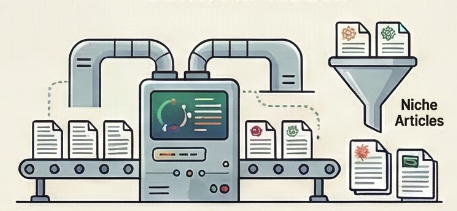
- A blueprint for a profitable AI publishing machine.
- The Lonely Cabin.
- Affiliate products
- The dashboard
- The AI content factory.
- Quality control has to be built into every step.
- We need to build the distribution pipes.
- The three pillars of distribution.
- SEO is crucial.
- But how do we logically transition them into paying customers for a full book?
- giving it away for free
- Source audit log
- Guardrails
- SEO
- 1. Introduction to the Blueprint
- 2. Understanding Success Metrics
- 3. Harnessing AI for Content Creation
- 4. Scaling Content Production
- 5. Distribution Channels & Audience Building
- 6. Turning Content into Book Sales
- 7. Social‑Media Strategy for Author Visibility
- 8. Counterpoint: Risks & Ethical Considerations
- 9. Synthesis
- Publishing Success in Practise.
A blueprint for a profitable AI publishing machine. #
This essay delivers a step‑by‑step roadmap for aspiring writers, showing how to harness AI‑driven content creation, multi‑channel distribution, and strategic book‑selling tactics to transform a manuscript into a profitable author brand. Building a profitable AI publishing machine.
You know, there is this incredibly persistent, deeply romanticized image of what it means to be an author. Like, you probably have it in your head right now.
The Lonely Cabin. #
Just someone tucked away in a snowed-in cabin, clacking away on a vintage typewriter, pouring their soul onto the page.
And then, as if by magic, a publisher just discovers them out of nowhere.
And suddenly the book is in stores everywhere. But for you, the reader, the modern author isn't just someone typing away in isolation anymore.
It's a beautiful image. But in today's digital ecosystem, it is almost entirely fiction.
Because today, they are a tech‑enabled literary entrepreneur. And whether you are sitting on a finished manuscript right now or you just have a really compelling idea for a book, the gap between writing the words and actually getting read and bought.
Let us dive into a comprehensive blueprint for a profitable AI publishing machine. It lays out exactly how aspiring writers can turn a solitary manuscript into a profitable, multi‑platform brand. Okay, let's unpack this. How can you use artificial intelligence, strategic distribution, and modern marketing to actually get your work read without completely drowning in information overload?
That is the fundamental challenge here. Because success in publishing is, well, it's no longer a linear path of simply writing, editing, and printing. It is a multifaceted system. What we are analyzing today is really a map of the entire journey. We're moving from AI‑assistance all the way down to actual measurable book sales. But before you can build this publishing machine, you have to know what you are actually trying to measure, right? We have to leave that romantic cabin and step into the hard metrics of the digital ecosystem. Exactly. You have to know your targets. Because success isn't just about how many physical books are sitting on a shelf anymore. I like to think of it like writing the book used to be a marathon, but now finishing the manuscript is literally just the starting line of a digital decathlon.
The source material outlines that success today integrates revenue, online presence, and audience engagement.
So what are the actual numbers we're talking about here? Well, looking at the financial reality first, the data shows the median self‑published author earns between $6,000, $12,000 in their first year. Okay. That's not bad for a first year, but it's not exactly quit‑your‑day‑job money. However, top‑tier indie authors are surpassing $100,000. Wait, really? Over $100,000? Yes. And they aren't doing that just from moving massive volumes of print books. They achieve that through diversified streams.
Affiliate products #
Affiliate products and speaking fees, and offering their work in multiple formats. Going from $12,000 to over $100,000 is a staggering leap. I imagine there are some very specific targets you have to hit to climb that ladder. For emerging authors, the goal is reaching 5,000 to 10,000 monthly site visits. 10,000. And that's after your first six months of publishing consistent content. You are also tracking brand presence and influence.
The dashboard #
How do you even measure influence? A publishing consultant would probably suggest aiming for a composite influence score above 50. Think of this as like a holistic measurement of your digital footprint across the internet. A cloud‑style score.
Alongside that, you want an engagement rate of greater than 3 % on Instagram and greater than 1 % on Twitter. Which proves your audience is actually paying attention, not just scrolling past. And if we connect this to the bigger picture, those numbers aren't just vanity metrics. They function as a diagnostic dashboard. Like the dashboard in your car. Just like your car tells you if you need gas or a tire rotation, these metrics dictate exactly where you should allocate your time and resources for the next phase of growth. So if your Twitter engagement is high but your website traffic is low.
The dashboard is telling you that people like your ideas but your funnel to get them to your actual website is broken. But I am looking at that target of 10,000 site visits and it sounds like a lot. It is a lot. A single human being typing away in their free time can't realistically produce enough content to hit those numbers without burning out in a month.
Which is exactly where we transition from purely human effort to machine‑assisted scale. You are essentially building an assembly line.
The AI content factory. #
What the Blueprint calls the AI content factory. The blue print breaks down a specific stack of tools for this. You use Gemmini or ChatGPT or Claude or any larger language models for the initial conversational brainstorming and drafting broad outlines. Just to get the ideas flowing.
Then you integrate Jasper, which is a tool specifically trained for SEO and marketing copy. And for the actual pros, especially if you are focusing on narrative flow or character building, you utilize an AI writing tool designed specifically to match your creative style.
You aren't just opening ChatGPT and saying, you know, write me a blog post. No, definitely not.
The workflow described here is much more methodical. How does it work? Well, you prompt the AI for 15 to 20 headings based on your topic.
You build a hierarchical outline from those. Then you feed those outline nodes back into the AI, requesting just 300‑word drafts for each specific note, breaking it down into really small chunks, while explicitly telling it what tone to use.
Finally, you use the AI's rewrite function to tighten the transitions between all those little blocks of text.
Quality control has to be built into every step. #
The source stresses maintaining a Flesch‑Kincaid readability score of 60 to 70. For context, what does that actually mean for the reader? That means keeping the writing at about an 8th or 9th grade reading level. Okay, so very accessible. Ensuring it is conversational for a broad audience rather than sounding like an academic textbook.You also run the final drafts through a plagiarism detector like Turnitin to guarantee uniqueness. Because AI algorithms can and will unintentionally reproduce existing text they were trained on.
Hold on. If I'm feeding an outline into a machine and telling it to spit out hundreds of 300‑word blocks, isn't my writing going to sound incredibly robotic and soulless? Like, how do you prevent every article from sounding like a monotone Wikipedia entry?
That is a very valid concern. The blueprint addresses this exact vulnerability with a concept called voice locking.
Voice locking? What is that? You establish a strict style guide before you even begin. You dictate your vocabulary, your sentence length, your preferred metaphors, and you use human‑in‑the‑loop editing.
You don't just copy and paste. Never. The AI is not the author. Think of AI as a highly advanced GPS for your draft. It can calculate the fastest route. It can even do the driving on the open highway, but you still have to tell it exactly what the destination looks like. And take the wheel when the terrain gets tricky AI is a productivity amplifier. It's a sous‑chef prepping the ingredients while you remain the head chef. You are tasting the dish, adjusting the seasoning, and ensuring the final product reflects your unique perspective.
I love that analogy. The AI chops the onion so you don't have to stare at a blank page. But generating all those perfectly seasoned articles is completely useless if they just sit in a folder on your desktop. We have to figure out how to get eyeballs on this work without spending 24 hours a day manually posting on social media.
We need to build the distribution pipes. #
So how do we actually distribute all this? Scale is the objective here, and the underlying strategy is repurposing. You take one deep, comprehensive 3,000‑word guide, and you fracture it. Break it apart. That single piece of content becomes a series of five‑minute blog reads. It becomes bulleted takeaways for your weekly newsletter. It becomes compelling, quote, graphics for your social media channels.
Which brings me back to feeling overwhelmed again. I mean, I'm looking at the list of tools the Blueprint recommends for this. Airtable, Zapier, Hootsuite, WordPress.
If I'm a writer, I want to write, not become a full‑time IT system administrator. It does sound like an IT job at first, but the key is that these tools are built sequentially to automate the heavy lifting.
You use a database tool like Airtable or Notion simply to build a visual content calendar so you know what it's publishing when. Just to stay organized.
Then you introduce a tool like Zapier or n8n that act as an invisible bridge between your different apps. So when you drag a finished article into a Google Drive folder marked ready, Zapier automatically detects it and pushes it straight into WordPress as a formatted draft. You don't even have to log into WordPress. Exactly. Meanwhile, tools like Buffer or Hootsuite allow you to spend one hour on Sunday queuing up an entire week's worth of social media posts. The system just runs while you sleep.
Here's where it gets really interesting.
The three pillars of distribution. #
The Blueprint categorizes all this distribution into three distinct channels, owned, earned, and paid.
I like to think of these three channels like real estate. Oh. Owned media is like building your own house, right? You own the property, you own your email list, and nobody can kick you out or suddenly change the algorithm on you. That is the most valuable asset you have. Earned media is like getting invited to someone else's house party. You are leveraging an existing audience by pitching guest posts or appearing on podcasts.. And paid media is just renting a billboard on the highway.
You allocate a modest budget, maybe $150 to $300 a month for social booths or ads, but you only get eyeballs for as long as you keep paying the rent. And to make that owned house truly effective, the Blueprint highlights the strategic necessity of segmenting your email list. Segmenting, separating out the subscribers? Yes. If you write both science fiction and self‑help productivity guides, you cannot blast the exact same emails to everyone on your list.
That would be a disaster. You segment them based on how they signed up. By doing that, you drip the precise, relevant content to the correct reader. Which keeps them engaged. That is the mechanism that converts a passive scroller into an active, engaged member of your community. But people still need to be able find your house in the first place. I can't just guess what people are searching for on Google, which is where search engine optimization comes in.
SEO is crucial. #
The Blueprint advises using SEO platforms like RFS or SEMrush to find target keywords. What kind of keywords are we looking for? You are looking for a very specific sweet spot. Search volume between 1,000 and 5,000 searches per month with a difficulty score of less than 30.
Why those specific numbers? Because if the volume is too low, nobody is looking for it. If the difficulty is above 30, you're competing against massive, established media corporations and you will never rank on the first page. And the Blueprint specifically mentions targeting long‑tail keywords. Those are the highly specific, slightly longer phrases people type into search engines, like how to self‑publish sci‑fi on Amazon instead of just searching the word writing.
You find that sweet spot, embed those long‑tail keywords in your headers in the first 100 words of your article, and then work to secure backlinks from reputable sites. Backlinks from other blogs or websites.. The data indicates that each high‑authority backlink can bump your organic traffic by 10 to 15 %. Just from one link. Because search engines view a backlink from a reputable site as a literal vote of confidence. It tells the algorithm, hey, other established experts trust the information in this house, so you should route more traffic there. That is wild. So we have the machine fully operational. We've got the AI drafting our outlines, Zapier bridging the apps, SEO pulling people in, and the segmented email list capturing them.
We have an audience happily consuming all your free snippets. The funnel is working.
But how do we logically transition them into paying customers for a full book? #
The transition relies on a process called manuscript expansion. What does that involve? Well, you don't just staple your blog post together and call it a book. That would be pretty obvious. You aggregate the articles, focusing on what the consultant calls thematic cohesion. You identify the narrative gaps between your articles. And you use AI to expand those outlines into full chapters.
How long should the chapters be?
Ensuring a minimum of 5,000 words per chapter to provide real depth. Then, trucially, you bring in human developmental and copy editors to polish the flow and structure. So you still need real human editors at the end. Absolutely. The AI builds the frame, but the humans polish the house.
Once it's polished, you face the classic fork in the road self‑publishing versus traditional publishing. Of the eternal debate. The blueprint outlines that self‑publishing offers up to 70 % royalties and incredible speed to market. It really puts you entirely in the driver's seat.
While traditional publishing offers an advance payment and physical bookstore reach, but it is a much slower process. You surrender significant creative control and your royalty percentages are substantially lower. Assuming you take the independent route, pricing and packaging become your primary revenue levers. Well, for niche nonfiction, the optimal price point is between $9.99 and $14.99. This maximizes both purchase volume and the perceived value of the information.
But the real driver of that $100,000 revenue target we discussed earlier is bundling. Bundling, like putting products together. If you pair the e‑book with an audio version or a companion workbook, you can increase the average order value by 30 %. Just by adding a workbook. And to launch this, you do a 48‑hour 30 % discount specifically for your email subscribers. To create a sense of urgency.
Utilizing countdown timers, bringing in beta readers, and dropping teasers on platforms like TikTok or Instagram to build social hype.
giving it away for free #
If I have been giving away my absolute best ideas, all these tips and stories, for free on my blog and in my newsletter for the last six months, why would anyone suddenly pay $14.99 for a book they have basically already read in pieces?
It is a common hesitation, but it fundamentally misunderstands reader psychology. Readers aren't paying for raw information. They aren't. They are paying for the thematic cohesion and the curation.
The book organizes those scattered, disparate insights into a structured, transformative journey.
They are paying for the convenience of having your best ideas refined, logically ordered, and bound together in a way that guides them from plane A to point B.
They are buying the map, not just a folder full of random pictures of the landscape.
Source audit log #
It is like an unstoppable machine when it all comes together. But, you know, generating hundreds of articles and constantly feeding this algorithm, it sounds like a fast track to severe burnout. There has to be a dark side to operating at this speed. This raises an important question about the operational risks of the blueprint. There are significant ethical and legal considerations here. As we noted, AI can dilute your personal style. But it can also suffer from hallucinations, confidently inventing statistics or facts out of thin air. AI just making things up. It can also unintentionally reproduce copyrighted phrasing.
The consultant insists that maintaining a source audit log is mandatory. A source audit log. You must systematically track exactly where the AI got its claims to avoid catastrophic reputational damage. Yeah. You do not want to be caught plagiarizing, even accidentally. And to maintain trust with your readers and, you know, comply with FTC guidelines, the blueprint also recommends using clear disclosures, something like portions generated with AI assistance. Transparency is non‑negotiable. But beyond the legalities, there is the very real threat to the author's mental health. The burnout factor.
The core promise of this blueprint is that you can produce massive volumes of content. That kind of output pressure can easily trigger unsustainable work rhythms. So what does this all mean? We use a brilliant technological tool that is supposed to save us time, only to fill that saved time with the pressure of grinding out 100 more articles. Which is why the blueprint is very explicit about establishing human guardrails.
Guardrails #
Guardrails like what? You must implement strict work hour caps and schedule non‑negotiable creative rest days. Oh, forcing yourself to step away. The time you save by using AI to draft an outline should not be used to just draft 10 more outlines. That saved time must be reinvested into genuine human research, real networking, and authentic storytelling. So you have to preserve the human element that the AI is amplifying in the first place. The machine serves the human, not the other way around. So to synthesize this for you, you are building an entire ecosystem. You utilize AI like large language models to handle the tedious drafting. You bridge your apps with automations so you don't have to live at your computer.
SEO #
You leverage SEO to pull readers into your own email list and then logically funnel that audience into purchasing a curated, cohesive book bundle. And you do all of this while setting strict guardrails to protect your sanity and your authenticity. But I want to leave you with a final lingering thought to chew on regarding this entire system.
We have explored how to use AI to perfect the drafting process and how to use algorithms to automate the marketing. If we play that out over the next few years, what happens to the intrinsic value of human writing?
In a future where the digital market is absolutely flooded with flawless, high‑volume AI‑assisted books, will a 100 % human‑made manuscript suddenly become a highly sought‑after luxury artisanal product?
Just like handmade wooden furniture became a premium status symbol in an era of cheap, mass‑manufactured plastics. Will that lonely writer in the Snowden cabin eventually become the ultimate premium brand?
It is definitely something to think about.
Until next time, keep exploring.
1. Introduction to the Blueprint #
In the contemporary digital ecosystem a successful author is no longer defined solely by the number of printed volumes sold. Success now integrates revenue streams, online presence, and audience engagement across a web of platforms. Artificial intelligence, once a curiosity, has become a core production engine, enabling writers to generate high‑volume articles, refine manuscripts, and amplify visibility with unprecedented speed. This essay maps the full journey, from ideation through AI‑enhanced output, strategic distribution, and ultimately book sales, so that writers can convert a solitary manuscript into a thriving literary enterprise.
2. Understanding Success Metrics #
Revenue – Gross income from book sales (print, ebook, audiobook), affiliate products, and speaking fees. Industry data from the Association of American Publishers indicates that the median self‑published author earns $6,000–$12,000 in the first year, while top‑tier indie authors can surpass $100,000 through diversified streams.
Readership – Measured by unique visitors to an author website, newsletter subscribers, and average monthly pageviews. A benchmark for emerging authors is 5,000–10,000 monthly site visits after six months of consistent content.
Brand Presence – Followers across social platforms, media mentions, and podcast appearances. A composite influence score above 50 (based on Klout‑style metrics) signals a foothold in the niche.
Influence – Invitations to speak, guest‑write, or consult; often correlates with engagement rate (likes/comments per post) exceeding 3 % on Instagram or 1 % on Twitter.
These metrics provide a diagnostic dashboard: they reveal where the author stands and guide resource allocation for the next growth phase.
3. Harnessing AI for Content Creation #
Overview of AI Tools
GPT‑4/ChatGPT – Conversational model ideal for brainstorming, drafting outlines, and generating first‑pass prose.
Jasper – Template‑driven platform built for marketers; excels at SEO‑oriented blog posts and ad copy.
Sudowrite – Creative‑focus suite offering character brainstorming, dialogue polishing, and style‑matching.
Workflow for Generating Articles
Idea Generation – Prompt the AI with a concise premise (“10 ways to overcome writer’s block for nonfiction”) and collect a list of 15‑20 headings.
Outline Construction – Refine selected headings into a hierarchical outline; ask the AI to supply a one‑sentence summary per section.
Draft Production – Feed each outline node into the AI, requesting a 300‑word draft while specifying tone (“professional yet conversational”).
Revision Loop – Use AI’s “rewrite” function to tighten language, improve transitions, and enforce a consistent voice.
Quality‑Control Checklist
Voice Consistency – Verify that the AI‑generated text matches the author’s established style guide.
Factual Accuracy – Cross‑check statistics, quotes, and citations; AI can hallucinate.
Originality – Run the draft through plagiarism detection (e.g., Turnitin) to guarantee uniqueness.
Readability – Aim for a Flesch‑Kincaid score of 60–70 for broad‑audience articles.
Bolded key terms: AI‑driven drafting, quality‑control checklist.
4. Scaling Content Production #
Producing Dozens to Hundreds of Articles per Month
Batch Prompting – Create a master spreadsheet of topics, assign each a prompt template, and run them through the AI in parallel using the OpenAI API.
Tiered Review System – Allocate junior editors to perform first‑pass checks; senior editors reserve time for final polishing.
Repurposing Long‑Form Content
Blog Posts – Break a 3,000‑word guide into a series of 5‑minute reads, each covering a subtopic.
Newsletters – Extract key takeaways into bullet‑point summaries for email distribution.
Social Snippets – Convert compelling quotes or statistics into graphics for Instagram carousel posts or TikTok captions.
Scheduling and Automation
Content Calendar – Use tools like Airtable or Notion to map publishing dates, assign responsible editors, and track status.
Zapier Automations – Trigger automatic posting to WordPress once a draft is moved to the “Ready” folder; simultaneously push the same content to Medium via an RSS feed.
Buffer/Hootsuite – Queue social updates weeks in advance, ensuring a steady cadence without manual intervention.
Bolded key terms: batch prompting, content calendar.
5. Distribution Channels & Audience Building #
Owned Platforms
Author Website – Serve as the central hub; include a lead magnet (free chapter or checklist) to capture email addresses.
Email List – Segment subscribers by interest (fiction vs. non‑fiction) and send targeted drip campaigns.
Earned Media
Guest Posts – Pitch article ideas to niche blogs; provide a byline and a link back to the author page.
Podcasts – Appear on shows that discuss writing craft, positioning yourself as an authority.
Collaborations – Co‑host webinars with complementary authors to cross‑pollinate audiences.
Paid Promotion
PPC – Run Google Ads targeting long‑tail keywords (“how to write a thriller outline”).
Social Boosts – Allocate a modest budget ($150–$300 per month) to amplify high‑performing posts on Facebook and Instagram.
SEO Fundamentals
Keyword Research – Use Ahrefs or SEMrush to identify terms with search volume 1k–5k and keyword difficulty <30.
On‑Page Optimization – Embed primary keywords in H1, meta description, and first 100 words.
Link‑Building – Earn backlinks from reputable writing resources; each high‑authority link can increase organic traffic by 10–15 %.
Bolded key terms: owned platforms, earned media, SEO fundamentals.
6. Turning Content into Book Sales #
From Article Series to Manuscript
Thematic Cohesion – Aggregate related articles into chapters; fill gaps with transitional prose.
Manuscript Expansion – Use AI to elaborate on outlines, ensuring each chapter meets a minimum word count (e.g., 5,000 words).
Professional Editing – Engage a developmental editor to tighten structure and a copy editor for line‑level polish.
Publishing Routes
Route
Advantages
Drawbacks
Self‑Publishing (Amazon KDP, Draft2Digital)
Full royalties (up to 70 %), control over pricing, rapid time‑to‑market.
Requires the author to manage cover design, formatting, and distribution logistics.
Traditional Publishing
Access to editorial expertise, wider bookstore reach, advance payment.
Lengthy submission process, lower royalty rates, less control over cover & pricing.
Pricing, Bundling, and Limited‑Time Offers
Price Point – For niche nonfiction, $9.99–$14.99 maximizes both sales volume and perceived value.
Bundling – Pair the ebook with a workbook or audio companion; bundles can increase average order value by 30 %.
Launch Promotions – Offer a 48‑hour discount (e.g., 30 % off) to email subscribers; amplify with a countdown timer on the landing page.
Leveraging Pre‑Launch Lists
Beta Readers – Provide early chapters to list members for feedback, generating goodwill and word‑of‑mouth.
Social Hype – Release teaser excerpts on Instagram Stories and TikTok, encouraging followers to “turn on post notifications.”
Press Release – Distribute a concise announcement to literary blogs and local media; include a high‑resolution cover image and author bio.
Bolded key terms: manuscript expansion, self‑publishing, launch promotions.
7. Social‑Media Strategy for Author Visibility #
Platform‑Specific Tactics
Twitter / Threads – Daily micro‑tips, thread‑style mini‑essays, and real‑time Q&A sessions. Use hashtags (#AmWriting, #IndieAuthors) to increase discoverability.
Instagram / Reels – Visual behind‑the‑scenes (writing space, research trips), short video teasers of chapter excerpts, and carousel posts summarizing AI‑generated article insights.
TikTok – Rapid‑fire “writing hacks” (15‑second clips), paired with trending sounds; encourage duets for community interaction.
LinkedIn – Publish long‑form thought leadership posts about the business of writing, targeting professional writers and coaches.
Content Pillars
Behind‑the‑Scenes – Show workflow, AI prompts, and manuscript drafts.
Excerpts & Teasers – Share compelling paragraphs; invite followers to comment on favorite lines.
Reader Interaction – Polls (“Which chapter title resonates more?”) and challenges (“Write a 50‑word synopsis”).
AI‑Generated Teasers – Create short, AI‑crafted “what‑if” scenarios related to the book’s theme; position them as fun experiments.
Community Engagement and Growth Hacks
Cross‑Promotion – Guest‑post on complementary authors’ newsletters.
Giveaways – Offer a signed copy or a free consultation in exchange for email sign‑ups.
User‑Generated Content – Feature fan art or reader reviews; this social proof boosts algorithmic favorability.
Analytics Loop – Track engagement metrics weekly; double down on the formats that yield the highest click‑through rate (CTR).
Bolded key terms: content pillars, cross‑promotion, analytics loop.
8. Counterpoint: Risks & Ethical Considerations #
Over‑Reliance on AI
Authenticity – Readers value a distinct authorial voice; excessive AI assistance can dilute personal style. Mitigate by voice‑locking: define a style guide and enforce it during the human‑in‑the‑loop editing phase.
Plagiarism Safeguards – AI may unintentionally reproduce existing phrasing. Run every draft through a plagiarism detector and keep a source‑audit log.
Managing Burnout
Output Pressure – The promise of “hundreds of articles” can trigger unsustainable work rhythms. Implement work‑hour caps and schedule regular “creative rest” days.
Human Oversight – Treat AI as a productivity amplifier, not a replacement for strategic thinking. Preserve time for genuine research, networking, and storytelling.
Legal & Transparency
Disclosure – When AI‑generated content is published, consider a brief note (“Portions generated with AI assistance”) to maintain trust and comply with emerging guidelines from the FTC and publishing unions.
Bolded key terms: authenticity, burnout management, legal disclosure.
9. Synthesis #
The pathway from manuscript to a recognized author brand is no longer linear; it is a multifaceted system where AI, strategic distribution, and disciplined marketing converge. By adopting the workflow outlined, leveraging AI for rapid, high‑quality drafts; scaling production through automation; exploiting owned, earned, and paid channels; converting content clusters into sell‑able books; and sustaining a vibrant social‑media ecosystem, writers can translate creative ideas into sustainable revenue streams. Continuous measurement of success metrics, iterative testing of headlines, and vigilant preservation of authentic voice will keep the author’s trajectory upward, ensuring that the literary venture thrives amid the digital renaissance.
Publishing Success in Practise. #
Week 1: Core Content Ingestion and Automation Pipeline
Develop the AI Content Generation Module: Set up the ingestion pipeline to use batch prompting via the OpenAI API to run prompt templates in parallel for rapid article creation. This module should support workflows utilizing specific AI tools, s for outlining, Jasper for SEO-oriented drafts, and Sudowrite for creative polishing.
Build the Automated Quality-Control Checklist: Implement a mandatory review phase before content is finalized. This module must include plagiarism detection (such as Turnitin) to guarantee originality, readability checks aiming for a Flesch-Kincaid score of 60–70 , and verification steps for voice consistency and factual accuracy.
Integrate Scheduling and Automation Workflows: Connect the ingestion pipeline to a centralized content calendar using Airtable or Notion . Establish Zapier automations to automatically push drafts to WordPress and to Medium via an RSS feed once they are moved to a "Ready" folder, while simultaneously queuing social media updates in Buffer or Hootsuite.
Week 2: Diagnostic Analytics Dashboard
Construct the Success Metrics Dashboard: Build a centralized "diagnostic dashboard" to track the four key metrics of author success: Revenue, Readership, Brand Presence, and Influence .
Program Industry Benchmarks: Configure the dashboard to measure performance against specific targets, such as 5,000–10,000 monthly site visits for readership, a composite influence score above 50 for brand presence, and engagement rates exceeding 3% on Instagram or 1% on Twitter for influence.
Implement the "Analytics Loop" and SEO Tracking: Create a weekly tracking system for engagement metrics and click-through rates (CTR) so users can identify and double down on high-performing formats. Incorporate SEO tracking to monitor target keywords, specifically seeking those with a search volume of 1k–5k and a keyword difficulty of less than 30 .
Delivering these features over the 10-day sprint will establish the PSM's core production engine, enabling users to generate high-volume content while relying on the analytics dashboard to guide their future growth.
Comments & Ratings
#
Loading comments...