


Title: Meridian Dust Ledger
Author: jeff meridian
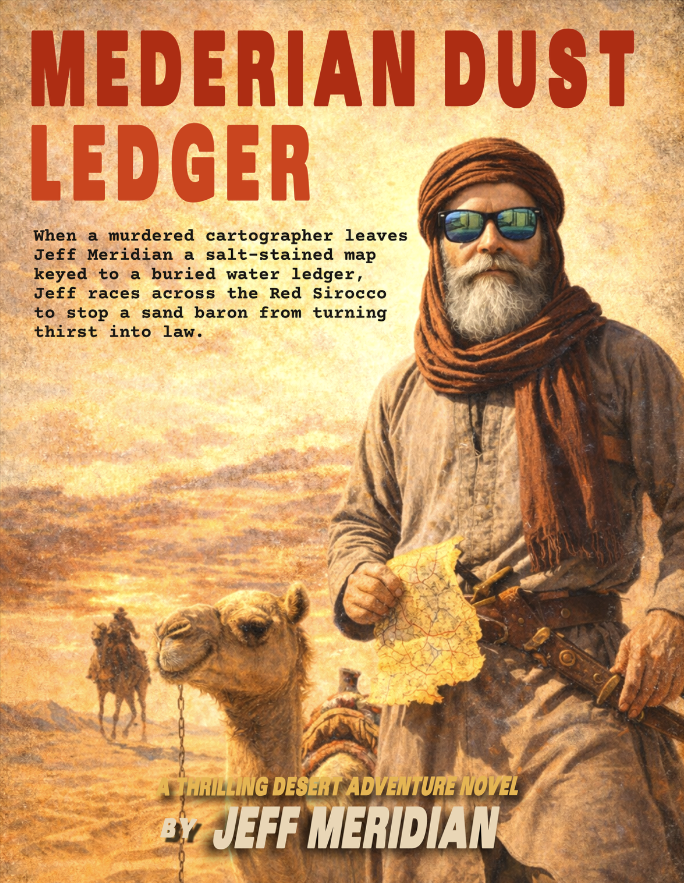
Railhead Widow’s Map #
Jeff kept his shoulders loose. Loose read as harmless. Tight read as guilty.
“Courier,” the coupon leader had called, like the word was a handle he could grab. The man stood by the drum with his clipboard held high to keep it out of the grit, coat bleached to the color of old bone. His seal ring flashed when he turned the page. The lock on the drum sat bright and new. Wrong on this siding. Wrong like a clean boot in a latrine.
Jeff looked at the drum once, then at the railhead keeper’s hands. Empty. The key wasn’t on his belt. It sat in the coupon man’s pocket like a pistol.
“Delivery,” Jeff said. He pitched it bored. “Done.”
“To who.” Not a question. A demand dressed as paperwork.
Jeff picked a name that wouldn’t pull a file fast. “Switch office. South relay.”
The switchman flinched without moving his feet. That was the cost of a lie. Jeff logged it and kept going. He shifted his pack strap with a thumb. The folded map inside his shirt rode against his ribs, salt grit scratching. It made him breathe shallow. He swallowed. Alkali dust stuck to his teeth.
The truck idled. The vibration came up through the hardpan and into his boots. Sand ticked against the bike frames in a steady dry hiss. Hot rubber stank under the fuel smell from a jerry can sweating in the shade line. Behind the shed, scrap iron sat in heaps: bent rail plates, a broken coupling, a length of chain that had eaten sand for years. Good cover. Bad footing.
Jeff angled like he meant to check his kit in the shed shadow. He didn’t hurry. Hurrying in a place like this was a flare.
He reached the shed corner and stopped where the boards blocked sight from the drum for half a second. His hand went to his chest as if to scratch. He flattened the map tighter against his skin, slid the fold down under the strap line so the bulge would ride with his sternum, not above it. The paper rasped. He kept his face blank.
His canteen knocked his hip with a dull clink. Half full. Not enough. He could taste what wasn’t there.
Across the siding, the tracker sat on the far bike with his boots planted wide, posture easy. Not a coupon man. No clipboard. No ring. His eyes did the work. He watched hands, the way a man watches cards. Jeff felt the look hit his chest, pause at the strap angle, drop to the canteen, then slide back up to his face.
The tracker didn’t call out. He didn’t need to.
Two fingers lifted off the grip. A curl. Small as a fly landing. The nearest gunman shifted his weight and slapped his magazine again—metal on metal, a bad seat. The sound was sharp in the heat. He glanced down, annoyed, and that was the only mercy Jeff got: distraction bought by someone else’s failing gear.
Jeff’s mind drew lines without asking. North along the rail was open ground and eyes. East wash was soft sand; he’d bog on foot with a pack, leave tracks like a confession. Behind the shed to the scrap iron would break sight, but his compass was useless near that pile. He’d have to run on poles and wind marks. The telegraph line was his spine. He could keep it on his left and cut when the stakes changed. If he got to the scrub line before the bikes fanned, he could vanish into broken terrain. If.
The coupon leader’s voice rose again, carrying over the ticking sand. “Hold him.”
Not yelled. Filed.
Jeff’s throat went dry in one hard step. His private rule tightened around his ribs with the map. Don’t trade a person’s water for your own safety. He’d already taken the map off a dying man and left the rest of the spur to an audit. Math that wouldn’t settle.
He shifted his pack as if settling it for a long walk. His fingers found the grit-packed bolt on his own strap buckle and turned it a fraction, loosening. If hands came for him, he could drop the pack as bait. Lose gear, keep lungs. Cost later. Always.
A boot scuffed behind him. Close. Too close for coincidence.
Jeff didn’t turn. Turning would seal it.
He took one step out from the shed’s shade into the glare, like he meant to obey, and let the light wash his face clean for the eyes on him. Then he planted his heel, ready to pivot into the scrap iron, ready to abandon weight, ready to run on poles and dust—while the tracker’s signal hung in the air and the first hand reached for his arm.
Laleh’s Last Fan Belt #
Jeff let the reaching hand commit.
He shrugged his shoulder forward like he meant to comply. At the same time he rolled the strap buckle with his thumb. The grit-packed bolt gave. The pack slid off his back and hung for half a second on his elbow.
The hand closed on canvas instead of bone.
Jeff stepped out of the grab, boot scraping hard-packed dirt, and shoved the pack toward the gunman’s chest. Weight hit him. The man staggered. A magazine clacked loose and skittered in the dust. Somebody cursed. Metal on ground, the sharp sound of a choice made too late.
Jeff didn’t look back. Looking back was for men with spare water.
He cut for the junk-lot line where the railhead’s last neat building stopped pretending it owned the day. Fence panels leaned, patched with wire. Wind had piled drifts against the bottom rails, smooth slopes leading into gaps that weren’t on any signboard. Jeff’s mouth tasted of alkali, chalk and old coins. His tongue stuck to his palate when he swallowed air.
Sand ticked on sheet metal roofs as he hit the first lane. The junk-lot wasn’t one lot. It was a dozen garages stitched together by theft and need. Corridors between stacked fenders and cut-down truck beds. Doors made of flattened drums. A hanging tarp slapped his shoulder when he shoved through; the grit in it rasped like a file.
He mapped without pausing. Fresh tire ruts meant someone had moved today, not last week. That meant an exit that wasn’t welded shut. A run of telegraph poles cut behind the far row—straight line anchor when the lanes kinked. Wind scours on the lee side of a pile told him where the drift would slow a bike. He chose lanes with broken glass underfoot; bikes hated it. Men on foot hated it too, but his boots had thick soles and no patience.
He caught the pump station in the corner of his eye—two tanks on a stand, a hand pump handle, a clerk window with a coupon slot. Reflex made him angle away. Pumps meant lines, stamps, eyes. Eyes meant paper. Paper meant Voss.
A loudhailer barked from the street, words flattened by distance and heat. Coupon patrol. The sound didn’t need to be clear to be a threat.
Jeff slipped into a bay marked by nothing but a sun-blistered signboard bolted crooked over the opening. The bay was half shade, half glare. A battered sand truck filled it, hood up like a mouth held open by a mechanic’s arm. The fan belt was half-seated on a pulley, black and shiny, refusing to sit. It squealed once, a short complaint, then went quiet as a hand clamped it.
Laleh Sato had her forearm jammed against the belt to keep tension. Grease striped her wrist. Her other hand worked a spanner in tight arcs. Every movement was measured against the belt’s urge to slip back off and steal another minute.
Jeff’s boots hit the concrete. The sound made her head snap toward him without her body shifting. She kept herself between him and the cab like it was muscle memory.
“Close the door,” she said, voice fast, not loud.
Jeff grabbed the hanging tarp at the bay mouth and yanked it down. Sand ticked against it, trapped. Outside noise dropped. Not gone. Just muffled.
Laleh’s eyes flicked to his hands, then to his beltline, then to the corners of the bay where scrap sat ready to become weapons. “You bring a tail?”
“Not by choice.” Jeff’s chest rose and fell in short pulls. His throat burned with dust. He kept his hands open, palms out, nothing in them. “I need a ride out past the pump stations. Now.”
Her spanner stopped for half a beat. The belt tried to walk off the pulley. She shoved her elbow harder, body leaning into the engine like a brace. “Everyone needs a ride. Everyone needs past the pumps. What are you paying with?”
Jeff reached into his shirt, slow enough to be insulting, and drew out the folded map wrapped in oilcloth. He didn’t unfold it all. He let her see the edges: salt stains that had bled through the paper, the ink lines laid down by a steady hand, keyed marks in tight survey notation. He kept his thumb over the corner that mattered.
Laleh didn’t step closer. She watched the paper like it might spit. “Who’d you lift that from?”
“A cartographer,” Jeff said. “He was dying when I got it.”
“That’s not an answer.” She twisted the spanner again, teeth set. The belt squealed, then settled a fraction deeper. “Who did he work for?”
Jeff listened. Outside, an engine revved and cut. Another answered. He pictured bikes fanning, men dismounting at gaps, eyes sweeping for a moving shadow. “He worked for a wage. Like everyone.”
Laleh’s mouth tightened. “Voss doesn’t pay wages. He pays coupons and favors. Which one are you?”
Jeff held the map steady, not offering it, not putting it away. “I’m the one with no water and no daylight.”
Her gaze dropped to his dented canteen hanging from his belt. It sagged like a dead weight. He unhooked it and set it on her bench with a soft, final clunk. Metal on wood. An empty sound.
Laleh’s nose flared once, catching the dry. She didn’t reach for it. Her left arm still locked the belt in place. “Empty means stupid or desperate.”
“Desperate,” Jeff said. “Stupid didn’t get me this far.”
A clack outside. Boots on gravel. A voice, too close to the bay row, talking to someone else. Jeff’s jaw set. He didn’t move toward the back. He didn’t scan. Scanning was a tell.
Laleh heard it too. She didn’t look at the entrance. She watched Jeff. “If this is a sting, you die in my bay and I have to scrub blood out of my drain. So I ask again. Who’s in the mix?”
“Coupon patrol.” Jeff tasted grit when he spoke; his tongue scraped dry. “Tracker with them. Quiet. Not local.”
Laleh’s eyes narrowed, calculating. “Tracker means they want you alive.” The spanner moved again. “Alive means paperwork.”
Jeff’s throat tightened on a swallow that didn’t help. “I’m carrying paper they want.”
“Paper.” She spat the word like it left a film. “Show me a corner.”
Jeff unfolded just enough to expose a cluster of marks near the railhead slag pile: a grid reference, a note in cramped script, a line traced along a wash with a small triangle and a number that looked like depth or elevation. Not a treasure scribble. Work.
Laleh didn’t touch it. “Voss’s bait maps mark false wells with a double notch on the north tick. Keeps fools chasing holes until their lips split.”
Jeff looked at the tick marks and shook his head once. “Double notch fails here. Wind scours off the slag pile drift iron dust into the wash. North tick gets pulled by compass drift and bad feet. You’d miss the cut by half a league.”
Her eyes held his for a beat. No softness. Just the shift that comes when a test gives an answer she didn’t want but needed.
Outside, the loudhailer barked again. Closer now, words still smeared. The sand truck’s engine bay held its own noise: belt squeal, a fan blade ticking as it settled, the hollow knock of a wrench set down and picked up.
Laleh leaned in and gave the belt a hard pull with a radiator rag wrapped around her hand for grip. The belt snapped into its groove with a sound like a slap. She released it slow, watching for creep. It held.
She wiped her hands on the rag, grease streaking the fabric dark. Then she reached up and slapped the hood down, not gentle. The latch caught on the second hit.
“Proof and payment up front,” she said. “Proof you’re not walking me into a coupon stop. Payment that doesn’t drag me into Voss’s book.”
Jeff kept the map close to his chest. “Name it.”
Laleh’s gaze flicked to the empty canteen again. Not pity. Inventory. “Payment is the map’s copy, not the original. I don’t hold your leash. Proof is you tell me where they’ll cut us off.”
Jeff’s mouth went drier at the thought of ink and time. Copy meant delay. Delay meant boots at the tarp.
“I can’t copy it here,” he said.
“You can’t ride out with it and keep it,” she replied, already moving. She shoved a drawer shut with her hip, grabbed a set of keys from a nail, and palmed them like they were a tool. “Pick.”
Jeff’s mind drew the lot in lines and exits. Telegraph poles behind the far row. Back lane with glass. A gate that sagged but wasn’t chained. The patrol would expect him to run for open ground or the pump, not deeper into the garages. He could predict their cut. He could say it. That would buy proof without giving away the whole page.
“Street lane to the pump gets blocked,” he said. “They’ll post there because everyone runs thirsty. Tracker will swing wide to the telegraph line because it’s the only straight path out. He’ll put a man at the third pole with the broken insulator.”
Laleh’s eyes flicked up, recalling without thinking. “Third pole does have a broken insulator.”
Jeff didn’t answer. His hands hovered near the map, protective and restrained.
Laleh stepped past him toward the cab. She didn’t invite him in yet. “Condition,” she said, and her voice tightened like a bolt. “I pick the route. You keep that paper hidden. If you flash it at a patrol, I drop you in the sand and keep my truck.”
Option removed. Control gone with the keys in her fist.
Jeff nodded once. It cost him more than it showed. His throat ached. His empty canteen sat on her bench like an accusation.
Outside, a boot scraped near the tarp, close enough to hear the grit drag.
Laleh swung into the driver’s seat and turned the key. The engine coughed, caught, and settled into a strained idle that vibrated through the bay floor.
“Get in,” she said. “And don’t make me stop.”
The bay stank of hot rubber and leaking fuel, the kind that sat in the back of your throat and made you swallow more than you had. Sun-heated tires lay stacked like black coins against the far wall. A drip line ran from a cut hose into a tin pan, tick-tick-tick, steady as a metronome.
Laleh didn’t let Jeff drift. She moved him with a palm to his shoulder blade, not rough, not gentle. Placement. She kept his body between the truck and her tool wall, between the passenger door and her parts shelf. Her eyes never stopped counting.
The truck was a stitched-together animal. Weld beads across the cab seam. A fender from one make, a door from another. Bolts packed with grit that had to be punched out with a nail. Near the dash, someone had mounted a brass compass in a bent bracket. Its glass had a crack like a hair laid across it.
“Proof,” Laleh said again. She leaned close enough that he caught the sharp edge of gasoline on her clothes. “Not words.”
Jeff’s jaw set. His hands went to the satchel. He unbuckled it slow, as if the leather might squeal and call the patrol in. He laid a strip of canvas on the bench—old shade cloth, frayed at the edge—and upended the bag.
Metal clinked, dull and tired. Survey coins rolled and settled, stamped faces flashing in the light. A coupon book hit with a flat slap; half its pages were missing, torn out in ragged bites. The brass compass came last, heavier than it looked, and skated an inch before the crack in its face caught the light and pinned attention.
Laleh’s fingers went for the coin stack. Jeff put two fingers down on the canvas between her and the compass, not to stop her, to mark his line.
“Take the coins,” he said. “Take that compass.” He nodded at the brass on the canvas, not the one on her dash. “You get paid now. I keep the paper.”
Her gaze flicked, fast, to the compass on the canvas and then to the one on the dash. Matching weight. Matching age. Leverage. Navigation in the Red Sirocco was water with a different label.
“And when your friends kick my door in?” she asked. “When Voss decides my bay needs a new owner?”
Jeff didn’t answer with comfort. He turned the compass on the canvas so the face caught the overhead strip light. The stamp on the back lip showed—an official mark, shallow but clean, half-worn by years of pocket grit. He knew that stamp. He’d been issued one like it when he still carried a line rod instead of a courier satchel.
“That’s survey hand issue,” he said. His mouth dried as he spoke, tongue sticking to his palate. “Not a market trinket. The cartographer didn’t start as a drifter. He had a line once. Official.”
Laleh’s brows shifted by a fraction. Not belief. Interest. She picked up the compass and ran her thumb over the stamp, then the crack. A flaw you could feel. A value you could lose.
“Maps get you killed,” she said. “Coins buy tires. A compass buys choices.”
She tucked the coins into her pocket with quick, practiced movements, then took the coupon book and flipped it. Torn pages. Missing stamps. Her mouth tightened. “These are Voss’s leash. He calls it stability. He calls it order. He calls it whatever keeps his name on the pump keys.”
Jeff watched her hands hover over the torn book. Deceit had tells. Over-precise wording. Avoiding water talk. Her anger didn’t dodge. It went straight at the machinery of it.
“I’m not here to burn your shop,” he said.
“You’re here to run.” She slid the compass into her belt pouch and snapped it shut. “And I’m here to keep my engine moving. Our interests meet for about a hundred miles.”
A boot scraped outside the tarp again. Closer. The grit drag made Jeff’s shoulders go rigid.
Laleh jerked her chin at the wall beside the truck. A grease-stained sketch was tacked there, drawn with a stub of charcoal on cardboard. Alleys, scrap fences, a culvert line marked with a thick black stroke. A coupon checkpoint drawn like a box with teeth. Beyond it, a slag berm with an arrow that bent behind it.
“Ten minutes,” she said. “Coupon patrol sweeps the junk-lot exits in under that. Once a flag goes up, they lock pump stations and start checking radiator caps. Fresh water theft leaves a ring. Voss’s boys know the smell.”
Jeff’s eyes tracked the sketch, and behind it he saw the yard as a map: lanes of scrap, choke points, places a truck could bog. His mind took the telegraph poles he’d named and pulled a line through them. He tasted alkali dust on his teeth without opening his mouth.
“The berm,” he said, pointing with two fingers, never touching the cardboard. “Wind scours on the face mean there’s a gap that stays clear. Sand doesn’t pile there. You can cut through without sinking an axle.”
Laleh looked at him, then past him, as if seeing the berm through metal walls. “You read dirt like a ledger.”
He didn’t smile. He swallowed. His empty canteen sat on the bench by the canvas like a question he wouldn’t ask.
She grabbed a rag and wiped a semicircle on the truck’s dash, then threw a piece of cloth over the rest to cut the glare. The cloth snapped once as it caught on a bolt head. She yanked it free and tucked it under the compass bracket.
“Listen,” she said, voice clipped. “This motor runs hot even on good days. I’ll short-shift, keep the RPM low, and if the gauge climbs I’ll run the heater core full open as an auxiliary radiator while we move, but that means you keep your side window cracked and you don’t complain when it blows furnace air in your face.”
One long sentence. A plan made of parts and costs.
Jeff nodded. “Dirty exit,” he said. “No pump stations.”
“Say it again and I’ll charge you for repetition,” she shot back, and it wasn’t a joke. It was a boundary.
Jeff scooped the canvas, wrapped the remaining scraps—nothing left but dust and a torn strap—and stuffed it back into the satchel. The map stayed under his shirt, flat against his ribs. He checked it by touch only, palm pressed, feeling the fold lines like bones.
Laleh tossed him a length of cord. “Tie that satchel down. If it falls out, I don’t stop.”
He looped it around the passenger footwell bracket, cinched hard, and tested the knot with a tug that made his bruised knuckles sting. He took the last swallow from his canteen. It wasn’t enough to wet his whole mouth. He capped it anyway, habit more than hope.
Laleh’s keys clicked in the ignition. The engine’s vibration came up through the steering column and into the floor like a warning. She checked the gauge with a glance and tapped it once with a knuckle. The needle quivered.
Outside, a loudhailer barked, words chopped by distance and canvas. Boots. A laugh that carried too easy. The cadence of men who had water at their backs.
Jeff stepped to the bay door and took the exposed spot beside the tarp, shoulder against the frame. He listened. Sand ticked against metal somewhere out in the yard, a dry rain on scrap. He didn’t lift the tarp to look. Looking was how you got seen.
“Two,” he said, low. “At least. One heavier. They’re not running.”
Laleh didn’t ask how he knew. She popped the passenger door from inside with a shove. “In.”
Jeff slid into the seat, keeping his body low. The cracked glass brass compass on the dash caught his eye. Another stamp on its rim, half-hidden under grime. He filed it away without naming it.
Laleh stomped the clutch. The truck lurched. Weld seams groaned like an old hinge. She eased it into gear with care that looked like impatience.
“Clock’s on,” she said.
The tarp lifted as the truck nosed out, the bay’s stink replaced by hotter air and the sharper bite of fuel from the yard’s drums. Junk-lot lanes opened ahead in narrow cuts between piled metal, and somewhere beyond them the patrol sweep was already turning in.
The truck talked through the wheel.
Not the engine note—Laleh had that held in a hard, flat band. It was the vibration up the steering column, the small tremors that said the front end wanted to wander and she wasn’t letting it. Every weld seam answered as they cut between stacks of rusted bed frames and corrugated siding. The column buzzed, then smoothed, then buzzed again as the tires crossed from hard pack to a patch of loose grit.
A belt chirped once. High and quick. Laleh’s left hand snapped to the dash and tapped the gauge. The needle quivered like it was tired of the truth.
“Hold,” she said. Not to Jeff. To the truck.
Jeff kept his head low and his eyes on gaps. Fence line on the right—chain link patched with sheet metal. Beyond it, telegraph poles, their spacing a ruler the yard couldn’t hide. He counted without moving his lips. Two poles in the gap. Turn. One pole. Short straight. Turn again. If they broke out on the third gap, they’d hit the perimeter road. If they broke out on the fourth, they’d run straight into the pump station lane where the patrol liked to sit with their books and stamps.
He braced his bruised knuckles against the door frame. The satchel cord dug into his wrist each time the truck jolted. The map under his shirt stayed flat, warm with his skin. He didn’t touch it. Touching turned it into a decision.
Laleh drove like she could read the ground’s history. She avoided the pale drifts where sand had pooled against scrap piles. She stayed on darker lanes where old tires had pressed clay hard. She cut tight enough that a mirror kissed a hanging chain.
The chain snapped back and showered sparks. They rang off the truck’s bed and bounced in the mirror like fast fireflies.
“Chain,” Jeff said, because naming it made it real.
Laleh didn’t look. She used the sparks as a curtain.
The yard opened a fraction, lanes widening between two stripped hulls stacked like boats in a dry dock. Jeff saw the sun-blistered signboard before they committed. Half-buried. Tilted toward the lane as if it leaned in to tell a secret.
WATER COUPONS REQUIRED.
The paint was bleached to bone. The word COUPONS still cut through.
“That lane,” he said, and kept it short, “used to have a box.”
Laleh’s fingers tightened on the wheel. “So it still does.”
A loudhailer barked ahead, close enough now to hear the rhythm of authority over tin. “Stop. Present—”
A light truck swung into view, pale dust on its hood, a loudhailer bolted to its cab. Two sidecars flanked it like dogs. Men on the sidecars had rifles laid across their knees, loose and ready. They weren’t running. They were setting a table.
Left sidecar angled to come up on them. Front truck slowed just enough to force a brake. Right sidecar drifted to herd them toward the wider lane that led to the pump station road.
Box-in. Coordinated. Early.
“Three,” Jeff said. “They want us right.”
Laleh answered with her right foot.
The truck surged, vibration climbing, the steering wheel kicking in her hands. She took a narrow aisle between a stack of oil drums and a pile of bent rebar. The patrol truck couldn’t follow that line without committing its bumper. The sidecars tried anyway.
Gain came as noise. Metal on metal. Laleh clipped another hanging chain—deliberate this time—just enough to make it swing down in a lazy arc. It slapped the lead sidecar’s front fender with a dull clang. The rider jerked, over-corrected, and had to brake to keep the bike upright. His rear wheel skated in loose grit and threw a fan of sand.
Jeff watched the gap open, counted it in truck lengths, then watched it shrink again.
Because the exit they’d aimed for—third gap, perimeter road—wasn't empty.
A second patrol vehicle slid across it from behind a stack of freight pallets, blocking the lane with calm precision. A man stood in its bed with a coupon book in one hand like it was a badge, rifle in the other like it was a stamp.
Loss hit like a door shutting. No clean line. No straight run.
A shot cracked. Not thunder. A flat, hard sound that made Jeff’s jaw clamp before his brain caught up. The round hit the truck bed with a sharp ping and tore a bright line in the paint. Another hit scrap nearby, sparks spitting, and one ricochet rang the cab like a hammer on a drum.
Jeff’s ears went hot. Sound narrowed. The loudhailer turned into a distant insect.
He flinched once—couldn’t stop it—then forced his hands back to the door frame. He took the wheel’s vibration through the cab, let it anchor him. He tasted iron where he’d bitten his cheek.
Laleh saw the wide lane ahead—clear lines, long sight. Death by paperwork and bullets. She didn’t take it.
Instead she yanked them toward the spill field.
“Laleh—” Jeff started, because he saw it too: shredded panels, broken pipe, jagged sheet metal half-buried under sand like teeth.
“Shut,” she said, and drove into it anyway.
The truck bounced. Hard. The steering wheel kicked like an animal in a trap. Laleh locked her forearms, jaw set, shoulders rigid. The vibration changed from buzz to hammering impacts. The frame groaned. Something in the dash rattled loose and skittered.
Rubber tore.
Not a pop. A rip. A wet, wrong sound under the engine’s strain. Then the thump of a tire went soft. Slap-slap-slap on the rim edge. The truck’s corner sagged and kept going because stopping was a choice that got you surrounded.
Jeff’s mouth dried in a rush. His tongue stuck to the roof. He could have thrown the map. Let it flutter out the window like bait. Give the patrol a reason to stop and snatch paper instead of chasing metal.
His hand twitched toward his shirt, then stopped on air. He stayed with his rule. Never trade a person’s water for your own safety. The map wasn’t water, but it led to it. It was the same math.
He leaned forward, ignoring the ring in his ears, and used the truck’s bounce to lift his sight over the spill. The patrol hesitated at the edge. Sidecars could thread it, but they’d lose tires too. The light truck would bog or bleed.
Between two stacked hulls ahead, Jeff saw a narrow cut—just a knife gap where shadow stayed cooler. The hulls were old freight bodies, their sides pocked and flaked, sitting at an angle that made a blind pocket.
“Cut,” he said. “Between the hulls. Two lengths. Now.”
Laleh didn’t question. She snapped the wheel and let the truck fall into the cut. The right side scraped metal with a shriek. Paint dust blew into the cab. The mirror folded with a crack. Jeff’s shoulder hit the door hard enough to sting through bruises.
Behind them, another shot chewed scrap. Sparks jumped. One round hit a pipe and screamed away. The patrol’s loudhailer garbled into rage.
They shot out the far end of the cut into a strip of hard-packed service track beyond the yard’s fence. The chain link here was broken and folded back, an old service breach for forklifts. The tires hit firmer ground and the truck skidded sideways, fishtailing once as the soft-slapping corner fought for grip.
Laleh corrected with a fast hands-and-feet rhythm. The engine held. The belt stayed quiet. The vibration settled into a steady, ugly shake.
Jeff looked back through the rear glass. Patrol vehicles clustered at the spill field’s edge, unwilling to commit deep. For the first time in minutes, the loudhailer didn’t fill the air.
The truck rode low on one corner, wobbling with each rotation. The smell of hot rubber pushed through the cab.
Laleh kept her eyes forward. “We bought seconds.”
Jeff swallowed and got sand and blood for it. He pressed his palm to his ribs, checking the map’s hard fold lines without pulling it free.
The service track ran straight toward open country, telegraph poles marching alongside like a set of counted steps, and the truck’s wounded tire started to slap faster as they picked up speed.
Laleh tore a strip of canvas from behind the seat and snapped it up against the window frame. The cloth hit the metal lip with a sharp slap, then she hooked it over the top edge and jammed the loose end under the dash with her knuckles. The truck shuddered as she did it. The canvas pulled tight, bowed once, then held, cutting the sand blast down to a gritty hiss instead of a full-face scrape.
Jeff wiped his mouth with the back of his hand and tasted alkali and old blood.
“You’re losing it,” Laleh said, eyes on the track and the telegraph poles ticking past. No glance at the tire, no glance at him. “Rear right’s shredded. Rear left’s chewed. Steering’s tugging. If I let it hunt, we roll.”
A shot cracked behind them. Another. The sound came flat over the open country, then the ping as a round kissed the bed rail. Jeff flinched low by reflex, then forced himself upright.
Options stacked in his head like ration tins. Stop and swap the wheel: capture. Ditch the truck: walk with no water. Keep driving: throw tread, eat rim, lose axle, die by inches.
“Rolling,” Jeff said.
Laleh’s jaw shifted. “Get on the bed.”
He stared at her. The truck hit a patch of loose grit and slewed. The seat belt bit his shoulder.
“Now,” she said. “I can keep it straight. You can’t fix a tire from in there.”
Jeff shoved the door open into the canvas shade, slipped out, and grabbed the cab’s roof gutter. Heat came up through the metal like a pan. He swung a boot to the running board, then hauled himself onto the bed, keeping his weight low. The world back there was loud: wind, sand tick-tick-ticking on the side panels, and the near-ragged slap of rubber dying.
The bed was a mess of scavenged scrap: short lengths of pipe, broken brackets, a coil of wire, a folded tarp pinned under a toolbox. The tailgate rattled with each bump. Jeff crawled on his knees toward the rear, one hand on the bed rail, the other reaching for the tire well.
Another shot snapped past. The air over his shoulder made a thin whip sound. He didn’t look back. Looking back didn’t change what was coming.
The rear right tire was down to cord, flapping strips like torn belt. Each rotation made the rim bark against stone. The left had a bite taken out of its sidewall, a pale crescent where rubber had peeled.
He found the spare under a heap of angle iron and a sheet of corrugated metal. It was lashed down with a strap that ran through a buckle. The buckle was caked with grit and rust. He thumbed it and it didn’t move. The little lever might as well have been welded.
“Buckle’s seized,” he shouted forward.
“You’ve got tools,” Laleh shouted back, voice steady, truck weaving in a shallow S to spoil the line behind them.
Jeff slid his hand into the toolbox. The latch was stiff. When it gave, it took skin with it. He hissed, then pulled out a flat bar and a small hammer. He wedged the bar under the buckle lever and tapped. Nothing. He tapped harder. The strap fibers creaked.
A burst of fire from behind, quicker now, not aimed shots but a string, like someone spending fear. Two rounds hit the bed. One punched through a scrap bracket and threw a bright fleck of metal past Jeff’s cheek. He flattened, then forced himself back up.
His tongue stuck to his palate. He spat into the buckle. The spit came out thick and short. It darkened the grit, made a paste. Water you didn’t get back.
He worked the bar again, grinding. The lever shifted a hair. He breathed through his nose, counted taps to keep his hands from shaking: one, two, three, four. The truck bucked. The buckle bit his knuckles. He ignored it.
The lever finally snapped up. The sound was small but clean. Jeff yanked the strap free and dragged the spare out, rolling it toward the tailgate. It bumped his knee and he caught it before it could bounce out.
He couldn’t mount it at speed. He knew it the same way he knew the distance between telegraph poles: as fact. No jack on a moving bed. No lug wrench with the rim bouncing. Try and the wheel would take his hand or take his head.
“Need a crawl,” he yelled.
Laleh swung the truck toward a low berm of dumped rail ties, dark wood stacked like broken teeth. She tucked them behind the pile and bled speed without braking hard. The patrol engines were louder now, a clustered growl on the service track. Close enough that Jeff could separate notes—two heavier, one lighter, the lighter riding high like it wanted to come around.
The truck slowed to a crawl, the shredded tire slapping slower, each hit a punch to the axle.
“Five seconds,” Laleh called.
She killed the engine.
Silence hit hard. The ticking sand kept going, and the faint ping of cooling metal. The sudden lack of vibration made Jeff’s stomach lurch.
Laleh set the brake and was out of the cab before Jeff could drop from the bed. She moved like this wasn’t her first time doing it with a gun line closing. She yanked open the toolbox without asking, already grabbing the bent scissor jack strapped to the bed floor.
Jeff landed beside her, boots sinking an inch into loose grit by the ties. The rail ties smelled like old creosote baking.
The jack went under the axle. Its arms were bent inward. When Laleh cranked, it lifted a fraction, then tried to fold. She cursed under her breath, sharp, then jammed a scrap of flat steel under one foot to keep it from skating.
“Wire,” she said.
Jeff tore open the coil and fed it to her. His hands were shaking now, not from fear. From heat and thin moisture and the way his body wanted to lie down. He pinched the wire between torn nails and pulled.
Laleh didn’t swap the wheel. She didn’t even touch the spare. She grabbed something else from under the tarp: cut strips of tire, already sized, already punched with holes. A stash. Prepared. He registered it as a new piece of her life, a line of past trouble made into kit.
“You keep those,” he said.
“People keep chasing,” she said, and had the strip under the torn sidewall, wrapping it like a boot. “Hold it.”
Jeff pressed the strip hard against the carcass. The rubber was hot, tacky at the edges. It left black on his palms. Laleh threaded wire through the holes with fast, practiced fingers, twisting with a short stick as a handle. Each twist was a decision. Too loose and it would tear. Too tight and it would cut into the boot and fail early.
A round hit a tie behind them. Wood chips jumped. Another whined off metal in the yard. The patrol had a sight line again.
“Engine,” Jeff said, not as a request.
“Not yet,” Laleh said. “Two more.”
Jeff’s mouth was paper. He swallowed and got nothing. He forced himself to count the wire turns instead. Eleven. Twelve. Thirteen. The twist stick bit into his bruised rib when he leaned in, and the pain steadied him. Pain was clean math.
Laleh finished the last twist, snapped the stick off, and tucked the sharp wire end back into the boot so it wouldn’t flay the fender. She slapped the tire once, listening with her hand.
“Down,” she said. “Jack.”
Jeff cranked the jack down fast. It wanted to fold again, the bent arms complaining. He kept pressure on the base with his boot until the tire took weight.
“Go,” Laleh said.
She was already in the cab. Jeff threw the spare back into the bed with no strap, no time. He hauled himself over the side, hit the running board, and shoved into the seat as Laleh hit the ignition.
The engine caught on the second crank. She dumped the clutch and the truck lunged, booted tire thumping like a bad heartbeat. The patrol engines flared behind the ties, closer, angry. A sidecar silhouette cut left, trying to get around the berm.
Laleh didn’t stay on the service track. She cut off it, over a lip of hardpack into open sand where ruts vanished and every line had to be made fresh. The truck wallowed, then found bite. Jeff felt the vibration climb through the steering column, a strained tremor.
She aimed away from the pump stations, away from any flag or tower that could be claimed. Kept the promise without saying it.
For half a minute the boot held. The thump stayed steady. The canvas at the window snapped and fluttered, then pulled tight again, keeping the sand from stripping their eyes raw.
Then Jeff saw the needle.
The temperature gauge, a small circle on a sun-bleached panel, crept past where it should stop. It didn’t pause. It climbed like it had somewhere to be.
“Laleh,” he said, and his voice came out dry.
She glanced once, quick, then back to the sand ahead. Her hand tightened on the wheel. “I see it.”
A white hiss pushed through the hood seam. Not dust. Not wind. Steam, thick and bright against the heat. It rolled up and over the windshield in a sheet.
The truck kept moving, booted tire pounding, patrol noise fading for the moment behind the berm and the open sand.
The needle kept climbing. The hiss grew into a steady pour.
Jeff leaned forward, eyes stinging, and put his palm on the dash as if touch could hold the engine together. The canvas snapped at the window again, hard, like a warning flag that wouldn’t stop waving.
Salt Pan Teeth #
First light didn’t rise so much as flare.
Mirror Flats took the sun and threw it back in a sheet. The white burn erased depth. A low hump could be a mile away or ten steps. Heat didn’t wait for noon out here; it came early off the salt, pushing up from below like a stove plate.
Jeff kept his head down and his eyes half-lidded. He tore two strips from the hem of his spare shirt and tucked them under his hat brim so they hung like blinders. Laleh copied him without comment, then wrapped another strip across her nose. Cloth went stiff with salt inside a minute.
The truck rolled onto the crust with a shiver through the steering column. That bad heartbeat in the booted tire was still there—thump, thump—steady, warning. The canvas at the windows snapped on its frame. Fine grains hissed against it and found seams.
Laleh reached across the dash and pinched the radiator rag where it was tied to the cap. She tugged once, testing. Her fingers came away damp and dark.
“Steam?” Jeff asked.
“Not now.” She nodded at the gauge. The needle sat lower than it had, but not calm. “If it climbs again we stop. If we stop, we cook.”
Jeff lifted his dented canteen, shook it by his ear. A shallow slosh. He did the math without speaking. Two people. Half a day of glare and engine heat. One swallow each every twenty minutes if they wanted to stay sharp. One swallow each if they didn’t.
He tipped the canteen and took his ration. Three pulls, small. Alkali taste, like licking the inside of a cold pan that had held bleach. He passed it to Laleh. She drank less, then wiped her mouth with the back of her wrist and set the canteen between them where it would be seen and counted.
Fuel next. She flicked open the under-seat flap and shoved two fingers into the jerry can mouth, checked wet line on skin, sniffed. Hot rubber and a trace of leaking fuel lived in the cab now, baked in.
“Half,” she said.
Jeff looked out through the windshield and forced his focus to the only usable detail: faint ripples on the salt where wind had shaved it. Wind scours ran in long, shallow arcs like pencil marks drawn by a tired hand. They all leaned the same way. That told him the wind direction and the wind direction told him what would drift, what would fill, and what would stay hard.
“Keep off the smooth,” he said. “Smooth is soft under. It looks strong. It breaks.”
“Copy.” Laleh eased left, letting the truck climb onto a patch with a fine stippled texture. The tire thump changed pitch. Still ugly. More controlled.
Jeff took out the brass compass. It was a compact piece, good weight, cracked glass in a crescent on the north edge. Salt dust had worked into that hairline and caught the sun. The needle wavered like a drunk trying to stand straight. It pointed, then reconsidered, then jittered again.
He tapped the case. The needle skated. He turned it in his hand and watched the jitter follow, not settle.
“No,” he said, and closed it.
Laleh glanced at his hands. “Compass done?”
“Not dead. Lying.” He tucked it away anyway. A bad instrument cost more than no instrument. “We go by scours and stakes.”
“What stakes,” she said, and her voice had that quick edge that meant she wanted him to be wrong so she could stay on throttle.
Jeff leaned forward until the glass made his eyes sting. At first he saw nothing but the flat white and the shimmer that pretended to be water. Then he caught the only vertical line in the whole world—a thin dark slash, half-buried, casting a short shadow east.
“One,” he said. “Then another. Same spacing. Maintenance line.”
They came up on the first stake and it wasn’t wood. Old rebar, cut rough, hammered in, the top bent where some truck had hit it years ago and kept going. Someone had painted it once. The paint was gone. Salt had eaten the metal into a pitted scab.
Jeff watched its shadow. Dawn made all shadows long and honest for a short window. He tracked the angle in his head. The rebar shadow pointed like a crude hand. He looked for the next stake and found it by its shadow first, a notch of dark on the white.
“Stay on the stake line,” he said. “Not on it. Two truck widths off. Someone watching will watch the line.”
Laleh let out one short sound that could have been laughter or air leaving her lungs. “Rumor says a buried cistern.”
“Rumor’s wrong shape.” Jeff pointed at the repeating stakes. “This isn’t a point. It’s a route. Someone serviced whatever runs under here. A line of work. That means a line of eyes.”
They followed the stakes, offset, letting their own track run parallel but not obvious. The flats gave nothing back. No rocks, no brush, no dunes, only the occasional patch where salt had crusted like broken glaze and the truck would skid for a breath and then catch again.
Jeff kept his gaze moving, building a map from absence. Wind scours told him where the crust was thin. Tire ruts—old, ghosted—told him where someone had dared it before, and where they had gotten away. A patch of darker salt, faint as a stain, showed where seep had once been and dried. He logged it. He logged everything. That was how he stayed calm. Make the world into marks and distances and costs.
Cost ticked down in his mouth. His tongue stuck to his palate when he swallowed air. He didn’t swallow spit because there wasn’t enough to waste.
“Time?” Laleh asked without looking at him.
He checked the watch strapped to his wrist, the face scratched and dull. “We’ve got five hours before the glare turns into a weapon we can’t aim around.”
“And water?”
Jeff slid the canteen between his boots and heard the slosh again. Less. “We cross in nine swallows each. Ten if the radiator stays quiet.”
Laleh’s fingers tightened on the wheel. The truck’s vibration came up through the column in a constant tremor, like a live wire under skin. She ran the rag across her palms once, just the habit of a mechanic checking what the machine was sweating.
Jeff lifted the compass again, couldn’t stop himself. The needle spun a fraction, then settled pointing somewhere it had no right to point. The crack in the glass caught the sun and flared hard enough to force him to blink slow.
He put it away. He’d rather be blind than lied to.
He leaned his head toward the side window and scanned the flats where their offset track would be most visible, where a pursuer would cut. If he were hunting them, he wouldn’t chase the truck’s line. He’d aim for the hardest crust, the shortest angle, and meet them at the stake route ahead. The flats were open enough for an intercept if you read the same marks.
That meant whoever else knew about this line could do the same.
The next stake came and went. Then the next. The repetition settled into a beat: thump of the bad tire, snap of canvas, tick of sand against metal underneath.
Jeff’s eyes found movement on the far white.
Not a mirage this time. A tight arc of black, small against the flats, moving with purpose. Scarves and head wraps, not flapping, held down. They weren’t racing. They were taking the angle.
He watched their line and felt his stomach go tight in a way he didn’t show in his face. Their arc matched the intercept he’d built in his head.
“Laleh,” he said.
She followed his sight. Her jaw set. Her right hand dropped closer to the rifle wedged beside the seat, not grabbing it, not yet.
Black scarves on the flats, cutting clean across the white toward the stake line.
And toward them.
The Ledger Under the Pan #
The sand ticked on the truck’s panels like thrown grain. It got under the hood seam. It got between teeth. Jeff kept his mouth shut and worked his tongue against his palate once, tasting alkali and old coffee.
Laleh held the wheel with two fingers and a locked wrist. The steering column buzzed, a strained vibration that never settled. Heat climbed through the floorboards in pulses.
On the flats behind them the black scarves had grown into bodies. Two mounts. One rider who sat too still to be a raider. A hired tracker. The high line on the dune shoulder gave him speed and sight.
“He’s reading us,” Laleh said.
Jeff watched the dune faces instead of the man. Wind had combed them into ribs, hard scours on the lee side, soft spill on the windward. The pattern told him where crust would hold and where it would suck a tire down to the axle.
A fence line showed as a stagger of posts, half-buried, wire gone but the line still there in the sand’s memory. It angled toward a crease in the terrain, a shallow cut that darkened near its throat. Dry gully. The only firm approach into it would be from the north lip where the ground pinched and packed.
He pictured the tracker’s choice tree. Stay high, cut ahead, take the pinch, force them to climb out into powder with rifles on them.
“He’ll go for the pinch,” Jeff said. He didn’t look at Laleh. He didn’t need to. “He thinks we avoid soft sand. We won’t.”
Laleh’s eyes flicked to him, then back. “Tell me where.”
Jeff pointed with two knuckles, low, so the tracker wouldn’t see a gesture. “Dead ahead. That pale smear? Looks like a sink. It’s a lip. Gully floor’s hard. We drop in. He commits high to cut. He’ll have no angle when we’re under him.”
Laleh gave a short nod, like taking a bolt to torque. She pushed the throttle.
The truck answered with a change in tremor—deeper, rougher. Jeff felt it through the seat springs. The engine note lost its clean edge.
A red bead winked on the dash.
Laleh’s glance cut to the gauge. “Oil.”
The needle had sagged off its usual lie and was sliding toward nothing. Not a fast fall. A steady one. The kind you don’t come back from.
“Don’t baby it,” Jeff said, then hated the sound of his own voice. Orders. Like he owned the machine.
Laleh didn’t take it that way. She snapped the hood latch with her left hand while keeping the truck straight with her right, and for a moment the canvas shade frame above them snapped and rattled, fighting the wind. Jeff grabbed it before it tore loose, felt the rough weave bite his palm.
“Cover me,” she said.
Jeff leaned out, one hand on the door frame, the other on the rifle. Heat hit his face like an opened oven. The tracker on the high line had closed enough that Jeff could see the dark wrap around his head, the way his mount’s legs cut clean strides on firmer sand.
Laleh popped the hood a handspan, not enough for a shot to find her. Hot rubber stench rolled out, mixed with fuel that had no right to be smelling that sharp. She slid her arm in blind, fingers searching.
Jeff kept the rifle low. He didn’t fire. Gunshots were invitations. He needed the tracker to keep believing they were afraid of the wrong ground.
Laleh tugged the dipstick out and held it up without looking, letting Jeff see by the angle of her wrist.
Jeff leaned closer. The stick came up slick, but the line was low. Too low for the distance they still owed the desert.
“You’ve got a weep,” Jeff said.
“Yeah.” Laleh’s voice stayed flat. Her hand went in again. “Line’s sweating at the crimp.”
Sand ticked. The truck shuddered on a ripple and the hood banged.
Jeff tracked the rider. The tracker rose in his stirrups, taking the faster shoulder. He was making the cut. Good. Commit. Don’t think. Keep chasing the obvious.
“What’s the choice?” Laleh asked, not looking up.
“Stop and patch,” Jeff said. “We lose daylight and he walks up on us. Abandon the truck, we lose everything that makes us faster than feet.”
“Improvise,” she said, already doing it.
She yanked the radiator rag from where it was looped on the dash—grease-stiff cloth that had saved them twice already—and shoved it under the hood. The engine heat flashed it to a sharp smell, old oil and scorched cotton. She wrapped the rag around the weeping line by feel, then fed thin salvage wire through her teeth, bit down, and twisted with both hands. The wire cut into her skin. She didn’t flinch. She cinched it until the rag bunched tight and the line stopped spitting.
“Minutes,” Jeff said.
“Minutes are a currency,” Laleh said. She slammed the hood and latched it with the heel of her hand. “Get in.”
Jeff dropped into the seat. The steering column still buzzed, but the oil needle stopped falling. It hovered, sickly, like a man sitting up when he should be lying down.
Laleh brought them straight at the pale smear—the dead end that looked like soft sand waiting to eat them. The tracker took the bait. He stayed high and drove his mount faster, aiming to beat them to the pinch point like it was a finish line.
Jeff tasted dust again and let himself smile once, without showing teeth.
“Hold it,” he said. “Wait. Let him think we’re stuck.”
Laleh kept the truck’s nose steady. The flats rushed under them. The gully lip came up fast, a faint dark line that deepened into a cut.
At the last moment Jeff saw the surface change. The pale smear wasn’t a sink. It was a crusted shelf over a drop. If they hit it wrong they’d peel the axle clean off.
“Now,” Jeff said.
Laleh turned in hard.
The truck’s front tires bit, then slid. For a breath the world tilted. Sand sprayed up in a sheet. The bad tire thumped and the truck bogged at the lip, tires chewing, engine note dropping into a cough that made Jeff’s stomach go cold.
“Come on,” Laleh hissed, and fed it throttle.
The oil gauge trembled. The steering wheel shook in her hands like it wanted to leave.
The truck lurched forward a foot. Then another. The lip held them like a hand on the collar.
Behind them, the tracker crested the dune shoulder and paused, expecting to watch them sink and die.
Jeff didn’t give him that. He grabbed the dash handle and threw his weight forward. “Drop it,” he said.
Laleh let the truck fall.
They went over the edge.
Jeff’s spine took the impact. His teeth clacked. Something in the bed slammed hard enough to ring through the frame. A jerry can bounced once, hit the tailgate, and popped the latch. The can pinwheeled into the air, spilling a thin arc of fuel that vanished into the sand before it hit. It hit the gully wall and vanished out of sight.
Jeff’s hand went to the empty space in his head where that fuel lived, and he counted it without speaking. One option gone. One margin shaved.
The truck landed on hard-packed floor. Traction came back like a gift with strings. Laleh straightened out and the tires gripped, rolling on a surface that felt like old clay under dust.
Above them, the tracker’s line failed. The high shoulder that had looked firm broke into powder at the edge. His mount skidded, legs scrambling, throwing sand. He checked up hard, forced to stop short of the drop. From below Jeff could see him on the ridge line, a black cutout against glare.
No clean shot. Too steep. Too much angle. He’d have to detour to a crossing or ride the gully edge and hope for a break.
Jeff leaned out and lifted two fingers in a small, rude salute the tracker couldn’t mistake. Then he sat back, because wasting water on gestures was still wasting water.
Laleh didn’t look up. Her attention stayed on the engine sound and the gully ahead. The walls rose on either side, casting a strip of shade that made the air feel cooler without giving any more water back.
“Fuel?” she asked.
Jeff checked the gauge. “Down.”
“Oil?”
“Still bleeding,” Jeff said. He could smell it now, hot and thin. “Rag bought us time.”
“Not miles,” Laleh said.
The gully bent. The light changed. The hard floor narrowed and the walls grew closer, the sound of their engine trapped and sent back at them in a dull roar. Sand still ticked, but softer in the shade.
Jeff craned his neck to read the bend. No tracks on the floor. Good. Or bad. Depends who laid the trap.
Ahead, half-buried in a drift against the right wall, a sun-blistered signboard leaned at an angle. The paint had peeled to bone. A symbol still showed through: a mission cup over crossed tools. Shelter. Water, if the board wasn’t lying.
Laleh eased off the throttle, listening to the engine protest.
Jeff’s eyes went to the gully mouth behind them, now hidden by the bend. He pictured the railhead, the straight run back, and erased it. With the tracker on the rim, they’d be overtaken on open flats before the next stake. Returning wasn’t a road anymore. It was a sentence.
The signboard’s lower edge scraped the sand in the wind, tapping in a slow, steady beat.
Jeff held the rifle across his knees and said, “We can hide in there.”
Laleh’s jaw tightened. “Or we can get sealed inside.”
The gully turned darker around the next bend, and the mission mark stared at them like an open door that didn’t promise it would open again.
The gully spat them out onto a flat hardpack apron, and the mission well sat there like it had been dropped from another world and left to blister.
A railhead-style water drum squatted beside a low concrete collar. A hand pump handle rose from the collar on two bolts, the steel browned by years of hands and grit. To the side, a coupon board hung under a narrow awning of canvas on a pipe frame. Stamps in neat rows. Names. Dates. A system with edges sharp enough to cut.
Their truck rolled the last ten yards on a cough. The smell hit first—hot rubber, leaking fuel, burned oil cooked thin. The engine idled rough, shaking the steering column through Jeff’s palms like a warning pulse.
Oil dripped from the sump to the dust. Dark spots, spreading slow.
Laleh kept the nose angled away from the well like she didn’t want to point hunger straight at it. She listened to the idle, head tilted, then reached across and killed the ignition.
Silence fell hard. The ticking of sand against metal replaced the motor. The heat stepped closer.
Jeff’s first thought was distance. Without the engine, their fastest option went into a box and got nailed shut.
Laleh popped her door and climbed out, boots crunching on caliche. She didn’t go to the pump. She went to the hood, flipped the latch, and lifted. The smell got worse.
“Rag’s soaked,” she said, glancing at the oil line. “We’ve got seep and burn. If we push it in this heat, we weld it.”
Jeff slid out with the rifle low and his hat pulled down. Alkali dust sat on his tongue. He swallowed and felt how little spit he had.
The pump handle didn’t move. No one stood guard. The defense was routine: coupon board, stamps, and the fact that this place was visible from the rim if you stood in the wrong spot.
A door opened in the low mission building behind the well. Not a dramatic swing. A measured crack, like someone checking wind.
A man stepped out in work clothes, not robes. Sun had burned his neck into leather. He carried a ledger under one arm and kept his hands empty. He walked past the public pump without touching it.
Father Rami El-Khoury stopped at a distance that made conversation possible and theft costly. His eyes did the work of a hand search: dust lines on their sleeves, oil speckle on Laleh’s forearms, the tight set of Jeff’s jaw that said he’d been holding back words and water.
“You came down the gully,” he said. Low voice. Patient. Not welcoming. “Not from the track.”
Jeff didn’t answer that. Answers turned into questions.
“We need water,” Jeff said. “We’ll pay.”
Father Rami’s gaze flicked to the coupon board. “Pay with what the board accepts? Or pay with a story?”
Laleh shut the hood with a soft slam and stayed by the truck, half between it and the pump, like she could cover both with her body if it came to it. Her right hand hovered near the toolkit in the bed.
Jeff lifted his left hand, palm out, showing he wasn’t reaching for the rifle. With his right, he drew a folded packet from inside his shirt, where the heat had softened the paper.
He kept it folded as long as he could. The less it breathed air, the less it belonged to anyone else.
“I’ve got a claim paper,” Jeff said. “Stamped. And I’ve got a map.”
Father Rami’s eyes dropped to the edge of the paper before Jeff fully unfolded it. They locked there.
“That stamp,” Father Rami said. Not a question. “Orin Pell.”
Jeff didn’t flinch, but something in his chest tightened. He hadn’t said the name. He watched Father Rami’s mouth form it like it had weight.
“You knew him,” Jeff said.
“I saw his work,” Father Rami said. “He filed clean. He wrote clean. Men like that get killed for their lines.”
Laleh made a small sound through her nose—half agreement, half warning. She kept her eyes on Father Rami’s hands.
Jeff unfolded the paper enough to show the stamp and a corner of inked grid. He did not show the whole.
Father Rami’s gaze moved from the stamp to Jeff’s face. “You’re carrying something that belongs to more than you,” he said. “And you want me to turn a handle.”
“I want water,” Jeff said. “And directions.”
“Directions get people buried,” Father Rami said. “Water gets people paid.”
Jeff’s mouth went drier when he heard the next name coming before it came. His fingers tapped the dented canteen cap. Tap. Tap. Not opening it. A habit that kept him from taking without accounting.
Father Rami said, “Kadir Voss.”
Laleh’s head snapped up. Her eyes sharpened like a wrench on a stubborn nut. Jeff didn’t move. He let the name sit. It turned the well into collateral in his mind, a line item in someone else’s book.
“I didn’t bring Voss,” Jeff said.
“You brought his gravity,” Father Rami replied, and the words landed with the flat certainty of a man used to weighing goods. “His foremen count this place. They count coupons. They count drum levels. They count who stays.”
Jeff kept his voice even. “Then don’t stamp us. Don’t put us on the board. We take what we need and we leave.”
Father Rami looked at the public pump handle. He still didn’t touch it. “If you pull that handle, you tell on me,” he said. “They check the drum seal. They check the collar bolts for fresh marks. Routine. Ugly routine.”
Laleh took a step closer, boots scuffing. “So you let people stand here and stare at water until they fold?” she said. Her tone was sharp, but it didn’t rise.
Father Rami met her eyes. “I let people live long enough to keep coming back,” he said. “If the mission gets cut off, everyone loses a stop. Not noble. Arithmetic.”
Jeff’s fingers stopped tapping. He forced them still on the canteen. His private rule pressed at the back of his teeth: never trade a person’s water for your own safety. His brain tried to do the math anyway. Map for water. Water for time. Time for distance.
He hated that the numbers lined up.
Father Rami shifted the ledger under his arm. “You have Orin Pell’s stamp,” he said. “That means paper. That means claims. That means Voss. I once helped file claims for Voss.”
No shame in the statement. No plea. He said it like he was reading an entry aloud so it could be acknowledged and never argued again.
Jeff watched him. “Helped how.”
“Forms. Seals. Transfers,” Father Rami said. “Temporary, they told me. For stability. For protection. ‘Hold the well under a stronger name until raiders stop.’ The transfers never reversed. Names changed. Water moved. People learned new rules: pay, or walk.”
Laleh’s mouth tightened. “And the mission?”
Father Rami’s gaze went past them to the gully mouth, like he could see foremen on the rim already. “The mission stayed supplied,” he said. “I traded paper for drum levels.”
Jeff’s throat worked. His tongue stuck for a moment to his palate when he tried to swallow. He didn’t reach for the canteen. He didn’t give himself that relief. He made his body carry the cost of hearing it.
“You’re not asking forgiveness,” Jeff said.
“I don’t barter in that currency,” Father Rami replied. “I’m telling you what you’re stepping in.”
Jeff unfolded a little more of the packet. Not the full map. A corner line. A key mark. Enough to prove he wasn’t bluffing.
“I can’t pull from the public pump,” Father Rami said, eyes tracking the ink. “Not for you.”
“Then we’re done,” Laleh snapped, and she turned her head toward the truck like she’d rather gamble on dying metal than on men.
Father Rami raised his empty hands a fraction. “There is another handle,” he said.
Jeff didn’t react fast. He let the offer sit and checked it for hooks. “Where.”
Father Rami nodded toward the mission building, to a low shed attached to the back wall, its door half hidden by stacked crates and a torn strip of canvas. “Hidden hand pump,” he said. “Old. Feeds a buried cistern. Not on the board. Not stamped. It’s for breakage. For sick. For when the drum line is cut.”
Laleh’s eyes narrowed. “Then why tell us.”
“Because Orin Pell’s stamp is on your paper,” Father Rami said. “And because Voss’s foremen will come here when they hear the gully engine. They will ask what I saw. I need a way to answer without lying and without feeding him.”
Jeff’s fingers resumed their small tapping—once—then stopped. “Price.”
Father Rami’s gaze held. “Show me the map long enough to copy one key mark.”
Laleh’s head jerked. “No.”
Jeff didn’t look at her. If he looked, he’d negotiate with her instead of the man who owned the handle. He kept his eyes on Father Rami’s face. “You copy it, you can sell it.”
“I can misdirect Voss,” Father Rami said. “Or I can send help to where you’re going. Network is built on marks and names. Without a mark, I’m blind.”
Jeff weighed the options. Keep the map sealed, get no water, burn the engine, die in a wash. Or trade a sliver of advantage to buy water now and time later.
His rule pressed again. Never trade a person’s water for your own safety. Father Rami’s water was for the mission and the sick. Taking it put others at risk. Taking it also kept the map out of Voss’s hands for another hour. Maybe two.
Jeff slid the packet open a hair more. “One mark,” he said. “You don’t copy the whole.”
Father Rami nodded once. “One mark.”
“And proof,” Father Rami added. “That you won’t bring Voss back here. If you run to him, you’ll point him at my door. If you die out there, he’ll still come asking what I saw. I need weight on my side.”
Laleh made a short laugh that held no humor. “He wants collateral.”
Jeff looked to the truck bed. What could he leave that hurt and still let them move? Fuel was already bleeding. Tools were Laleh’s hands. Water was the point.
Ammo.
He had two boxes left after the ridge line shots. He could leave one. It would cut options later, but it would also lock his own behavior. Without rounds, he couldn’t buy his way out by feeding violence.
He hated that, too, because it sounded like virtue and felt like a trap.
Jeff reached into the bed, pulled one box of rifle rounds from under the tarp, and held it out. The weight was clean in his palm. Measurable.
Father Rami didn’t reach for it right away. He looked at Jeff’s face again, reading the set of his mouth, the way his fingers didn’t want to let go.
“That costs you,” Father Rami said.
“It costs me,” Jeff agreed.
Father Rami took the box and set it on the mission’s step, not hidden, not cherished. Like a receipt left where God could see it.
“Inside,” Father Rami said, and led them around the back, away from the coupon board’s line of sight.
The shed door creaked on a dry hinge. The air inside held a cooler, damp hint that made Jeff’s throat ache with want. A pipe ran down into the floor. A hand pump handle sat lower than the public one, its grip wrapped in cloth that had been replaced many times. The bolts on its base were worn smooth from careful wrenching.
Father Rami stood aside and watched. He still didn’t touch it.
Laleh stepped up first. She pulled the cloth off the grip and ran it through her fingers like she could tell the pump’s mood from the weave. “Old seal,” she muttered. “If it’s dry, it’ll tear.”
Jeff took his canteen and a strip of cloth from his pocket. He wrapped the cloth over the canteen mouth as a filter, more for grit than for safety, and set the canteen under the spout.
Laleh pumped slow. Not jerking. Not greedy. The handle complained with a dull squeal. The pipe answered with a wet cough, then a thin stream, then a steady run that smelled faintly of iron and old concrete.
Jeff watched the first splash hit cloth and darken it. He waited. He sniffed the wet cloth. No rot. No sweet stink. No oily sheen. He tasted a single drop on his fingertip. Metallic. Flat. Not clean, but drinkable.
He nodded once.
They filled in silence. One canteen, then another. Jeff counted the liters by feel and sound. He did the ration math without letting it show: two people, wounded truck, heat climbing. A short cool window, then the salt pan would turn into a white plate that cooked skin through cloth.
Father Rami held out his ledger after they’d capped the second canteen. “The mark,” he said.
Jeff unfolded the map on the shed’s workbench, pinning the corners with two rusty washers. He didn’t spread it wide. He revealed the key mark near a grid intersection—a small circle with a notch, inked darker than the rest. A surveyor’s shorthand that meant something specific to someone who had filed claims.
Father Rami leaned in. His eyes didn’t skim; they fixed. His finger hovered over the paper but never touched. He pulled a stub of pencil from his pocket and copied the mark into his ledger, then drew two short lines that matched the map’s orientation.
Jeff watched every movement. The man’s hand was steady. Not a liar’s flutter. Not a thief’s grab. A clerk’s precision.
When Father Rami finished, Jeff folded the map back up with quick, practiced motions and tucked it against his ribs again, under his shirt. Sweat softened the paper edges.
Father Rami closed his ledger. “Rumor,” he said, like he was offering a tool and naming its limits. “The ledger you’re chasing is sealed in a metal tube. Under a salt pan marker stone—one with a cut notch on the north face. The tube sits below the hard crust. If you dig wrong, the pan collapses and swallows the hole. If you go after noon, the glare blinds your depth and the crust heats your hands through gloves.”
Laleh wiped her palms on her pants. “How far.”
“Seven leagues by straight line,” Father Rami said. “Fewer if you cut across the iron scrap field, but your compass will drift there. Use rail poles until the third broken one, then follow the wind scours that run like ribs. The marker stone is set where the ribs kink.”
Jeff’s mind built the route at once: gully exit, mission, rail line to the broken pole, then the wind-rib pattern across a flat that would punish mistakes. He pictured pursuers too—tracker on the rim, foremen on coupons, Voss’s logistics reaching like a net.
“Timed constraint,” Father Rami added, eyes on Jeff now. “You have one cool window. You start now, you can reach the pan edge and work the tube before noon. You wait, the pan cooks you and the mission shows from a hundred angles. People will see dust. People will ask stamps.”
Jeff’s mouth tried to water at the word “noon” and failed. Dry math. Tight time.
Laleh looked past Father Rami to the public pump, to the coupon board that might as well have been a gun rack. “We can’t stay,” she said.
Father Rami’s face didn’t change. “You won’t,” he said. “You don’t use the main well. You don’t sit here through midday. Foremen come, they will see your truck. They will ask me why my drum seal has a new scratch. I won’t lie for you, and I won’t trade my people’s water for your skin.”
Jeff’s fingers tapped the canteen cap again, once, hard. The rule bit him. He’d come here to take, and the man was drawing a line that kept the mission from paying for Jeff’s chase. Jeff respected it and resented it.
“What about the truck,” Jeff said, eyes on Laleh.
Laleh was already moving. She dug into the bed, pulled the radiator rag free, and checked it. Blackened. She looked at the oil drip on the ground and then at Jeff. “We restart, we risk it,” she said. “We don’t restart, we die on foot.”
Father Rami stepped back toward the shed door, giving them space like a man closing a ledger. “Go,” he said. “And if you live long enough to see the stone, don’t bleed over the pan. Salt remembers.”
Jeff shouldered the rifle, lighter by a box of rounds. He took one last look at the public pump handle he wasn’t allowed to touch, at the coupon board that would rat them out with ink and stamp.
Options closed behind him one by one: no shelter through midday, no public water, no waiting for the engine to cool properly. The desert didn’t care. Voss’s foremen didn’t care.
Laleh slid into the driver’s seat and turned the key.
The starter ground, slow and strained, like it was chewing sand.
The engine didn’t catch on the first try. It coughed once, a dry bark, then fell dead again.
Jeff’s hand tightened on the door frame. He listened to the ticking of sand on metal and, farther out, a faint sound that wasn’t the wind—an engine note on the rim, searching for where the gully had spit them out.
Laleh didn’t give the starter a third grind. She waited, palm on the wheel, listening through the cab. Sand ticked on the roof. The other engine note on the rim came and went like a question asked twice.
“Again,” Jeff said.
“On my count.” Laleh breathed through her nose, not deep, saving wet. She turned the key. The starter dragged. The motor coughed, caught for half a second, then stuttered. Laleh feathered the throttle in short, mean taps. The engine climbed, unwilling, then held. Oil pressure twitched up. The smell in the cab shifted: hot rubber, old fuel, a faint bite of cooked wire.
“Don’t let it sit,” Jeff said.
“I’m not,” she said, and eased them off the hardpack.
They rolled out of Father Rami’s yard with the pump handle still clean behind them. Jeff watched the shed in the mirror until it was a low block in the glare. He kept the rifle across his knees, muzzle down, and counted without moving his lips.
Water: Father Rami’s drum had bought them one canteen and a half between them. Jeff’s dented canteen was down to three fingers at the seam. Laleh’s was heavier by a swallow or two. Fuel: the gauge needle hugged the bottom line and trembled with each bump. Daylight: the sky was pale, not yet the hard white that flattened distance and stole shapes.
Jeff tipped the canteen, checked the weight, then capped it tight. “Two swallows each, every hour,” he said. The words came out flat, like numbers read off a rail invoice. “No mouth rinses. No spitting.”
Laleh glanced at him. “I don’t waste.” She nudged the truck into a shallow trough where the salt crust looked darker, less broken.
He stopped talking. Once said was enough. Plans were like water; repeat them and they leaked.
They aimed toward the salt pan edge where the map said a stone sat, but the old rail telegraph poles didn’t agree. The poles leaned away, a line of weathered wood and sagging wire running toward a distant siding that meant nothing to Jeff except pursuers. Poles were roads you could see from far off. Roads were promises to men with trucks.
Jeff tracked the poles with his eyes, then ignored them. He found the other line instead: old survey stakes. Not the new bright ones with plastic flags—these were cut wood with rusted tacks, driven in a stagger that made sense only if you’d spent a season walking a chain and cursing the sun. The stakes angled toward the salt like a hand pointing without wanting to be noticed.
“Take the stakes,” he said.
Laleh’s mouth tightened. Transactional talk. “Stakes don’t lead to fuel.”
“Stakes lead to firmer crust,” Jeff said. He leaned out the window and let the wind rake his face. The taste of alkali dust coated his teeth, dry and bitter. Ahead, mirage distortions wavered over the flat—shimmering bands that made the far edge lift and fall. He watched how the mirage bent around darker patches. Darker meant damp, and damp meant a crust that could hold or a trap that would eat the tires.
He pointed with two fingers, low. “See the mirage break there? That’s a shallow pan, not a mud pocket. We ride the wind scours.”
Laleh followed his line. She shifted, not arguing, hands light on the wheel like she was reading the truck through her palms. The steering column vibrated with a strained engine note, a shiver that told Jeff the oil was thin and the bearings were tired. She kept the speed down, then brought it up in a short burst, then let it coast. Off. On. Off. On. She cycled the motor like a ration.
“Temp?” Jeff asked.
Laleh tapped the gauge with a knuckle. “Climbing. I’ll give it thirty seconds and kill it.”
She did. The engine died and the cab filled with the small sounds: sand ticking against the undercarriage, wire twanging faint on the poles, their own breath held back. The truck rolled on momentum, tires hissing over salt.
Jeff took the brass compass from his pocket and flipped the lid. The glass was cracked in a web, and the needle didn’t settle clean. It hunted, then drifted as if someone was pulling it by a thread. He turned it in his palm, watched the needle lag.
“Iron,” Laleh said without looking. “Scrap field.”
They’d hit a patch where the desert spat out old metal—rail tie plates, a broken coupling, half a barrel rim. The compass needle jerked toward it like it wanted to die there. Jeff’s jaw set. Options tightened.
“Trust the compass,” Laleh said, voice thin.
“It’s lying,” Jeff said.
“Detour back to stakes,” she offered, and the offer cost them time in her tone.
Jeff looked up. The stakes line was a faint rhythm now, spaced wider where the survey crew had gotten lazy or scared. The telegraph poles remained bold, an easy guide for anyone chasing their dust. He tasted the dust again, swallowed nothing.
“We go on my read,” he said. “No detour.”
Laleh didn’t like it. He saw it in the way her fingers hovered over the ignition like she wanted a contract. But she did it. She turned the compass away, shoved it back into his hand like a broken tool, and aimed for a low ridge where wind scours had combed the salt into long ribs. Firmer. Less crust fracture. Less chance of bogging.
They ran the salt pan clock in bursts. Thirty seconds of engine to pull them over a soft patch, then coast with the motor dead, radiator given a breath it didn’t deserve. Each restart was a grind of teeth. Each grind ate the starter, ate the battery, ate options.
Jeff watched the far edge, not for beauty but for shape. The salt pan wasn’t flat if you knew how to see it. It had shallow bowls where runoff sat after rare storms and left a different residue. He leaned out and read the wind marks: scours that ran clean meant hard under. Scours that ended in small drifts meant a dip that would grab a tire.
Laleh spoke once, tight. “If we stop for shade, we don’t make it.”
“We stop when the truck makes us,” Jeff said.
The marker stone showed up as a blemish at first, then a block, then a human-made fact. It sat at the edge where salt gave way to packed sand and scattered rock. Not tall. Not heroic. Practical. Sun-blistered signboard paint clung to one face in peeling strips—old directional arrows from some long-dead route. Someone had tagged it in fading white: a number and a crude line pointing west. A caravan marker. You could find it without a map if you’d been taught where to look.
Laleh eased the truck behind a low lip of sand beside the stone, not skylined, not obvious from the pan. She killed the engine and the sudden quiet hit like a blow. Heat pressed down harder now. The glare off the salt made Jeff’s eyes burn. He blinked slow, lids gritty.
“Shade,” Laleh said.
They had a canvas sheet and a frame, but the wind snapped it hard, a loud, useless flag. It wouldn’t hold without weight. The stakes here were too shallow. Rocks were scarce. Laleh yanked the tarp from the bed and slammed the passenger door open until it stuck at an angle. Metal creaked. She ran the tarp from the top edge of the door to the truck’s rear wheel, tied it off with cord, and threw sand on the bottom hem. It sagged into a low wedge of shade, mean and narrow, but shade.
Cost: time. Sweat that didn’t bead, only thickened the skin. Jeff felt his tongue stick to his palate when he tried to swallow air.
“Two swallows,” he said, and handed Laleh his canteen first.
She didn’t argue. She tipped it, took a measured pull, then stopped. No extra. She passed it back. Jeff took his two. The water tasted of canvas and a clean barrel. Father Rami’s line held in his mouth like a debt.
Jeff pulled the map out and checked the stone’s base. The dead cartographer’s marks had been precise: two paces north from the stone’s chipped corner, then down. Jeff took the pry bar, its grip wrapped in rag, and stepped into the shade wedge with Laleh.
“Listen,” he told her.
Laleh tilted her head. The ticking sand on metal gave a steady, small noise. Under it, if you held still, you could catch distance: a far engine note, thin as wire. It wasn’t close. It existed. That was enough.
Jeff dropped to his knees and scraped at the salt crust with the pry bar tip. It was hard at first, a brittle skin. It broke in plates that cut his knuckles when he cleared them away. Salt got under his nails. The glare bounced up under the tarp edge and turned everything white.
They dug without romance. Pry. Break. Scoop. Hands in. Hands out. Jeff’s fingers stung where the crust split skin. He wiped blood on his pants and kept going. The salt packed into the pry bar notch. He had to knock it free against the stone. Each tap was loud in the shade.
Laleh worked the other side with a flat spade, blade dull, scraping in short strokes. Her breath came in controlled bursts. She paused once to spit dust from the corner of her mouth and stopped herself, jaw clenched, keeping the wet.
Jeff leaned close to the hole and sniffed. The air down there carried a damp tang, not rot, not fuel. He saw a faint dark line in the salt—old oilcloth residue, maybe, or just the way the crust changed where something had been buried. He didn’t trust it. He didn’t drink. He didn’t talk.
A minute later, the pry bar struck something that wasn’t salt. A dull note. Not rock. Not hollow. Metal, wrapped or boxed.
Jeff froze with the bar in his hands. The vibration traveled up his arms into his shoulders. He looked at Laleh, and she looked back, eyes narrowed against the glare.
“Again,” she said, low.
He tapped once more. The same dull note. Real.
They cleared the edges. Jeff hooked the pry bar under a lip. The object fought, held by crust and suction. His hands shook, not fear, the math of dehydration catching up. Laleh shoved her fingers into the gap, nails scraping metal, and grunted as the salt cut her knuckles.
“On three,” Jeff said.
“No counting,” Laleh snapped, then softened it with action. She set her feet, took the exposed position at the hole edge, and pulled.
Jeff pulled with her. The crust gave in a tearing sound, like cloth ripped under strain. Something long and narrow broke free and rose into the shade wedge: a tube wrapped in oilcloth, dark and greasy, sealed at both ends with stamped caps.
They had fingers under it now. It was out enough to steal, not enough to run with.
One more pull. Jeff’s grip slipped on oil. He reset it, jaw hard, and hauled as the far engine note outside the tarp edge grew louder by a thread.
Laleh laid the tube across her thighs like a rifle she didn’t trust. Oilcloth stuck to her palms. The tarp shade snapped once on its frame and then went slack again, the canvas whining as the wind shifted.
Jeff kept the pry bar low. No big swings. Salt pan had ears. He wiped his hands on his pants, then on the tube, trying to get purchase on grease that wanted to slide free. The taste of alkali dust sat on his teeth like a fine grit he couldn’t spit out.
“Caps first,” Laleh said. “If the threads are chewed, we stop.”
Jeff nodded and took the near end. The stamped cap had a shallow knurl and a seal line under it. He turned it a fraction. It resisted, then gave with a small squeak that sounded wrong in the quiet. He stopped and leaned in.
The seal wax wasn’t cracked in the way age makes it crack. It was sheared clean, a neat ring. Someone had warmed it, spun it, put it back. Jeff ran a thumbnail along the threads. No burrs. No cross-thread. It had been opened with the right tool, at the right angle, by someone who cared about leaving it looking old.
Laleh scraped her knuckle across the far cap. Fresh skin took a clean cut. She didn’t curse. She just looked at the thin line of blood and wiped it on the oilcloth, eyes flat.
“Tampered,” she said.
Jeff’s eyes flicked to the marker stone beside the hole. A scuff at its base he’d clocked as their own bootwork now read different: a half-moon scrape, too clean, packed with darker grit from somewhere else. Someone had knelt here recently. Someone had braced. Someone had lifted and set it back.
He brought the pry bar tip under the cap lip and levered with a controlled push. Metal popped with a dull complaint. He caught the cap before it clanged. Laleh held her breath without meaning to. Jeff twisted the tube mouth toward the shade, away from the glare, and slid two fingers inside.
Paper rasped his skin.
For one long sentence, his brain tried to make it something else—cloth, ledger leaves swollen with damp, a roll of vellum—but it was only a coupon book with crisp, new-cut edges against the old oilcloth, and when he peeled it open the owner line was already filled in with JEFF MERIDIAN in block print like a receipt waiting for a thumbprint.
His throat locked. No swallow left. Tongue stuck to palate. His fingers started a small shake that he couldn’t clamp down on, the kind that wasn’t fear and wasn’t cold, the kind that came when he’d cut a corner on water and told himself he hadn’t.
Laleh didn’t reach for it. She watched his hands instead. Watched the way he held the book like it might bite.
“That’s a collar,” she said.
Jeff tried to wet his lips and found nothing. He turned the book. The coupons were numbered, each stamped with a seal he recognized from mission stores. The ink smelled sharp, fresh. It wasn’t old stock. It was printed to look like permission.
He forced his voice out in a scrape. “This isn’t the ledger.”
“No.” Laleh slid off the tube and went up on her knees, head angling to scan beyond the tarp edge. She was all angles and listening. “This is a point.”
Jeff’s eyes dropped to the inside cover. A line in smaller print, too precise to be a blessing: REDEEMABLE AT AUTHORIZED DRUMS ONLY. UNAUTHORIZED POSSESSION SUBJECT TO SEIZURE.
A weapon that didn’t need a trigger.
New fact landed and took one of his options with it. Father Rami’s rumor hadn’t led to a buried ledger. It led to a planted hook, the kind you set where a desperate courier would bite. Either Rami had been fed the lie and passed it like a kindness, or Orin Pell’s map had been cut into decoys on purpose. Jeff could feel Orin’s careful stamp placement in his mind—always low left, always kissing the edge of the mark. This book’s seal was centered, too proud, like a foreman’s hand, not a cartographer’s.
Outside the shade, a sound built: sand ticking against metal in a rhythm that wasn’t wind. Engines. Several. Not the ragged note of raiders. Synchronized, held back, disciplined.
Laleh’s head snapped toward the far ridge. “Dust,” she said. “Line of it.”
Jeff slid forward, keeping low, and peered past the tarp. Heat bent the distance, making the salt flats swim, but movement read through distortion. Dark blocks on the ridge. A lead vehicle nose down, then the next, then the next. Spacing like a drill. Sun caught on water drums strapped high and fuel cans lashed in pairs. Authority rolling on tires.
“Count,” Jeff said before he could stop himself.
“Six,” Laleh answered. “Maybe eight. Two with mounted rigs.”
Their truck sat behind them, half in shade, half in glare. The hood was up from Laleh’s last check. The engine ticked as it cooled and the smell of hot rubber and a faint fuel seep hung in the air. Oil line. Low. Their best speed was already a story they couldn’t tell twice.
A loudhailer crackled. The sound traveled clean over open salt, a hard voice riding electricity. It took a second to resolve, and then Kadir Voss was speaking as if he’d stepped into the shade with them.
“Jeff Meridian,” Voss said, smooth as stamped paper. “Courier. Former survey hand. Possessor of disputed property.”
Jeff’s jaw tightened until his teeth hurt. Laleh glanced at him once, quick, then back to the ridge.
“You will return the map,” Voss continued. “In exchange, I will honor Mission Rami’s current allotment through the next cycle. No penalties. No seizure. No interruption of cistern line service.”
Behind them, the mission sat low against the salt and scrub. A hand pump. A water drum. A handful of faces Jeff could name by the way they held their cups. If Voss cut them off, it wasn’t an argument. It was days of dry tongues and empty canteens. It was bodies under canvas.
Voss’s voice didn’t rise. It didn’t need to. “Refusal,” he said, “will be treated as theft and sabotage. Mission Rami’s coupons will be voided by sundown. All drums in the quadrant will be notified. Stability will be maintained.”
Jeff held the coupon book tighter without thinking. His name sat on the owner line like a claim tag tied to a fence post. He’d carried men’s freight and paid in water. He’d told himself he never traded someone else’s share for his own exit. Now the book was asking him to do it with ink.
Laleh’s hand went to the truck’s open hood, fingers testing a hose clamp, then the oil line fitting, as if the metal might give her a better answer. “We can’t outrun them,” she said, low. “Not on that oil. Not across open.”
Jeff’s situational map built itself without permission: salt pan wide, no cover, ridges as firing points, their tracks visible as a confession. The mission behind them. The convoy ahead. Options burning down to two.
The loudhailer clicked again. “You have thirty seconds,” Voss said, and made it sound like a courtesy.
Jeff’s mouth was so dry it hurt to breathe through his nose. His hands shook once more. He forced them still, the way he used to steady a compass needle near scrap fields.
He looked at the coupon book. Then past it, at the mission pump handle catching sun. Then at Laleh, waiting, eyes hard, ready to move the instant he chose repair, improvise, or abandon.
The convoy rolled off the ridge, tires dropping into the flat with slow confidence, and the space between them tightened like a vise while Jeff stood under snapping canvas holding paper that could starve a hundred leagues.
Contract at Gunpoint #
Jeff tore a strip from Laleh’s spare shirt without looking at her face. The cloth came away with a dry rip that put lint on his fingers. He knotted it to a split stick from the mission fence line. White enough to read from a ridge. Cheap enough to hate.
He stepped out into the open.
Alkali dust rode up off the pan and sat on his teeth like chalk. His tongue stuck to his palate when he tried to keep his mouth shut. Swallowing cost water he didn’t own. He walked anyway, pacing it like a survey line: nine steps to the burned-out culvert half-buried in drift, twelve to the low berm that wouldn’t stop a rifle round but might stop eyes, then a clean stretch to the shadow under the nearest truck bed if things went wrong. He watched his own feet so he wouldn’t speed up.
Sand ticked against metal. Not wind—just the pan’s fine grit thrown by idling tires and the slow vibration of engines that never got to cool. It made a sound like coins in a tin can.
Kadir Voss waited beside a portable desk bolted to the bed of a flatbed. It was a stripped office welded onto a working truck: a plank top, a single drawer, a ledger box, and a safe hanging under it on a chain. Paperwork lay in neat stacks, corners weighted by a rail spike with rust flaking off in thin scales. A clerk stood to Voss’s right with an ink stamp and a coupon book open to the page with Jeff’s name. The clerk’s eyes never left Jeff’s hands.
Two guards sat on the tailgate with rifles across their knees like tools. Another pair loitered by the rear trucks. They rotated without hurry, trading shade and sightlines. A fuel truck sat off-center under a canvas rig. The shade snapped and fluttered on a frame, cord biting into grommets. Water drums rode on a trailer behind it, lashed with rope that had seen too much sun.
Voss’s suit didn’t belong out here. That made it armor. He didn’t blink against the dust. He didn’t squint into glare. He gave Jeff the kind of smile you give a man when you’re already writing his receipt.
“Mr. Meridian,” Voss said. Calm. Contract-calm. “Thank you for making the stable choice.”
Jeff kept the flag upright. Kept his other hand empty. “You called this a courtesy.”
“It is.” Voss nodded toward the desk as if offering a seat in a parlor. “The alternative is confusion. Confusion becomes violence. Violence becomes interruptions in service. I prevent interruptions.”
Jeff stopped at the edge of the desk’s reach. He didn’t step close enough to touch the paper. Close meant owned.
Voss’s fingers tapped the rail spike once. The sound cut through the ticking sand.
“Let’s remove the theatrics,” Voss said. “Orin Pell was bait.”
Jeff didn’t move, but his throat tightened. Pell’s salt-stained map tube flashed in his mind the way metal flashes when you turn it in sun. “He was dead.”
“He was useful,” Voss corrected, like he was fixing a number on an invoice. “He carried a tube. He died on a line that you, Mr. Meridian, are known to walk. The tube was meant to be taken. It was taken. And—this is the part you will appreciate—the tube was swapped.”
Jeff made his face a blank board. He kept his questions short because a long question gave Voss space.
“Where?” Jeff asked.
Voss spread his hands. “At the railhead. A clerk. A porter. A man who doesn’t talk about water when he should.” He let that last part hang like a hook. “The tube you have is a copy. The useful material is already mine.”
Laleh would be watching from the mission shade. Jeff didn’t look back. Looking back asked for a shot.
Voss leaned in a fraction. “The ledger you believe you’re chasing? It is in this convoy. It is rolling to the central pump house now, under guard, to be corrected.”
“Corrected,” Jeff repeated. He tasted grit. His lips wanted to crack.
“Burned,” Voss said, as if he’d said “filed.” “Then stability continues. Wells stay under proper management. Coupons stay valid for those who comply. Service is uninterrupted.”
The clerk’s stamp hovered above the coupon book like a hammer held at rest.
Jeff’s mind built the rectangle without effort. Trucks staggered to make lanes that weren’t lanes. Firing lines that looked like parking. The fuel truck’s shade made a dark patch with men near it. The rear guards paced a rhythm—two minutes looking out, thirty seconds trading positions. If he ran, he’d run into a crossline. If he shot, he’d die with his name still on paper.
The desk vibrated with the flatbed’s idle. He saw the bolt plate under the desk edge—cracked clean through one side, flexing each time the clerk shifted his weight. The safe under the desk tugged on its chain with every vibration, like a dog testing a leash. The chain ran to a bracket under the bed. Thick link. The padlock was a common spool type—brass body, steel shackle. Old. The kind that hated fine sand.
The clerk’s keyring hung on his right hip, caught on a belt loop. Two keys. One big. One small. The small one sat forward, easy to grab if you were close enough to lose a hand.
Voss slid a folder across the desk. It stopped under the rail spike. “Here are your terms.”
Jeff didn’t reach for it.
Voss read them anyway, because Voss always read his own terms. “You will sign away any claim to cartographic materials, surveys, route notes, and associated property.” His voice stayed even. “You will hand over all such items currently in your possession.” He glanced at the white flag as if it might be included. “In return, I grant you and those under your immediate protection safe passage out of this quadrant. I allocate one drum of water. Standard ration. No penalties. No seizure. No interruption of cistern line service to Mission Rami—for now.”
“For now,” Jeff said.
Voss nodded. “Stability requires review.”
Jeff felt his hands start to shake again. He forced them still by curling his fingers into the stick. His private rule sat in the back of his skull like a nail you can’t pull: never trade a person’s water for your own safety. The contract asked him to do it with ink and a smile and a stamp.
He looked at Voss’s convoy. At the water drums. At the fuel. At the guards. At the desk with the cracked bolt plate doing its slow failure dance.
He had no shot here. He had no cover. He had a mission behind him that would die on paper as fast as it would die under rifles.
“Pen,” Jeff said.
The clerk didn’t move until Voss gave the smallest nod. Then the clerk set a pen on the desk like it was a loaded tool. The pen barrel was nicked and stained. Ink made a dark ring on the clerk’s thumb.
Jeff stepped closer. The safe chain tugged again with the engine’s vibration. The cracked bolt plate flexed, a hairline opening and closing, opening and closing. He could time it. He could use it. He could pay for it later.
He set the flag against the flatbed’s side, careful. He took the pen. The metal felt hot from sun and engine heat. He opened the folder. Paper. Clean. Lines for signatures and dates and witness marks. The words were the same kind of clean that hid blood.
“Your people,” Voss said, soft, “will thank you for choosing stability.”
Jeff wrote his name.
Pen down gave him what he needed: eyes low, face hidden, attention on the clerk’s hands, the keyring position, the guard pair at the desk shifting weight, the rear pair turning their heads at the same time like a practiced habit. He measured how long Voss held his breath between sentences. He listened for the moment the engines surged or dipped.
He signed where the line demanded. He watched the clerk lift the stamp. The stamp came down once. A dull thud. Ink bled into fiber. Ownership made visible.
The clerk turned the coupon book toward Voss. Voss didn’t touch it. He didn’t need to. He already had the lever.
Jeff capped the pen and set it back. His throat burned. He kept his face flat.
Voss closed the folder with care, fingertips smoothing the edge like closing a door in someone’s face. The rail spike stayed on top like a nail. “We are finished here.”
Jeff lifted his eyes. “Safe passage starts when?”
“Now,” Voss said. “You may return to your mission. Your drum will be delivered under guard. Your map materials will be collected.”
Jeff’s jaw set. “And the ledger.”
Voss’s smile returned, small and polite. “Ah. Yes.” He turned his wrist and checked a watch too clean for this pan. “One hour until the convoy reaches the pump house. One hour until the document is corrected and disposed of.”
He looked up as if offering help. “If you wish to do something useful with your remaining time, I recommend prayer. It comforts people when the math fails them.”
Jeff took the white flag back into his hand. The cloth fluttered once, snapping on the knot. Behind Voss, engines rose a fraction, readying. The safe chain tugged again under the desk, link by link, testing the cracked plate above it.
One hour.
Jeff turned toward the mission with the taste of alkali on his teeth and ink on his name, walking back across open ground with a contract in the air behind him and the only cistern line for a hundred leagues ticking down like a bad gauge.
Jeff kept the pen between his fingers one breath longer than the line required. The metal was warm from other hands. Ink clung in the nib seam. He watched the clerk’s thumb worry the keyring as if the keys could chew through skin.
The desk sat on a sheet of cracked plate, bolted to two rails sunk in the pan. Under it, the safe chain tugged, the links ticking faint through metal each time a guard shifted his boot. A brass compass with a spidered face sat near the ledger folder, useless here, more prop than tool. Paper ruled everything inside this fence.
Voss stood a half-step back, letting the clerk do the labor. His boots stayed clean. His watch stayed clean. His mouth stayed clean.
Jeff laid the pen down, then picked it up again as if checking the point. His tongue stuck to his palate. He swallowed once and tasted alkali dust that had settled on his teeth in a thin grit layer.
“One concession,” Jeff said, keeping his voice flat. He did not look at the rifles. He looked at the papers. “Tied to the contract. You want this to hold, you make it visible.”
Voss’s eyes narrowed a fraction. “You have safe passage.”
“Written,” Jeff said. “And a fill. For the injured at the gate. Not my drum. Their canteens.”
The clerk’s gaze flicked to Voss. A question without sound. The clerk’s hand hovered over the stamp.
Behind Jeff, the yard ran on metal and thirst. A water trailer squatted to the left, tank ribs banded with rust straps. A brittle rubber hose ran from its lower outlet to a drum rack, patched at the coupling with old tape and a split sleeve clamp that looked wrong—too tight on one side, too loose on the other. A radiator rag hung from the mirror of the lead truck, stiff with dried salt. One driver turned the key; the starter ground, high and thin, then the engine caught and settled into a strained vibration that traveled through the steering column and into the man’s wrists. He shook his hands out as if he’d been bitten.
Jeff tracked the guards the way he tracked wind marks on a dune. Two at the desk. Two on the fence line. One with eyes on paperwork—he kept glancing down, counting stamps, counting signatures. One with eyes on rifles—he never stopped scanning hands. One checked hoses as he walked past, tapping the coupling with knuckles. One watched the fuel truck, leaning close enough to smell leaking diesel and hot rubber.
Fuel truck. Desk. Those were the cuts. If noise started, pursuers would converge on those points like men hearing coins spill.
The rear lane between trailers sat half-shadowed and narrow. Soft. Also a funnel. If Jeff ran, he’d run into a choke.
Voss tilted his head. “Water for the injured is a sentiment.”
“It’s math,” Jeff said. “You deny it, they riot. I can’t carry your order through a riot.”
That landed. Voss liked order that looked self-made.
He nodded once. “A canteen fill. And a stamped line for safe passage.” He looked at the clerk, and his voice turned mild. “Make it neat.”
The clerk exhaled and pulled a blank chit from a stack. Jeff watched the keyring swing as the clerk shifted. Three keys. One thin and bright, teeth cut fine—safe key. The ring sat on a nail in the desk’s side, looped, easy to hook. Easy to lose.
The clerk wrote. Scratch, scratch. Jeff read the motion, not the words. Voss’s name at the bottom, a loop like a noose. The clerk aligned the stamp.
Thud. Ink bled. The sound was blunt, final. Paper made promise into a tool.
At the water trailer, Father Rami drifted into view, hands empty, palms out, his sleeves rolled as if he’d been working, not bargaining. He spoke low to a driver Jeff hadn’t noticed before—a thick-necked man with a coupon book tucked into his belt and a cracked fingernail black at the edge. Rami’s mouth formed careful phrases. Confirm the allotment. Bless the agreement. His tone was patient, like someone talking a mule down from a ledge.
The driver hesitated, then shifted aside without being told. A remembered favor, cashed in. Rami didn’t touch the hose. He didn’t need to. He got close enough that the guards’ eyes slid past him like he was part of the fence.
Laleh was a shadow in work clothes near the drum rack, head down, posture wrong for a laborer—too alert, too still. She held a coil of wire and a strip of cloth like rags meant for wiping. Her fingers moved once, fast and small. She tested the patched coupling with a press of her thumb. The rubber looked sun-cooked, the surface checked in fine lines. She loosened the sleeve clamp a fraction, then packed grit into the seam where tape met rubber. Her choice was clear even from here.
Improvise.
It would fail under pressure. When it failed, it would spit water into sand. It would buy seconds at the price of a trail and a mark.
Jeff’s mouth went drier thinking of it.
The clerk slid the stamped chit toward Jeff. “Safe passage under contract,” he recited, as if the words could stop a bullet. His hand stayed on the paper a beat longer than it should have, protective.
Jeff took the chit with his left hand. With his right, he kept the contract stack flat, edges aligned. He leaned in to see the stamp impression, forcing the clerk to tilt the paper for him. The clerk’s elbow moved. The keyring swung on its nail, flashing in the sun.
Jeff let his shoulder bump the clerk’s forearm, light and stupid, the way a man bumps when he’s tired and his boots slip on grit. “Sorry,” he said, and made his hands show open at the same time, palms out, nothing clenched.
The clerk’s reflex was to steady the stamp, not the keys. His fingers went for the stamp handle.
Jeff’s fingers went where the keys had swung.
The ring was thick. The safe key was thin. Jeff pinched the thin shank between nail and finger and rolled it off the ring’s split just enough. The metal clicked once, swallowed by the engine noise.
He tucked it under the contract papers, sliding it into the fold where the pages overlapped, hiding the glint. He did it with the same care he used to square a map edge. No hurry. No grab.
The guard who watched hands shifted his weight. His rifle’s sling creaked. His eyes narrowed at Jeff’s open palms.
Jeff kept his palms open. He kept his breathing even. He lifted the chit so the stamp showed. He held it out where anyone could see the ink and believe in it.
Voss’s gaze touched the chit and moved on. He liked proof. He didn’t like mess.
“Take it,” Voss said. “You have your line. You have your water. Move.”
Jeff nodded once. He turned with the white flag in his hand and the key under paper and the taste of alkali building like a debt he couldn’t pay. He walked away from the desk at a measured pace that said compliance.
Behind him, a guard shouted at the water trailer to get the fill done. A valve wheel squealed as someone cranked it. The hose flexed.
Jeff counted steps to the rear lane. He counted the distance to the fuel truck. He counted the time until pressure hit the grit-packed seam.
A rubber squeal cut through the yard’s engine noise—high, wrong, brief.
Then a wet spit, sharp as a cough.
Jeff didn’t turn his head. He felt the window open anyway.
A rubber squeal cut off in a wet spit.
Pressure hit the seam. The hose coupler at the water trailer jumped like it had a mind. For half a blink it held, bulged, then the clamp let go with a blunt pop that carried over the yard noise. Water punched out in a hard white rope, slamming the sand flat. The ground went from powder to paste in a breath. Mud fanned under tires. A man yelped when his boot slid and he caught himself on a drum rack, knuckles scraping metal.
Shouts stacked. “Valve—” “Kill it—” “Hose! Hose!”
The smell changed first. Hot rubber, sharp fuel, wet canvas. Dust turned to a damp stink that stuck to the back of Jeff’s tongue.
A guard nearest the spill swung his rifle toward the spray on reflex, like the water had done it on purpose. His stance opened. His eyes followed the jet, not the lane.
Jeff kept moving. White chit in his hand, contract papers folded over the thin safe key like a scab. He walked like he belonged in the mess, head down, shoulders tight, one more tired hand waiting his turn at a drum.
Laleh was already in it. Low, fast, inside the confusion where legs and wheels hid her. She slid between the rear axles of a cargo truck, one hand on a tire to judge skid, the other cutting a secondary tie on a stack of small drums with a mechanic’s knife. The tie snapped. Two drums rolled, slow at first, then faster as the mud took them. Men chased them without thinking, boots skating.
Father Rami appeared where Jeff expected him—two steps behind trouble, carrying it like a load. Laleh flicked her fingers twice: pull. He grabbed a latch on the water trailer’s side box and yanked. The box door dropped. Spare hose lengths spilled out, tangling under a driver’s feet. The driver went down hard. His elbow hit with a hollow knock. He didn’t get up fast.
“Spread it,” Laleh hissed, no more than air. She kicked one loose drum into the wet. It burst its bung and bled a thin stream that drew men and attention away from the fence line.
Jeff took the gain and paid for it in distance. Every step into the convoy interior was a step away from a clean exit.
Engines idled louder as drivers tried to reposition without bogging. A truck lurched forward, tires chewing the new mud. The vibration ran up through the ground and into Jeff’s boots. He used it. He timed his crossing behind the truck as it moved, letting its bulk block eyes.
A second lurch from the fuel truck, sharper. Someone revved too high, panicked. The fan whined. Heat rolled off the engine bay in waves that made the air shiver.
Laleh pointed a route without looking at him—two fingers down, then a hook left. Under the tanker. Left of fuel. Don’t step in the slick. She didn’t say the words. Her hand did.
Jeff angled toward the desk trailer where the clerk’s stamp lived. The perimeter guards were shifting now, not to stop a spill but to stop a theft. Voss’s yard had training. It showed in the way pairs formed, backs to each other, rifles crossing lanes to cut off angles.
Kadir Voss stood on a raised pallet near the desk like he’d paid for gravity. He didn’t run. He didn’t look at the water. His eyes went over men and vehicles and came down on the one detail that mattered.
The coupler.
He spoke once. Jeff couldn’t hear the words. He didn’t need to. A guard’s head snapped up and a shout carried, clean and sharp: “Sabotage!”
The white chit in Jeff’s hand turned from permission to evidence.
Option gone: walk out.
A guard pair moved to seal the rear lane. Another took the side gap by the fuel drums. The only open path ran straight through the center where the desk trailer sat.
Jeff lowered his shoulders and went in.
He moved by touch and timing. When an engine lurches, eyes go to the driver. When a drum rolls, hands reach. When a man curses and slaps his boot to clear mud, his rifle drops for a beat. Jeff took beats like he took measurements. One. Two. Three.
A door swung open on the cargo truck ahead, catching a gust and slamming back with a metal clap. It made men flinch. Jeff slid past the hinge line as it moved, close enough to feel the vibration in the panel.
A rifle cracked somewhere near the fence. Not aimed at him. A warning shot to freeze the yard. It worked on most. It didn’t work on Laleh. She was already under the tanker, elbows in mud, dragging herself by the crossbeam like she’d been born in crawlspaces.
Rami followed her line and paid for it. A guard saw the cleric collar and grabbed for him, more insult than tactic. Rami turned with the grab and used the man’s weight against him, hip checking him into a drum rack. Metal rang. The guard’s teeth clicked. Rami took a forearm across the mouth for the exchange. His lip split. He didn’t go down.
Jeff hit the desk trailer’s steps in a crowd of men pretending the desk mattered more than the water. He climbed with his head tucked, papers up, the safe key pressed flat by his thumb.
Inside, heat sat heavy. The smell of ink and sweat. The clerk’s chair was shoved back. The stamp lay on its side, handle smeared with mud from someone’s palm. The safe was where it always was—under the desk, chained to the bolt plate set into the floor.
Jeff dropped to his knees and slid under.
Sand ground into his teeth. He tasted iron off the bolt plate before he touched it. The chain was thicker than he’d judged. Not a light deterrent. A commitment. The cracked bolt plate at the desk base flexed when he put his shoulder to it. A squeal came out of the wood and metal, thin and ugly.
Failing object: the plate. Choice in his head, fast as a blink. Repair? No time. Abandon? Lose the only leverage they’d bled for. Improvise.
He stopped pulling.
He brought the papers close to the safe face, peeled them back, and slid the thin key into the lock.
It didn’t go.
Grit in the slot. He felt it bite the key like sand in a gearbox. His mouth went dry from more than heat. His private rule flickered—don’t trade a person’s water for your safety—and the math that followed made his jaw set.
He worked the key out a hair, blew once, short and useless, then used the edge of the contract paper as a crude brush, folding it into a narrow strip and pushing it into the keyway to sweep grit. Paper fibers tore. He did it again. He didn’t look up.
Footsteps stopped above him. A shadow filled the gap at the desk edge. The clerk’s shoes. The stance wide, uncertain. A rifle muzzle dipped into view, dark circle aimed at the space his head occupied.
Jeff held still, key between finger and thumb, and listened to the sand ticking against the trailer skin. He could hear his own pulse in his ears, a steady knock like a pump trying to prime.
The key went in on the third try. It slid, then caught at the last fraction. He put his wrist into it, hard, controlled. The lock gave with a grudging click.
Above him, the rifle muzzle lowered another inch.
Outside, metal shrieked—high, tearing. A tool in a fan shroud. The engine coughed and howled. Men shouted again, a fresh wave, heads turning toward the new noise because it promised fire.
The rifle muzzle jerked away.
Jeff yanked the safe door open. Inside: a packet wrapped in oilcloth, edges stamped and sealed, and a coupon book with Voss’s mark pressed deep, the imprint clean in spite of the yard mud. A ledger card with columns and names. Water allotments. Well IDs. Dates.
Not treasure. Proof.
He shoved the packet into his shirt under his ribs. It stuck to sweat. He grabbed the coupon book and the card stack with his left hand, because his right still had the key and his brain refused to drop it until the job was done.
“Move,” Laleh’s voice snapped from outside the trailer, close. “Now.”
Jeff backed out from under the desk, shoulders scraping wood. He came up into a burst of light and noise.
The yard had changed shape. Guards in pairs, rifles up. Drivers pinned in their seats, hands on wheels, waiting for orders. Water still jetted in an arc, lower now as pressure fell, turning the lane into a slick strip that shone like oil.
Voss was walking toward the desk trailer with a calm that made the space around him clear. Men moved aside without looking at him.
Jeff didn’t have a clean lane. He had one lane with cover: between the fuel drums and the tanker belly. He saw Laleh crouched near the tanker’s rear, one hand braced on a ladder rung, the other holding her pistol low. She wasn’t aiming to kill. She was aiming to make heads turn.
Rami was at her shoulder, face wet at the mouth, eyes narrowed against pain. He held a guard’s wrist in a grip that kept the rifle pointed at dirt. The guard fought it, boots sliding in mud. Rami’s ribs took an elbow. He grunted once and didn’t let go.
Jeff jumped down the trailer steps into the lane. His boot hit slick mud and skated. He caught himself on a drum rack, palm slapping wet canvas. The touch was cold and wrong under sun heat.
A rifle barked from the left. Not warning now. Real. The shot cracked through the engine noise like a snapped rail.
Pain hit Jeff’s right forearm with a hot punch. His hand opened on reflex. The key and the card stack slipped. The world narrowed to the way his fingers didn’t listen, numb and thick. Blood came fast, darkening dust, turning it to paste.
The items fell for half a beat.
Jeff snarled air through his teeth, grabbed the packet at his chest with his left and dropped his left hand toward the ground, clawing. His fingers smeared blood on paper. He hooked the coupon book and cards against his palm, dragging them up through mud and grit, squeezing until edges cut his skin.
He stood with his right arm hanging wrong, blood running to his wrist, and he forced his legs to move toward Laleh’s hand signal—under the tanker—because stopping meant Voss’s boots on the steps behind him and the only cistern line for a hundred leagues closing like a door.
Jeff hit the drum rack hard enough to rattle the bands. Sand ticked against metal like dry rain. His right forearm hung off him in its own argument, the hand slack, fingers curled as if they’d quit mid-task.
He didn’t look at the hole. Looking made it real in the wrong way.
He pulled his belt free with his left hand. The buckle bit his thumb. He looped leather high on his right arm, above the wound, and hauled until his teeth rang. The world narrowed to numbers and distances. Blood on the ground meant minutes leaking. Heat meant worse. Water meant everything.
The belt cinched. His forearm went pale in a strip above the cut, the skin tight as stretched canvas. His hand stayed numb, but the bleeding slowed to a steady drip. Trade made. Cost accepted.
“Head up,” Laleh snapped, and the words weren’t comfort. They were instruction, the way you talk to a motor that wants to die. She grabbed his collar and shoved him under the shade thrown by the desk trailer’s corner. Canvas snapped on its frame overhead, a hard slap in the wind. She moved into the open edge of the shade line and stayed there, angled so any shot coming low would have to find her first or punch through a drum before it found Jeff.
A round smacked a fuel drum and sparked, then died in wet mud. The smell of hot rubber and leaking fuel mixed with water and dust until Jeff’s throat tried to close.
Rami was dragging a water drum by its rim, boots sliding. The bung was cracked; water still jetted in a weakening arc, splashing his legs and turning dust into slick. Each gallon that hit the ground was a door closing somewhere downline. He jammed the drum into a lane between two trucks until it wedged. It made cover and a mess at once.
A truck near the tanker coughed. The carb gave a wet choke, then a hollow pop. The engine stumbled like it had swallowed sand. The driver pumped the pedal, panicking fuel into a throat that couldn’t take air. The motor sagged and stalled. Another rig behind it clanked into neutral, then ground as the driver tried to force it, the vibration carrying through the yard into Jeff’s knees.
Failing objects everywhere. Choices stacking with no time to sort them.
Jeff slid down on his left hip. The safe was there, half under the desk trailer’s steps, iron box scabbed with rust and mud. It was still chained to the desk frame. The chain ran to a bolt plate on the trailer’s wall—cracked and already pulling, the screws bent like tired nails.
He reached with his left hand. His right arm stayed close to his chest, useless weight.
“Cover me,” he said. Two words. All he could afford.
Laleh didn’t answer with speech. She answered with motion. She stepped out, fired once, and the shot wasn’t meant to hit flesh. It hit a tire sidewall on a guard’s pickup. The tire blew with a slap and a hiss. The pickup dropped on its rim and slewed, blocking a clean line for two other rifles. She ducked back, counted under her breath. “Three left,” she called, and the way she said it meant three in the magazine, not three chances.
Jeff pulled a wrench from a mud-smeared tool roll that had spilled near the desk. The wrench head was gritty. He shook it once, then wiped it on a strip of cloth. The cloth was already stained with alkali and his own blood. He didn’t waste clean.
The bolt plate gave him the answer before the lock did. The screws had wallowed the holes; the plate flexed when he put weight on it. He hooked the wrench behind the plate edge and used the desk step as a fulcrum. His left shoulder burned. His injured arm protested with a dull, distant ache that tried to become sharp.
He leaned in.
Metal screamed. A sound like a rail being torn loose.
Every head in the yard turned toward it. Jeff didn’t need to see. He felt the shift in fire. The next shots came faster, closer. Mud kicked under the trailer. A round punched through the step and whined off the safe’s corner, leaving a bright scar.
Laleh moved again, low and ugly, no wasted distance. She fired twice, then rolled behind a drum. “Reloading,” she said, flat, and slapped a magazine home with a practiced smack.
Rami’s voice cut through the gunfire for one breath. Not prayer. Not pleading.
“Banat Nassar!” he shouted, naming a caravan clan like a tool you swing at a lock. “You owe me for the pump at Kheled Cut—look at me!”
For half a second, one guard hesitated, eyes flicking from Jeff’s cover to Rami’s face. The rifle’s muzzle dipped. A half-second bought in old labor and remembered thirst.
Jeff used it.
He threw his weight into the wrench again. The bolt plate tore free with a final shriek, screws ripping out and clattering into mud. The chain went slack. The safe lurched into Jeff’s lap, heavy enough to bruise. The impact sent a hot pulse up his injured arm. He tasted iron at the back of his tongue.
Now the lock.
The safe had a keyway packed with fine grit. Desert finds every gap. Jeff pulled the key ring from his pocket with his left hand. The keys were slick. He pressed them against his shirt to get purchase. Blood made everything slide.
He tore a strip from the sand-filter cloth—coarse weave, already used at a roadside seep. He folded it and pushed it into the keyway with the tip of a thin nail he found in the mud. Grit came out in a dark line. He breathed through his nose, slow, because if he swallowed air wrong he’d start coughing and then he’d be done.
Laleh’s shoulder bumped his as she crouched in closer, using the safe itself as part of her cover. “Which one?” she asked.
Jeff didn’t look at the keys. He felt them. He counted by shape. Short ward. Long ward. One with a bent tooth that always caught.
“That,” he said, and put the bent one in.
The lock resisted, then caught. His left wrist shook as he applied pressure, careful, steady, like easing a stuck valve. The key turned a fraction. Stopped. He eased back, cleared grit with the cloth again, tried once more.
Click.
The sound landed in him like water hitting a dry cup: small, definite, not enough. He turned it the rest of the way and the bolts inside slid with a heavy, satisfied clunk.
He pulled the door open.
Inside was an oilcloth packet, thick and wrapped tight, the corners squared like someone had cared about the edges. The smell hit him first: machine oil and paper, sealed away from sun. There was also a stamp on the outside, black ink, clean despite the yard.
KADIR VOSS—ADMINISTRATION.
Below it, a second stamp in red, harsh and fresh enough to look wet in his head even when it wasn’t.
IMMEDIATE DISPOSAL: BURN AT PUMP HOUSE
A line beneath, boxed.
TIME FROM RECEIPT: 1 HOUR
Jeff’s throat tightened. Not from fear. From the math. One hour meant there was a runner already moving, a foreman already paid, a furnace already hot. Voss hadn’t been calm because the secret was safe. He’d been calm because the schedule was a weapon.
Jeff’s eyes flicked up and caught the desk trailer’s open window. He saw paperwork on the desk inside, neatly stacked, and a stamp pad sitting where a hand could reach it without looking. Too clean. Too ready. The calm earlier snapped into place with that small detail.
Laleh leaned in, read the red stamp, and her mouth went flat. “We can’t sit on this.”
“No,” Jeff said. The word scratched out of him. He tucked the packet inside his shirt, oilcloth against skin, and the contact made his blood feel colder.
Rami dragged himself back into the shade, one hand pressed to his ribs, breathing through teeth. He nodded once at the packet without asking. He’d heard the stamp in Jeff’s silence.
Out in the yard, engines started catching again. One after another, a staggered chorus. The stalled truck’s driver was slapping the carb housing, trying to clear the choke. Another rig’s starter ground until it caught with a lurch. Voss’s convoy was re-forming, not panicked now—coherent. A moving wall of steel and coupons.
Jeff shifted, tried to push up, and the hurt in his arm turned his vision tight at the edges. His right hand didn’t want to close. Driving would be a problem. Climbing would be worse. Reloading would take twice as long. Two scenes at least, his body insisting on payment.
He looked past the drums toward the open sand beyond the railhead. No cover. Heat shimmer over salt flats bending the sightline into lies. Mirage distortions made distance look shorter than it was. A trap built out of physics.
“Water?” he asked.
Laleh jerked her chin at the cracked bung. “Half drum left on the ground. Two canteens between us. One’s dented.” Her eyes flicked to his belt tourniquet. “And you’re leaking.”
Option gone. No sale. No waiting. No clean exit.
A horn blared—one of Voss’s trucks calling the line to move. Tires began to roll, chewing mud into ruts. Men with rifles started repositioning with purpose, not scatter.
Jeff braced his left hand on the safe, used it to stand, and felt the engine vibration through the trailer’s step as the first rig crawled forward. The packet rode against his ribs like a hot brick.
The only way out was across open sand, with the convoy waking up behind them and a one-hour stamp ticking in red ink against his skin.
Water Without Coupons #
Jeff left the shade and the railhead noise fell behind him in pieces—horns, grinding starters, men shouting numbers like they could bully machines into obedience. In front of him the sand lay flat enough to lie about speed. A salt pan glare bit at his eyes. He kept his head down and his mind on small units.
“Two canteens,” he said. “Four mouths if we count Rami’s ribs.”
Rami made a sound that could’ve been a laugh if it didn’t end in a cough. He waved them on with two fingers, staying behind the drums and the cracked bung. He’d given the route. He wasn’t coming.
Laleh didn’t argue. She moved first, light and quick, pack riding high. Jeff followed, left hand gripping the strap that crossed his chest and pinned the packet to his skin. The oilcloth stuck where sweat had dried to salt. The taste of alkali dust crawled over his teeth and his tongue dragged against his palate when he tried to swallow.
The back route existed as Rami’s pencil scratches on a scrap and Jeff’s own habits. Dune ridge. Wind-scoured saddle. Old stake line. The convoy would expect a straight run along the hardpack toward the pump road. Straight lines were readable. Readable got you cut off.
They angled away from the main track at a shallow slant, not a hard turn. Jeff counted steps until the rail yard fell out of earshot. He counted again until the tire ruts thinned and broke. He watched the sand’s skin. The wind had combed it into ripples that pointed the way it had been pushing all morning. Wind marks didn’t lie unless the ground changed.
Laleh stayed off the crests. She climbed each ridge with a bias, never putting herself on top against the sky. When she had to cross a high point, she did it fast and low, like a tool being slid under a door.
Jeff’s right hand throbbed inside its wrap. Every time his fingers flexed, the bandage tightened and then gave with a wet pull. Grit worked into the cloth. It hurt in a way that forced math.
“Capfuls,” he said.
Laleh stopped without turning. She crouched in the lee of a ridge where the sand ticked faint against her canteen’s metal. She unscrewed the cap and poured once into the lid, handed it back. “One.”
Jeff took it, held it to his mouth, and forced himself to sip, not gulp. The water tasted of old canvas and iron. It slid down his throat and did nothing for the dryness that had set up shop on his tongue. He kept the cap, screwed it on, and handed the canteen back like it was a debt.
“How far to the stake line?” she asked.
Jeff looked for what wasn’t there: a fence, a pole, a straight edge. In the open, he used rail telegraph poles as a metronome. Here the poles were gone, and the sand was a blank ledger.
“Three ridges,” he said. “Then a saddle that runs like a drain. After that we should see the stakes if they haven’t been pulled.”
“And if they have?”
“Then we use wind. And the scrap field as a boundary.”
He didn’t add what his head supplied: the scrap field would drag their compass off true and make the sand feel like it had opinions. He felt Laleh’s eyes on him anyway, sharp and measuring.
They moved. The desert made every climb cost two. Soft sand grabbed at Jeff’s boots and stole effort with each step. His calves cramped, a tight knot that threatened to seize. He adjusted his stride and forced his lungs to work without opening his mouth too wide. Every breath through his mouth felt like scraping cloth on a wound.
On the second ridge, the ground changed. Dark flecks appeared in the sand—old rivets, flakes of rust, wire fragments half-buried. The air smelled faintly of hot rubber even though no engine ran near them. It came from their own kit: a fuel line sweating in the heat, a gasket warming, the world cooking small failures into bigger ones.
Laleh pulled the brass compass from her pocket and flipped it open. The cracked glass spidered across the face. The needle swung, found north—then twitched. Stopped. Twitched again like a bad eyelid.
“No,” she muttered, and tapped the casing with a fingernail. The needle stuttered and settled a few degrees off.
Jeff watched the needle, then the ground. The iron scrap field wasn’t a neat pile. It was a scatter of loss, spread by years of wind and salvage. Enough to pull metal’s faith off line.
“It’s drifting,” Laleh said.
“It’s lying,” Jeff said.
That got her to look up. Her expression stayed flat. “We’re trading one lie for yours.”
Jeff’s mouth went tack-dry again. He worked his jaw and tasted blood where grit had cut his inner lip. “My lie comes with reasons.”
“Give me one.”
He crouched, pressed his left palm into the sand, and traced the ripples. “Wind’s been from the west. Those ripples lean east. That saddle should cut southeast to the pump road. The scrap field runs like a broken crescent. North edge has less metal. We stay along the clean sand, we keep the crescent on our left.”
Laleh held the compass a moment longer, then snapped it shut hard enough to make the cracked glass click. “Fine. We do it your way. You’re paying if it goes wrong.”
Jeff nodded once. Payment was built in.
They hit the saddle and it was worse than Rami’s sketch had promised. The wind had scoured it down to a hard crust in places, then piled soft pockets where the sand had nowhere to go. Jeff stepped onto what looked firm and his boot sank to the ankle. He lurched, caught himself with his right hand by reflex, and hissed as the bandage took his weight and slid. Warmth ran under the wrap.
Laleh grabbed his strap and hauled him upright. Not gentle. Efficient. “Don’t do that again.”
“Not planning to.”
They pushed through the saddle and the ground dropped into a shallow bowl. Sand here was fine as flour. It swallowed their boots. Each step made a sound like cloth dragged across metal. The sun climbed. The heat pushed at the back of Jeff’s neck and under his collar where the packet sat. Sweat ran down his spine and stopped where his belt pinched, turning to salt. His blinking slowed without permission.
He could hear the convoy in his head, not behind him. He built their line from habit. They’d take the main track, then fan. They’d send a pair wide to cut any run toward the pump house. They’d use the hard ground to gain. He could feel where they’d aim their trap: the pump road, the fence, the gate.
If he were them, he’d bet on speed and straightness. So he refused both.
The bowl took their strength. When they climbed out, Jeff’s thighs shook. Laleh’s breathing stayed controlled, but her nostrils flared and her lips had gone dry at the corners. She checked their fuel bottle without being asked. She didn’t say the number. Jeff didn’t need it spoken; he could hear it in the way she screwed the cap back on too carefully.
A stake appeared ahead—weathered wood with a metal tag, half-buried, angled like it had tried to crawl out and failed. Jeff felt a small relief that wasn’t allowed to become comfort. One stake meant a line. A line meant direction. Direction meant time.
They followed the stakes at a slant, weaving between patches where rust showed through. The compass stayed in Laleh’s pocket like a sulking witness.
Then the sand went soft again and the ground dropped under Jeff’s left foot. He pitched forward, caught air, and hit his knees. The packet thumped against his ribs. Pain flashed hot in his arm. The world narrowed to sand grains and his own breath held tight in his chest.
Laleh was past him, then back, scanning. “Bog pocket.”
Jeff pushed up with his left hand. His right refused to clench. He stared at his fingers as if they belonged to someone else. They trembled, not from fear. From heat and blood and the body refusing to be cheated.
“We go around,” Laleh said.
Jeff looked at the stakes. Going around meant losing the line. Losing the line meant guessing. Guessing meant time. Time meant the shift-change at the pump house—workers outside, gate moving, procedures loose for a few minutes. Miss that and they’d find the gate locked and the men inside content to let two strangers cook against chain-link.
“Straight,” Jeff said.
Laleh’s eyes narrowed. “Straight is what you hated five minutes ago.”
“Straight through the pocket,” he said. “Not straight to the pump. Different problem.”
She stared, then nodded once. She cinched her pack straps, tightened her belt, and stepped into the soft sand with care, feet wide, knees bent. She moved like she was testing a floor that wanted to drop her.
Jeff followed, copying her stance. The sand pulled. It didn’t let go. Each step cost twice, then three. The fine grains poured into his boots and ground at his toes. His tongue stuck to his palate again. He swallowed and got nothing.
Halfway in, Laleh’s foot sank deep and she rocked, trapped to mid-calf. She tried to pull free and the sand tightened around her like a fist.
“Don’t fight it,” Jeff said.
“Then what, we negotiate?”
He dropped beside her, used his left hand to scrape sand away from her boot in small scoops. “You lean back. Put weight on the heel. Let it widen.”
She did, breathing sharp through her nose. Jeff dug until his nails tore and grit packed under them. He got both hands in for a second, forgot his right, and pain lanced. He bit down hard and tasted more blood. He kept digging with his left.
Laleh eased her foot out a fraction. Then another. Then she was free, panting. She didn’t say thanks. She handed him the canteen without being asked.
“Cap,” she said.
Jeff shook his head. “You.”
“Cap,” she repeated, and her tone made it a tool, not a kindness.
He took it. Poured into the lid. Drank. Handed it back. He watched the level drop by a line you could measure.
When they made it out of the bowl, their legs were heavy and their pace had turned from run to grind. Jeff could feel the day bleeding away in the angle of light on the sand. The stakes led them toward a low rise. Beyond it, a squat silhouette broke the flat—corrugated walls and a pipe run like a spine. The pump house.
The sound reached them late: a steady mechanical thrum, low and constant, carried through hot air in a way that made it hard to place. The vibration wasn’t in the ground yet, but Jeff could imagine it in the steering column of a truck, in the bolts that held the intake line.
He wiped his mouth with the back of his left wrist and came away with dust. His bandage had darkened at the edge. He tightened it one notch and felt his fingers go colder.
Laleh crouched behind a low hump of sand and peered over. “Perimeter fence,” she said. “Chain gate on the road side. One guard shack.”
Jeff crept up beside her, keeping low. The sight of the pump house brought a new kind of pressure. Not the chase. The clock. Shift-change. Workers outside for a moment. A window. If they missed it, they’d be two specks on open ground with a packet against Jeff’s ribs and no cover worth the name.
He checked the sun by instinct, then corrected by the heat on his face. No instrument. No comfort. “How long?”
Laleh watched the yard. “If they run by the book, ten minutes. If Voss has them tight, less.”
Jeff’s throat clicked when he swallowed. He tasted alkali and the oilcloth against his skin. He could dump the packet here, bury it, run lighter, move faster. He could buy his own distance and let the desert keep its secrets.
His jaw set. He didn’t move his hand toward his shirt.
“We go now,” he said.
They slid down the back side of the rise, using the slope to hide their approach. Sand ticked against Jeff’s belt buckle. The smell of leaking fuel grew sharper near the structure, hot and thin, like a warning you only got once.
As they closed in, Jeff saw workers’ boot prints near a side door—fresh. A smear of grease on the corrugation. A hand pump handle left out in the open, grit packed into the knurling. Tired hands. Rushed work. A place that had been pushed to keep running.
The thrum of the pump filled his teeth.
He glanced at Laleh. She nodded, already shifting her tool roll forward on her hip.
Jeff kept his eyes on the chain gate and the guard shack as they moved into the lee of the intake line, where the pipe’s shadow cut the heat by a sliver.
Above the roofline, the sun climbed without mercy. In Jeff’s head, the shift-change bell wasn’t a sound yet. It was a threat with a schedule. If they didn’t hit that gate while men were outside, Voss could lock it and wait them out until their tongues turned to leather.
Comments & Ratings
#
Loading comments...