


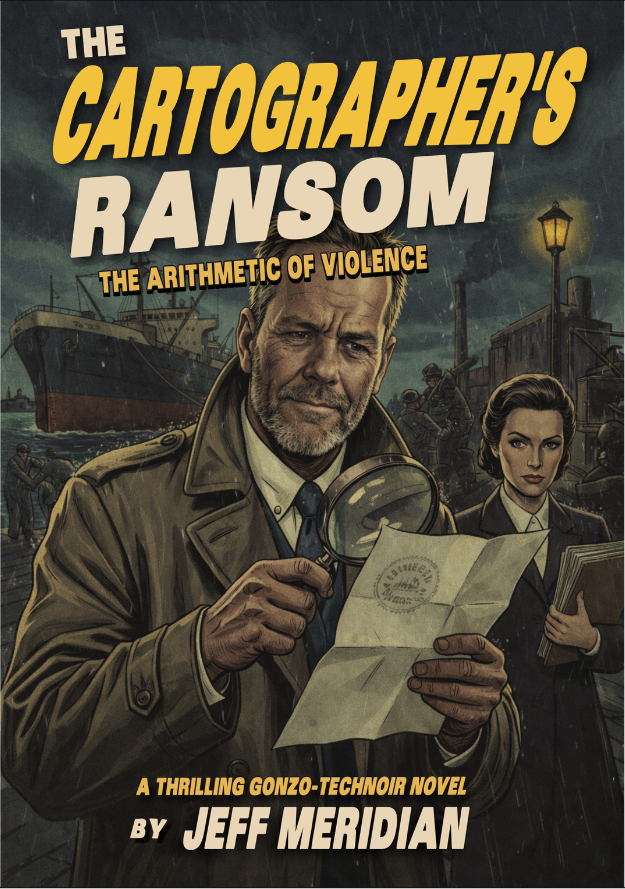
Title: The Cartographer's Ransom
Author: jeff meridian
The Chart in the Icebox #
The union office sat over a print shop and under a freight line. It heard everything and forgave nothing. Typewriter keys clacked like a cheap pistol. An adding machine chattered, then rang its little bell. A file drawer went shut with a flat slap that said someone meant it.
Maeve Kline didn’t look up when I came in. She had a ledger open, a pencil moving in short strokes, her mouth set like she was stamping a form. The air carried ink and old paper. Her desk lamp threw light on the numbers and left the corners of the room in work shadow.
“You’re late,” she said.
“I charge by the problem,” I said. “You want it cheaper, hire a priest.”
That got her eyes up. Gray, fast. She took in my coat cuffs, the scuffed toe of my right shoe, and the way I stood with my shoulder near the door. She didn’t smile. She slid the chain on the office door one link tighter with her foot without looking down.
“Close it,” she said. “And keep your hands where I can invoice them.”
I shut the door. The corridor outside went muffled, but not gone. I counted: one window to the alley, painted shut; one inner door to a records closet; one hall door with a chain; and the fire escape sign that lied. I hated rooms with only one honest exit. My head did the arithmetic on its own. It always did. Then it hit the old remainder I never spoke out loud: I was tired of watching men disappear and calling it work. I swallowed it like bad coffee and kept my face blank.
Maeve put a manila folder on the desk between us. No flourish. No story warm-up. She pushed it with two fingers as if she didn’t want it to touch her longer than needed.
“Eli Draffen missed an audit meeting,” she said. “Yesterday at three. He doesn’t miss. Not when I tell him it’s on the books.”
“Cartographer,” I said.
“He draws harbor charts for whoever pays legal,” she said, and the way she said legal sounded like a dock pass with a forged stamp. “He’s also been fixing our route maps. Shift changes. Tug assignments. Things that keep men from getting crushed.”
“Missing since when?”
Maeve tapped the ledger with her pencil. Tap. Tap. Tap. “He signed out at Pier 9’s cold-storage office at nine-ten. He was due here at eleven for a check-in. Due back at Pier 9 at one for another set of records. Due to meet me at three.” Tap. “He didn’t make any of it.”
“You already called the cops?” I asked.
“I don’t call Lt. Sable for missing men,” she said. “I call him when I want a missing man to stay missing and a file to go dead.”
That was a name with a badge behind it. She didn’t have to say more. The typewriter in the next room stopped. Someone coughed. Work resumed like nothing had been said.
“Why can’t you send a runner?” I asked.
Maeve’s pencil stopped. She looked at her ledger, not at me. “Because my runners have families. And because if I send one, the man I’m looking for becomes a message.”
“So you hire me,” I said.
“I hire you because you can walk into a place that hates you and still come out with a receipt.”
She opened the folder. Out came two items, laid down with care like evidence on a clean counter. First: a torn corner of a harbor chart, no bigger than my palm. Second: a pay envelope, thick from being stuffed wrong. The envelope mouth was bruised from being opened and closed too many times.
Maeve didn’t touch them again. “Those came from his desk. His actual desk. Not a story.”
I picked up the chart corner with two fingers, like it could smear. The paper wasn’t cheap. Rag content, not pulp. It had that faint stiffness that comes from size and press, not from age. The tear ran at a shallow diagonal, clean in some fibers, feathered in others. It hadn’t been cut. It had been ripped fast, but not sloppy—someone had pulled with both hands, braced on something solid.
There was salt staining along one edge, a tide line in miniature. It had dried in a way that left a darker band and a lighter bloom, like water that had licked and retreated. I turned it and caught the lamp at a low angle. Pencil indentation showed through the back, a straightedge pressed hard. That meant Eli had been leaning on a board or table, not sketching in his lap. The corner had a margin tick mark and a partial grid number—half a “7” and the tail of a “3,” printed with plate pressure you could feel with a thumbnail.
I ran my thumb across the printed line. It raised, faint. Intaglio or a heavy plate press. Official-style. Harbor commission stock didn’t come off a storefront mimeograph.
“Not a pocket map,” I said.
Maeve’s mouth moved once, a half nod. “Eli doesn’t carry full sheets on the street. They stay in tubes.”
I set the chart down and picked up the pay envelope. The paper was softer, cheaper, and had fold memory like a man who’d been stopped and searched. The flap crease was sharp from being reopened. The glue line had been wet at least once; you could see the shine where someone resealed it in a hurry.
My fingers found thumb smears at the corner where a clerk would pinch it. Ink had rubbed there too, a faint purple—cashier stamp, the kind that transfers when it’s fresh and you press too hard. Someone had handled it right after stamping. The envelope was swollen with paper inside.
I slid a finger in and drew out the contents: betting slips, three of them, folded twice. Cheap stock, porous. The ink bled at the edges, a little feathering that comes from a fast stamp on damp fingers. One slip had a cut corner—a clipped triangle at the top right. Not damage. A mark.
Maeve leaned in and didn’t reach for them. She didn’t need to. Her eyes tracked the lines like she was reading a freight bill at a glance.
“Fight date,” she said, and her voice stayed flat. “Friday night. Harroway Athletic Club. Three slips, three different names, same hand. See the ‘M’?” She mimed it in the air with her pencil without touching the paper. “Downstroke heavier, loop tight. Whoever wrote these writes too fast to be careful. Same handwriting across different bettors.”
“How do you know Eli didn’t place them?” I asked.
Maeve made a sound, not a laugh. She tapped the clipped corner in the air. “Because Eli can’t throw money away on three different men in the same bout. He’s a map man. He follows lines. And because the cashier stamp—look at it.”
I held the slip closer. The purple stamp read PALLAS CASHIER in a ring, with a number in the center that had been stamped twice, slightly off. A double hit. A clerk who didn’t lift straight.
Maeve’s eyes narrowed. “Same stamp impression on all three. Same double hit. Same cashier. Same window.” She looked up at me. “That’s not a man making separate bets. That’s someone bundling bets through a house book and using names as cover.”
“Dock cash,” I said.
“Dock cash washed through prizefights,” she said. “Because a dead man can’t complain and a winner’s paid in a back room.”
I checked the slips again. The ink bleed told me they’d been stamped in a hurry. The paper fibers at the fold were broken, not worn. Folded and unfolded only once or twice. Placed, not lived with.
“You said these came from his desk,” I said.
Maeve’s pencil started moving again, a soft scratch. “Yes.”
“Who had access?” I asked.
Her pencil stopped. Her shoulders stayed square. “People who work.”
“That’s an answer that keeps you clean and gets me killed,” I said.
Maeve looked at the ledger like it was a shield. “I’m not handing you names so Varrin can buy them off your coat pocket.”
There it was. Leo Varrin, said like an account payable you don’t want posted. Maeve’s face didn’t change, but her left hand slid under the ledger and pressed it down as if it might float away.
“You know he’s involved,” I said.
“I know his money is,” she said. “His money is everywhere. Like carbon paper. It stains what it touches.”
I let that sit. I didn’t ask where she’d heard it. I didn’t ask what she’d seen. Questions were cheap; answers cost.
I picked up the chart corner again and lined it against the envelope, edge to edge, as if I could make a new map out of scraps. The grid marking told me standard harbor chart sizing. The tick was too precise for a casual copy. The salt stain said waterfront contact. The straightedge indentation said drafting table or office board.
“Eli was working when this tore,” I said. “Not running. Not rolling it up. Someone took a full sheet and ripped the corner to break a match. Like tearing a dock pass stub.”
Maeve’s eyes flicked to the closet door. “He wouldn’t surrender a chart.”
“Maybe he did when he saw the alternative,” I said.
Maeve’s pencil snapped its point on the ledger line. She didn’t flinch. She reached into a drawer, came up with a fresh pencil, and sharpened it with a small knife. The blade made a quiet scrape, like a box cutter on twine.
“Bring him back,” she said. “Alive.”
“I bring back what I can lift,” I said. “Sometimes it’s a man. Sometimes it’s proof.”
“Proof doesn’t make widows eat,” she said.
“And widows don’t make syndicates stop,” I said.
Her eyes met mine again. Cooperation had a price, and we were both checking the invoice. She slid a business card across the desk—union letterhead, her name, her extension. On the back, in tight clerk handwriting, was a time: 9:10. And a place: PIER 9 COLD STORAGE.
“Start there,” she said, as if she’d planned it and let me pretend it was my idea. “They keep records. They keep keys. They keep quiet.”
I pocketed the card and the chart corner. I left the betting slips on the desk a second too long, then took them too. Maeve watched my hand and didn’t object. That was her small assist, and she’d make me pay for it later.
At the door, I paused and listened. Typewriter keys. Adding machine bell. A distant tug horn through the floorboards, long and low, like the harbor clearing its throat.
Maeve’s voice followed me, dry as carbon paper. “If Sable calls you in, you tell him you’re working for me on wage theft. Nothing else.”
“And if Varrin calls?” I asked.
“Then you don’t answer,” she said. “He charges interest.”
I unhooked the chain and opened the door. The corridor smelled like damp coats and ink. I checked the stairwell, then the far end, then the window that didn’t open. Three exits, two useless, one honest.
I chose paper over bruises. Pier 9 would have logs, tags, and signatures. If Eli had gone missing on a schedule, the schedule would be written somewhere, and written things leave scars you can measure.
I took the stairs two at a time, careful with my knee on the turn. Outside, the street noise hit like a slammed drawer. I headed for the waterfront, where cold storage kept its own books and the harbor kept its own time. The tide wouldn’t wait for my questions. Neither would the men who tore maps for a living.
Pier 9 sat low and heavy on pilings, a working brick box with frost on its teeth. Diesel seeped out of the dock edge in thin black tears, and the planks took it up like a stain you could feel through your soles. I kept my hand off the rail. The rope along the cleats was wet and hairy, and the salt on it had teeth.
The freight door had a wheel handle and an attitude. I put my shoulder in, felt it give a half inch, then stop like it had decided my time was worth less than its hinges. My knee complained on the shove. I ignored it and used both hands, palms flat. The door broke its seal with a wet pop and a draft of cold that bit the inside of my nose.
Inside, the air changed the rules. It smelled like brine, old paper, and the bleach they use when a man doesn’t come back from the floor. The light was a hard yellow. It made every puddle look like oil.
A desk had been bolted to the wall near the entry, more for control than comfort. Behind it sat a clerk in a wool cap with a pencil tucked behind his ear like a cigarette he couldn’t afford. His fingers were red from the cold. A stamped dock pass lay under his palm, greasy at the corners from too many hands.
He looked up without moving his head. “You got a pass?”
“I got a question,” I said. I kept my voice flat. Questions were cheaper than bribes, if you paid them fast.
He held out his hand. “Pass or signature.”
I took the pass on the desk and turned it once, slow, like I was reading. The paper was thick, cheap stock. The stamp was blue and tired. The ink had bled into the fibers in a way that told me it had been pressed hard, the kind of hard that comes from an impatient arm. The date was today. The signature line was empty.
“You like paperwork,” I said.
“I like not getting fired,” he said. His eyes slid to a clock on the wall. The second hand ticked loud in the cold. “Inventory pull at eight-forty. Crew comes in. If you ain’t on the sheet, you’re a problem.”
Fresh constraint. A window you could measure, not argue with.
I fished Maeve’s union card out of my pocket and laid it down like it was a warrant. Her letterhead did work even when she wasn’t there. “Maeve Kline,” I said. “Union office. I’m checking on a payroll discrepancy tied to your claim checks. One name. I don’t need a tour.”
The clerk’s mouth tightened at the word payroll. That hit closer to his ribs than syndicates did. He tapped the card with his pencil, as if testing whether it would smear. “We don’t do payroll.”
“You do tags,” I said. “Tags lead to men. Men lead to pay.” I leaned in a fraction. “Eli Rusk. If he signed for a locker, I need the number before your crew walks through and starts lying for each other.”
At the name, his pencil paused in midair. That pause was a confession with no sound. He looked past me, toward the dock, then back. His thumb rubbed at a smudge on the desk until it was clean.
“Rusk,” he said, like tasting a bad batch. “That’s not… that’s not my section.”
“It is today,” I said.
He opened a ledger with hands that had done it too many times. The cover was cracked at the spine. The pages were thick, cheap, and furred at the edges from damp. Carbon sheets were interleaved, black and glossy, leaving fingerprints like guilt.
He flipped to the week and held it angled away. I shifted my stance so the yellow light caught the paper anyway. The pencil lines sat on the page with light pressure except in one spot where the carbon had bitten hard enough to emboss. Someone had signed angry there. Someone had pushed.
“Turn it,” I said.
He didn’t. I reached under the desk and slid the ledger toward me two inches. He stiffened but didn’t stop me. He watched the doorway, not my hands.
Line items marched down the page: date, time, locker aisle, claimant name, clerk initials. Page numbering in the upper corner, stamped, not written. The stamp was aligned true—until this page. Here, the number sat a hair low, like it had been applied by a different hand or a different jig. I touched it with a thumb and felt the ridge of the impression. Fresh stamp, older book.
Overwritten line halfway down. You could see the ghost of the first pencil under the second if you caught it sideways. Eli Rusk. Aisle D. Locker 17. Time: 7:55. Clerk initials: T.H.
Next to it, a second entry, lighter pressure, like a man writing with a borrowed spine. “Harmon, R.” Same aisle. Locker 18. Time: 8:05. Initials didn’t match the earlier hand.
I didn’t like that. Ten minutes. Two lockers. Two hands.
I tapped the overwritten line. “This was changed.”
The clerk’s eyes flicked to it and away. “People make mistakes.”
“Carbon doesn’t,” I said. I lifted the carbon sheet and looked at the back copy. The original name was there, clean and dark: ELI RUSK. No overwrite. The change only lived on the top page. Somebody wanted the record to look different to anyone who didn’t bother lifting a sheet.
I slid the ledger back. “Where’s Aisle D?”
He jerked his chin toward a metal stair that ran along the wall. The bolts on it were orange with rust, the heads rounded from years of boots and mops. “Down. Then left past the beef. Don’t touch nothing.”
“I only touch what touches me,” I said.
A shape moved in the entryway behind me. A dock guard in a pea coat, cap low, baton on his belt. He stepped in and let the cold roll off him like he belonged to it. His face was one I’d seen under different light. Years back. Another pier. Another job I quit without notice.
“Meridian,” he said. He said it like a tally mark. “Thought you went inland.”
“Harbor keeps receipts,” I said. “Some of us don’t get to tear them up.”
His eyes went to the union card on the desk. Then to the ledger. Then to the clerk, who sat still as a stamped envelope. “You on the sheet?” the guard asked.
“Not your sheet,” I said. I reached for the greasy dock pass and slid it toward him. “You want a signature, I’ll give you one. You want to stop me, you’ll need a reason that fits on paper.”
He picked up the pass, pinched it at the corner like it was contaminated. The stamp offset was visible now, a hair to the right of the printed seal. A rushed stamp. A lazy clerk. Or a borrowed stamp pressed in a hurry.
The guard sniffed, not at the paper. At me. He looked at my hands. “You’re limping.”
“Door stuck,” I said.
His mouth made a line. “Inventory pull,” he said to the clerk. “Keep him up front.”
I looked at the clock. Eight-thirty-four. Six minutes before bodies and noise. I counted exits. Freight door behind. Stair down. A narrow hallway to the right with a wire-mesh gate and a padlock. One honest path, two traps.
I slid the dock pass back onto the desk and signed it with my pen. The ink went down clean, black, no feathering. Good pen. Bad paper. “There,” I said. “Now I’m a problem with a signature.”
The guard started to speak. I cut him with motion. I stepped past the desk before he could plant himself. The planks near the stair were slick where the cold had sweated them. My boot slid an inch. I caught the rail and felt the chill bite through my glove.
Downstairs, the cold thickened. Hanging sides of beef swung on hooks, slow, like they were listening. Their fat held the light in dull bands. The floor was wet. Each step made a small sound, leather on slime. The air carried a rope smell—wet hemp and old salt—mixed with meat and bleach. It was a ledger of labor you couldn’t fake.
Aisle letters were painted on the end posts in white. A through F. I found D. The lockers were steel, tall, each with a nail and a tag hanging from twine. Brass-edged tags, dented at the corners, punched holes at the top. They looked like set dressing in a place that didn’t do decoration. Men grabbed, signed, hung them back. The system worked because it was simple and because fear backed it.
Locker 17’s tag hung a little lower than the rest. At first look, it was only that—sloppy twine, lazy knot. I took it between finger and thumb. The brass edge was cold enough to sting. The front read E. RUSK in pencil, neat block letters.
Second look. The hole where the tag was punched had a fresh scratch, a bright crescent cut into the brass rim like a screwdriver had worried it. The twine knot was wrong. The others were square knots, quick and flat. This was a clove hitch, tight, sailor’s habit. Someone who handled rope for a living had retied it. The tag also carried a faint round ink stamp, purple, half off the edge, like it had been hit by a stamp head that didn’t meet flush. You could see the bottom curve of letters: …OLD STOR…
Cold storage stamp. Offset. Like the dock pass.
I pulled the tag off the nail and palmed it. The metal left a cold print in my skin.
Locker 18’s tag was blank. Not missing—blank. New tag, new twine, square knot, no dents. Somebody had swapped a name out and left a clean mouth where a truth used to be.
I crouched and ran my hand along the seam of Locker 17. The paint was chipped where hands always went. The hasp had a new file mark across it, shallow and straight. Tool scar, not wear. Someone had tested it, not opened it.
I heard a sound up the aisle. Footsteps. Two sets. Rubber soles, not boots. Crew, not guard. Shift change. The air carried their damp wool and cigarette ash.
I could back out with the tag and the ledger detail and live to ask Maeve what Harmon meant. Or I could open the locker line and see what Eli hid in a place built to keep rot slow.
I chose the locker.
I slid my pick into the cheap padlock on 17, wrist tight to keep the metal click small. The cold made the lock sluggish. I turned, felt pins give with a gritty reluctance. The shackle sprang with a soft tick. I caught it before it could swing.
The door stuck. Paint and ice at the seam. I pulled, slow, and it gave an inch, then two. Cold air spilled out like a held breath. Inside, the locker was half full of canvas sacks and butcher paper rolls. I pushed one aside and my fingers hit something flat and wrong for meat work.
Paper. Dry, too dry for this room. I drew it out in one motion and kept it close to my chest. The sheet was folded tight, edges sharp. Chart stock, pale and fine, not the brown pulp the city bought by the crate. It had a smooth tooth that took ink clean. Too clean.
I lifted it under the aisle lantern and angled it. Watermark caught for a second—an eagle in a circle, off-center by a hair, like it was laid wrong in the mold. That wasn’t municipal supply. That was specialty. The kind a pressman paid extra for because it lied well.
I ran a thumb over the printed lines. There was a plate impression you could feel, shallow ridges where ink sat raised. Not pen. Not pencil. Press work. I checked the edge with my nail and found fiber specking—tiny blue threads embedded, deliberate. Anti-counterfeit thread, or a counterfeit of it. My paper sense did the arithmetic fast.
Eli hadn’t been stealing maps. He’d been handling paper meant to become something else.
The footsteps came closer. A cough. A murmur. The sound of a crate dragged over wet concrete.
I slid the chart stock back into my coat, kept the locker door cracked, and moved my body to block the view. My split knuckle from last week’s job rubbed against the cold steel and made a small sting. I wiped it on my cuff once, then again, until the blood spot stayed small.
Voices turned into words at the aisle mouth. “D’s got to be counted before the bell,” one said.
I had three choices and six minutes. Hide behind beef and keep hunting the vent gaps for more paper. Confront the crew and buy control with a lie. Or retreat now with the tag and the sheet and let somebody else close the door behind me.
I listened to the soles. They were almost at D.
I eased the locker open the rest of the way and stepped inside the aisle shadow, deeper than a man should go with witnesses walking in. My hand stayed on the cold brass tag in my pocket like it was a key I hadn’t earned yet.
The locker row ran tight between hanging sides. The aisle lantern threw a thin stripe of light, and the rest stayed black as dock water. My shoes stuck to concrete with a tacky pull. Diesel and cold fat cut the air and sat in my throat.
Eli’s brass claim tag burned my palm through my coat pocket. D. Same letter the voice had called out. I counted lockers by touch, knuckles on steel, one-two-three, until the tag’s notch matched a dented latch.
Locker D-14. The door sat shut, but it didn’t sit right. The hinge pins were clean-bright where the rest wore rust. Somebody had pulled them and set them back with care. I put two fingers under the lip and tugged.
The door opened with a wet sigh.
Eli Draffen was inside with the meat.
He wasn’t hanging. He wasn’t posed like a warning. He was slumped on the floor plates, shoulder against the locker wall, chin down like he’d sat to rest and never got back up. His hat lay on his lap, brim creased. His boots were still on. That was the first lie. Men who fold in a cold room don’t keep their boots neat. They kick and scrape and try to find footing.
I crouched, close enough to see the skin.
His cheek had a bruise that wasn’t a fall. It was a flat oval, edges sharp, like a knuckle duster or a tool handle had kissed him once and done its work. Under his collar, at the base of his neck, a thin red line cut across—rope or cord, pulled tight, then released. The skin around it was pale in a way the cold couldn’t explain. Cold gives you blotches. This was a band, clean as a stamp line.
I touched his wrist. Hard. He’d set.
His right hand was clenched, thumb buried, fingers locked like he’d tried to keep a secret from the room itself. I worked my own split knuckle against my glove seam and slid the glove off with my teeth. The air bit my skin at once.
I hooked a finger under Eli’s first two fingers and pulled. Nothing. The tendons held like cable.
“Come on,” I said under my breath. My voice sounded wrong in the locker, swallowed by beef and steel.
I tried again, using my thumbnail at the crease. His finger pad tore a fraction at the joint. A dark bead welled where it shouldn’t have. Rigor doesn’t bleed easy. That meant he hadn’t been here long.
The object came free with a scrape against bone.
A brass token. Heavy, warm from his hand and my work. It had a stamped face—deep impression, not cast. The edge was worn down on one side, like it rode a pocket with other metal. I rubbed the stamp with my thumb until the grease lifted.
Q-17.
Not a letter. A code. The Q sat hard and square, like a punch set. The 1 and 7 were slightly off level, hand-set dies. Somebody wanted it to look official and didn’t have the jig.
I slid the token into my coat lining seam and pressed it flat with my palm until it sat quiet.
Eli’s left hand lay open on his thigh. Under it, caught between his sleeve and the hat brim, was a strip of paper no wider than my thumb. Chart margin. The edge had the machine cut—smooth, no tearing. I lifted it by the corner. It was damp on the underside where it had kissed his skin.
Tiny print ran along it: tide times in neat columns. The ink was blue-black, pressed, with a bite you could feel when you ran a nail over it. Along the bottom someone had written in pencil: Q-17, and beside it a dock code in shorthand I’d seen on harbor boards. The pencil line was thin and hard. 2H, maybe 3H. A hard lead. It hadn’t smudged in the damp until Eli’s sleeve had dragged it; the smear ran left to right, meaning it had been written, then rubbed by a cuff moving inward. He’d checked it, pocketed it, then clutched it when the room turned on him.
I didn’t have my camera out. Too loud, too bright. I slid my matchbook from my pocket, peeled back the cover, and laid the strip inside, folding the cardboard tight so it wouldn’t curl. The matchbook still smelled like sulfur and cheap tobacco. It mixed with ink and made a new kind of problem.
There was more paper in the locker, wedged behind Eli’s shoulder like somebody had tried to hide it in the dead. I pinched the corner and eased it out.
Chart stock. Pale. Fine. The same tooth as the sheet I’d already pocketed. I held it up to the lantern stripe and watched the light sink through.
Watermark: eagle in a circle, off-center. The paper had sizing—stiff, sealed fibers that shed water in beads. City supplier ran soft and thirsty. This was specialty stock. The plate-press bite sat along the compass rose, a shallow ridge. I rubbed it between finger and thumb. It squeaked faint. Good rag content, blue fiber specking laid in like a lie you could point to.
I compared it in my head to the city’s chart paper I’d handled at the Harbor Office. This wasn’t theirs. This was made to pass, made to travel.
A sound at the aisle mouth—steel on steel. A crate dragged. Then a different sound: twine snapping tight.
I didn’t look up. I made my hands small and fast.
In the locker door jamb, hanging from a nail that shouldn’t have been there, was a fresh cargo tag. Not a claim tag. A shipment tag, stiff card, printed header, and a smear of wax pencil across the bottom. The twine was new. Too new. It wasn’t the butcher’s twine, which came rough and hairy. This twine had a smooth spin and a flat spot where it had been tightened with pliers.
I lifted the tag and turned it. The back held a receipt stub stapled on—clean staple legs, no rust. The signature at the bottom was tight and slanted.
H. Pell / tally.
New name. New hand.
Method, too. That smooth twine, that clean hinge pin—somebody had swapped access like it was cargo. Duplicated claim checks. Locker opened, body placed, door closed, hinge set back with fresh pins so the latch sat true. It read like a man crawled in to sleep off rye. It was a ledger entry with meat around it.
Footsteps hit the aisle, faster now. Rubber soles. A man in work boots wouldn’t hurry that silent on wet concrete.
“Police,” a voice called, too calm for the smell in here. “Nobody leaves this row.”
Lt. Orin Sable arrived like a bill you didn’t remember making.
He filled the aisle mouth in a dark coat that didn’t belong in cold storage. His hat brim was dry. His eyes took in the hanging sides, the open locker, me crouched at a dead man’s knees. He didn’t step closer to Eli. He stepped closer to the doorway, body angled to block it. Control first. Evidence later. If ever.
Behind him, a warehouse foreman hovered, cap in hand, breath showing in small puffs. Sable didn’t look at him either.
“Lock it down,” Sable said, soft. “Chain the doors. I want a list of every man on shift. Names, times, assignments.”
“Yes, Lieutenant,” the foreman said, and moved like he’d been hit with a stamp.
Sable’s badge flashed once, fast as a knife. “Meridian,” he said. Not a question. A file tab.
“Lieutenant,” I said. I kept my body between him and Eli’s hands. My bare fingers stung from the cold. I slid the glove back on slow so it looked like I was giving the dead man respect and not covering prints.
Sable leaned his head a fraction, like he was reading a report in the air. “Looks like your friend found a quiet place to fold.”
“Eli didn’t drink quiet,” I said. One line. No speeches.
Sable’s eyes dropped to the open locker door, then to my coat. He saw the bulge where paper sat. His mouth didn’t move much when he spoke. “Anything you picked up in here belongs to the department.”
I held up my hands, palms out, and let the glove show clean. I kept my right hand close to my coat seam where the token sat flat.
“I found him,” I said. “That’s it.”
“Turn out your pockets,” Sable said, like he was asking for a match.
I reached into my coat slow and came out with the wrong thing: the sheet of chart stock I’d first pulled from the locker row, the one I’d already judged as press work. I let it show under the lantern stripe. Enough to feed his appetite. Not enough to feed his case.
Sable took it with two fingers like it was dirty, and he didn’t even look at the watermark. He looked at me, watching my eyes, watching my hands. Procedural chokehold. He didn’t need to know what it was. He needed it out of mine.
“Chart paper,” he said, flat. “So your dead man was stealing city property and froze in the act. That’s the report.”
I kept my face still and my mind counted seconds. He was too fast. Too ready. Somebody had rung him before the body cooled. Or he’d been waiting for a call that had my name on it.
I nodded once, like I didn’t care. My left thumb pressed inside my coat where the matchbook sat with the margin strip folded tight. Cardboard. Paper. Quiet proof.
Sable flicked the sheet once, then handed it back to a uniform behind him without turning. “Bag it. Mark it as recovered from scene. Meridian, you’re staying.”
“On what,” I said, “a folding chair?”
Sable’s eyes tracked my mouth, not my hands. “Material witness,” he said. “Unless you’d like to confess to tampering. You get to choose.”
The room gave a low hum from the refrigeration unit. It sounded like a sump pump failing.
I looked at Eli. I looked at Sable. I made the only choice that kept my legs under me.
“All right,” I said. “You write your report. I’ll sit where you can see me.”
Sable’s mouth tightened, satisfied without showing it. He lifted a hand to the foreman. “Get me a table. Get me a pen. And keep this aisle clear.”
I stepped back from the locker, slow, and let my shoulder brush the steel. My coat shifted. The token stayed hidden. The matchbook stayed flat.
Q-17 wasn’t a street. It was a timed door. Tide times weren’t for reading; they were for arriving.
Sable turned his body a hair, keeping the exit in his control. I watched the angle of his feet, the way his coat hung, and I counted two routes out: one through his badge, one through the meat rail.
He wanted me on paper. Varrin wanted me in the water. The tide didn’t care.
When the foreman came back with a shaky card table and a pen that scratched, I took the seat Sable pointed at and kept my hands on my knees like a man waiting to be weighed. Under my coat, brass and paper rode my ribs.
Sable uncapped the pen and started to write my name like it was already inked on a tag.
I stared past him at the locker row and listened for the next set of footsteps, the kind that didn’t bother to announce itself.
A chain slapped iron somewhere out past the bay doors. It wasn’t the clean rattle of a man working. It was the loose talk of steel being fed fast. The refrigeration hum stayed behind me when I pushed through the side exit, and the pier lane hit my ears like a bell.
Tug horns moved under wraps out on the channel. The notes came smothered, like somebody had laid a wet glove over the mouth of them. Close in, I heard the small sounds: cleats pinging, a winch pawl catching, a length of line dragged over plank seams. The water between pilings lipped at the wood with a slow, sure tongue.
I didn’t look back into the warehouse. Sable owned that doorway with his badge and his paperwork. I walked as if I’d been told to fetch a cigarette and wasn’t supposed to come back.
Pier 9 sat down the lane, its numbers painted on a stanchion in white that had been freshened too often. A tug nosed off it with the care of a man leaving a bedroom without waking anybody. Her running lights were wrong. A strip of something—canvas or paint, I couldn’t tell at this distance—cut the green and red down to a muted slit. Even her stern light had been hooded, so what should have been a clean point was a dull coin.
Masked lights meant intent. Intent meant schedule.
My fingers went inside my coat. The brass token rode high against my ribs, cold through the lining. It wasn’t heavy, not for metal. It felt heavy anyway, the way a key feels heavy when you don’t know what it opens. The edge of it bit my knuckle when I pressed it, and the ridges on its face told me it was made to register in a slot, not sit pretty in a pocket.
Q-17 wasn’t a street. It was a door with a time clock, and the tide was the man turning the handle.
A small rectangle lay on the planks near my shoe, close enough I could have stepped on it and claimed I never saw it. Paper shouldn’t have been there. The pier was wet in streaks. Most everything turned to pulp if it sat. This piece didn’t.
I crouched, keeping my weight over the balls of my feet. My ribs had a bruise under the left side that complained when I folded. I took the paper between two fingers, like I was lifting evidence off a corpse, and I brought it up into the spill of a dock lamp.
Dry on top. Damp underneath. It had kissed wet wood minutes ago and hadn’t stayed long. The surface still held a clean tooth. Under my thumb, the bottom layer had started to soften at the edges, the fibers swelling.
Ink sat on it in a thick hand, the kind a bookie uses when he wants to look casual and doesn’t have time for straight lines. There was a smear at the end of the last word—fresh enough that a careless sleeve had dragged through it. The paper itself wasn’t the cheap newsprint men used for race picks. This had a tighter weave. It had been cut clean, not torn. Somebody made slips like this on a stack cutter.
I turned it, slow.
The print up top read: HARBOR ATHLETIC CLUB. Under it, in block letters, the bout line.
MERIDIAN, JEFF — 12 TO 1.
They’d put me down as the underdog, like it was a joke told in public. Like the whole waterfront was meant to read it and decide whether to bet on my blood.
Below that, a time was written in pencil, firm and tight, the graphite dug in hard enough to leave a ridge on the back:
11:40.
And next to it, a mark that wasn’t a number. A circle with a notch, like a crude keyway.
My skin went cold under my collar. The tug eased farther out, her hooded lights sliding along the channel like she was ashamed to be seen. The pier lane around me stayed busy in that quiet way docks get when men work without talking. Two longshoremen rolled a dolly past the far end, heads down. They didn’t look at me. They didn’t need to. The message wasn’t for them. It was for anyone who’d ever taken a fall in a ring or a hold on a line.
Boxing lines as a telegraph. Public bets as a leash.
They’d done it clean: set a target, set a time, and invited muscle to collect.
I thought of Maeve Kline’s ledger, names written in careful columns, men who clocked in and came home with splinters in their palms. Varrin could freeze their pay with a pencil. He could buy a foreman with an invoice. This slip meant he was buying attention the same way—turning the waterfront into a board and putting my name on it.
I swallowed once, and my throat scratched like I’d inhaled paper dust. One line of truth broke loose in my head, sharp enough to cut.
If I’m wrong, she pays for it.
I folded the bet slip along its existing crease, careful not to smear the ink more than it already was. The pencil time stayed visible at the edge. I slid it into my inside pocket behind the token, paper against brass, like a bill tucked under a lock.
The tug gave one more muffled horn, short, like a signal that wasn’t meant to travel. A shadow of a man moved on her stern, quick and low. A coil of line dropped, then was hauled in. No wasted motion. A crew that worked under orders.
Tide window. Quarantine door. Masked lights. And a fight line that doubled as a deadline.
I stood and looked down the lane. Back toward Sable’s doorway, I had my badge problem and my air problem. Out toward the water, I had my sinking problem. Somewhere between was Maeve, with her ledger and her memory and her own lines drawn tight.
I counted exits. One through the warehouse and Sable’s pen. One down the pier after the tug, if I could find a skiff and a man who didn’t ask questions. One along the shore, tailing from planks and shadows, gambling the fog and diesel lanes wouldn’t swallow her whole.
My left thumb pressed the token through the lining again. Cold brass. Cut edges. A key that wanted a throat to fit.
The next tide didn’t wait. Neither did men who bet in public.
I turned my shoulders away from the warehouse and started for the small-boat berths, keeping close to the pilings where the light died quick, already reaching into my pocket for the token as if it could tell me which lock I had to hit first.
Fixed Fight, Clean Hands #
Maeve Kline didn’t knock. She used the side-room latch like she’d paid dues on it. The union office was a box behind the hiring hall, work-lit by a shaded bulb that made every page look older. My desk lamp threw a hard circle over a blotter scarred by paperclips. The air held that dry ink tang, the kind that sits in your nose after a long day of forms.
Maeve came in with one hand bare and the other clenched around a single sheet like it was a warrant.
“Don’t ask for the book,” she said. “You don’t get the book.”
She laid the page down flat, palm sliding off it with no tenderness. Torn edge at the top. Three punch holes down the left. Blue ruled lines with the union’s faint header stamp. She tapped one entry with a fingernail kept short for work.
ELI HART—Cash advance—$180. Routed: Red Banner Athletic Club.
She didn’t look at me when she said it. She looked at the clock over the door, the second hand chopping. “Shift change at Pier Nine. Ten minutes. He signed out early. Same day the cartographer went quiet.”
I kept my hands off the paper for a breath. You learn that on docks and in courts: you don’t grab a thing until you know how much trouble it can smear.
“Eli Hart,” I said. “That’s your missing man.”
“My clerk,” she said. “My mistake.”
The sheet sat there like a loose tooth. I hooked it with two fingers at the corner and lifted it slow, feeling the drag of the pulp. Stock weight matched what I’d seen in her office before—thin enough to fold, tough enough not to tear clean. Union bought in bulk. Cheap, consistent.
I turned it and held it an inch from my nose. Old paper smell, faint paste. No perfume, no cologne. The kind of page that lived in a drawer with rubber stamps.
“What’s Red Banner doing in your ledger?” I asked.
“It’s not.” Maeve’s voice went flat. “That’s why you’re here.”
I set the page on my blotter and ran my thumb pad across the cash line, light pressure, then harder. The ink didn’t lift. It wasn’t fresh. It had dried and sunk into the fibers. But the groove under it told on the hand. Different nib pressure. Whoever wrote “Red Banner Athletic Club” leaned in like they meant to leave a dent, not a record.
I tilted it under the lamp and watched the ruled lines. The printed numbering on the margin sat straight. The handwritten amounts floated a hair above the line on that one entry. Not much. Enough.
Maeve’s eyes tracked my hands, not my face. Clerk’s habit. Witness habit. “It was in the book yesterday,” she said. “Not like that. The cash line was there. The route wasn’t.”
I held it up to the bulb, letting the paper go thin. Watermark came through—Union Local 18, rope-and-anchor mark, centered and faint. The torn edge showed where it had been stapled to a packet once. Two staple holes with a pull scar, a little crescent of missing fiber where someone yanked it free. On the right margin there was a faint offset smear, a ghost of ink from a page pressed against it before it cured. The smear sat too close to the added notation, like the add-on was written after the page was pulled and stacked.
I dropped my eyes to the torn top. That rip wasn’t a panic tear. It was careful, worked back and forth so the header would stay with the book. Maeve had done it. She didn’t steal; she extracted.
“It’s your paper,” I said. “Your stock, your watermark, your stamp. It came from your book.”
Maeve didn’t blink. “Good. Now tell me I’m not insane.”
“You’re not.” I tapped the route line with my pencil tip, not touching the ink. “This was written later. Different hand weight. Different anger.”
Her mouth tightened. She didn’t let it become a word.
Someone had used her ledger like a coat rack. Hang a dirty payout under a clean line and hope nobody looks twice. Hide a cash-out in the middle of dues, advances, and strike relief. And if the page ever got questioned, a bent lieutenant could wave it into evidence and lock it in a drawer until the bodies stopped making noise.
Maeve leaned in, close enough that I caught the starch on her collar. “Sable came by the hall,” she said. “Twice. Asking clerks for clarifications. Wanting to see the books. Wanting names.”
The name landed like a wrench on a toe.
“If you show him that page,” she said, “he takes it. He calls it procedure. He walks it out in a file. Then it’s gone and my men are dead on paper before they’re dead in the water.”
I set the page down and smoothed it with the side of my hand, like I could flatten the risk back into pulp. My inside pocket held the bet slip and the brass token. My ribs still remembered the pier planks from earlier, a bruise building interest.
“Why bring it to me here?” I asked.
“Because you don’t have a badge,” Maeve said. “And you don’t pretend you do.”
I counted the room without meaning to. One door to the hall. One window painted shut. One back closet big enough for a mop and a man if you hated him. No good exits. That meant speed, not safety.
“Red Banner,” I said. The words tasted like cheap rye and rope tar. “That’s a gym line item masking payouts.”
Maeve’s finger slid down the page to the amount. “One-eighty. That’s not groceries. That’s not rent. That’s a bet that went right. Or a bet that went wrong and got bought.”
She watched me, waiting for me to ask for her list. I did anyway. It was part of the arithmetic.
“Bring me the rest,” I said. “Every name tied to Red Banner. Every advance tied to a dock pass. I can’t chase one entry blind.”
“No.” Maeve’s hand came down flat on the page, not touching the ink line, guarding it. “Those names are men who still clock in. Wives who still think the pay envelope is late, not seized. You don’t get to wave them in front of a syndicate accountant to see what shakes loose.”
I felt my jaw tighten and forced it loose with my tongue against a tooth. Pride costs. Pride gets billed monthly.
“Then I work with what you hand me,” I said.
“You work fast,” Maeve said. “Pier Nine shifts at the quarter hour. Eli signed out early. If he went to Red Banner, he did it when the hall was busy. If he went somewhere else, it was in the gap.”
I reached for my magnifier and didn’t use it. I didn’t need it. My paper sense had already given me the shape of the lie.
Someone had leaned over Maeve’s book and added a route to make a payout look like union business. That meant two things: Red Banner was a cash window, and the person who wrote it had access to the ledger—either a clerk, a supervisor, or a cop who could “clarify” with his hands.
Maeve pulled her hand back and produced a second item from her coat pocket. Not paper. A stub of thin card stock with a stamp. “Last month,” she said, and slid it toward me. “Red Banner rental receipt. Promoter’s name. You asked for a list. You get one line.”
The receipt had a purple rubber stamp impression, slightly doubled like the hand had bounced. RED BANNER ATHLETIC CLUB. Under it: H. LASKY—MANAGER.
“Lasky,” I said.
Maeve nodded once. “He pays out like it’s a payroll. He smiles like he’s paying a dentist.”
I picked up the receipt and ran a thumbnail over the stamp. Raised edge where the ink sat thick. Real enough. Not the kind of fake Varrin’s press would waste time on. This was their storefront, their mask, their little clean sign for dirty money.
Maeve’s eyes flicked to my inside pocket when I tucked both papers away. She didn’t ask what else I carried. She knew better than to ask questions you couldn’t afford the answer to.
“I can come,” she said. No plea. Just a tool offered. “I can point out faces. I can tell you which cut-man always has too much cash. I can tell you which clerk took a lunch they didn’t have.”
“No,” I said, sharper than I meant. I softened it with work talk. “Red Banner’s a room full of men with hands trained to hurt. If they see you, they don’t see a clerk. They see a ledger that talks.”
Maeve’s chin lifted a fraction. Friction, clean and hot. “And if they see you?”
“They see a man they can hit,” I said. “That’s cheaper.”
She stared at me long enough to make it a bill. Then she reached into her bag and came out with a pencil worn down to a nub. She tore a corner off a spare sheet from the desk tray and wrote in quick strokes.
H. LASKY
BACK ROOM DOOR—ALLEY SIDE
RING BELL CODE: TWO SHORT = FIX IN
She slid the scrap to me. Small assist, no apology.
“That bell,” she said, “is not for rounds. It’s for men who need to be told when to fall.”
I pocketed the scrap and touched the torn ledger page through my coat, feeling the edges. Paper against brass again. Evidence against key.
Maeve stepped back toward the door. “One more,” she said. “Sable asked who you were. He didn’t ask your address. He asked where you keep your files.”
My throat went dry, the way it does when a harbor line snaps and you see it coming. “He’s tightening a net.”
“He’s making a desk for your evidence,” Maeve said. “So he can sit behind it.”
A new constraint, stamped and filed: I couldn’t let a cop’s procedure touch my proof. Not the ledger page. Not the receipt. Not whatever I lifted next. If Sable got his hands on it, Varrin would get his hands on it, and the waterfront would keep paying for being alive.
Maeve’s hand hovered on the latch. “Pier Nine in ten,” she said. “Red Banner opens its back door at the half hour. That’s when the bettors count their money and the trainers wash their hands.”
I stood, coat swinging off the chair. My ribs tugged when I moved too quick. I adjusted, making my body a schedule instead of a complaint. I checked my revolver. I checked my pocket for the token. Cold brass, sharp edge. I checked the papers one more time—ledger page, receipt, Maeve’s scrap—stacked so the edges wouldn’t crush and the ink wouldn’t rub.
Maeve watched me do it like she was watching a man tie off a line. “You stop at the ferry office,” she said. “You can catch a travel record for Eli.”
I shook my head once. “Ferry clerks talk to cops. Cops talk to Sable. Sable talks to Varrin. That’s a chain I don’t pull.”
Her eyes narrowed. “So you go to Red Banner blind.”
“I go to Red Banner on the clock,” I said. I reached past her and opened the door into the hall. The hiring bell down front clanged, a sound like iron on bone. “I can check a ferry log later. I can’t check a back room after it gets cleaned.”
Maeve didn’t follow. She didn’t argue again. She stepped aside and let me pass, then caught my sleeve with two fingers—no warmth, all control.
“Jeff,” she said, low. “Don’t trade that page. Don’t trade my men.”
I looked at her hand on my sleeve and then at the pencil callus on her thumb. A clerk’s armor.
“I don’t trade what I can’t replace,” I said, and meant it in the only currency I had left.
I moved down the hall, boots loud on old boards, papers tight against my chest like a second skin. Outside, the dockside noise rose—tug horns, shift whistles, a ring bell in my head tapping out two short notes.
Red Banner Athletic Club was a name painted on a door.
And a door was a place to put your shoulder.
I took the stairs two at a time, chose the street that ran behind the warehouses, and aimed for the alley side—where Lasky kept his back room and the money changed hands before the first punch landed.
Red Banner Athletic Club worked for its rent. The front room held speed bags and a row of lockers with paint worn off the hasps. Canvas and sweat lived in the boards. A jump rope slapped the floor in a steady double-time, like a clerk’s stamp when the line gets long.
I went in with my hands empty and my hat on straight. Not a badge. Not a favor. A customer with a pocket and a face that didn’t ask for trouble.
I took the room the way I used to take a pier: count the ways out, count the hands paid to notice you, count what moves and what doesn’t. One door to the street. One door marked MEN that would lead to a back hall if the building had any sense. A cashier window with wire mesh and a little shelf worn by a thousand wrists. A stairwell behind a canvas banner that said TRAIN HARD, painted by a man who couldn’t spell hard without help. Two boys in sleeveless shirts ran between the ring and the window carrying rolled towels and loose talk. A thick man in a suit jacket stood too close to the cashier for a citizen. Doorman. Not muscle. A hinge.
The ring sat under lights that made every bruise look like a confession. The bell on the table had a dent in its rim. Somebody had hit it with something heavier than a glove.
A man in clean cuffs drifted toward me with a smile that had a receipt attached. Hair neat. Tie straight. Shoes shined like he had a boy at home doing it every night.
“Evening,” he said. “Crowd’s light. Means you can see the work.”
“Means the smart money’s somewhere else,” I said.
His smile didn’t change. “Smart money’s always here.”
I let my eyes slide past him to the cashier window, then back. “I’m looking for a cash-out. Name’s Eli. He withdrew on a date that matters.”
The doorman’s chin moved a hair, like a signal to somebody behind the wire.
Clean Cuffs didn’t blink. “We don’t do banking here.”
“You do,” I said. “You do it with chalk and paper and men who can’t read their own name.”
He laughed the way a promoter laughs when a man misses weight—loud so the room thinks it’s a joke. “You got the wrong kind of club.”
I took one step closer, not crowding, just making him spend air. Liniment stung my nose from the corner where a kid got his shoulders rubbed down.
“Ledger says your house paid out last Thursday,” I said. “I’m not asking for your books. I’m asking for one entry.”
His eyes went to my coat pocket. Not to the gun side. To the paper side. That told me Maeve was right to worry.
He leaned in like we were sharing a tip. His voice dropped. “You want to watch a bout? I can get you ringside. Good seat. Close enough to hear the teeth click.”
“I didn’t come for the show.”
“You did,” he said, still soft, “if you want to leave with your ribs in the same order.” His glance flicked down once, too fast for a civilian. Somebody had already priced my limp.
I kept my face still and made my mind do math. “What’s your name?”
“Rance Hobb.” He said it like a printed letterhead. “And I’m telling you as a friend: leave Q-Seventeen alone.”
“Q-17,” I repeated. “That’s a locker? A berth? A bill?”
Rance’s smile finally tightened at the corners. “It’s a door you don’t open.”
“And what’s the offer?” I asked.
He spread his hands, palms clean. “You place a bet. You enjoy the round. You stop asking about a boy named Eli. Transaction’s simple.”
Behind him, the betting board hung on the wall like a parish notice. Chalk lines. Odds. Names of fighters in block letters. Under it, a row of slips pinned to a strip of cork. House paper, cheap and thin, edges curled from fingers and sweat.
I drifted toward it like the board had called me. Rance stayed at my shoulder, polite pressure, the kind a foreman uses when he wants you in a certain lane.
I leaned in close enough to smell the chalk dust. The board itself wasn’t the clue. Boards lie easy. Paper has to work harder.
Three slips sat together, pinned low. Different names at the top, different amounts, but the ink had the same sick bloom around each stroke. Feathered edges. The kind of spread you get when a pen is loaded heavy and the hand moves fast. Same pen. Same rushed wrist. Same house pad stock—fibers showing on the torn edge like cheap cloth.
I had seen a thousand forms die in a rain barrel. This wasn’t water. This was speed and control.
I reached for a fourth slip with my eyes, looking for the odd one out. Plenty of them—some written with a pencil that bit deep, some in a cleaner ink that sat on top of the paper and dried crisp.
House writing, I thought. One hand filling in for three “customers.” Planted money. Line control. A fix dressed up as a crowd.
Rance watched me watch. “You like numbers?” he asked.
“I like knowing who holds them,” I said.
“You want the window,” he said, nodding toward the wire mesh. “Or you want the ring? I can make either easy.”
Easy was a word men sold when they were out of truth.
I hooked a finger at the pinned slips. “I want to place a bet.”
Rance’s smile warmed back up, like he’d gotten his way. “That’s the spirit.”
He guided me to the cashier window. The runner there was a skinny kid with a cap pulled low, ink stain at the side of his thumb rubbed half-clean. He kept his eyes down but not calm. His shoe toe tapped once, twice, then stopped—signal timing, not nerves.
A fresh slip slid out under the mesh. I took it between finger and thumb. House pad, same cheap fiber. I pulled my pencil and wrote slow, making my hand look dumb on purpose.
The runner pushed his pen through the slot to fill the official line, and I watched his grip. Short hold. Thumb high. Pressure heavy enough to score the paper without tearing. He wrote the odds and the stamp number in one practiced breath.
Ink spread the instant it hit. Same bloom. Same feathering.
I didn’t need a microscope. I had the proof warm in my hand.
I set my slip next to the three pinned ones in my mind and the edges lined up like dock planks. One writer. Multiple bettors. A house runner doing the syndicate’s work.
I folded my slip once and put it in my inside pocket, against my chest, where sweat couldn’t smear it. My ribs complained. I ignored them and kept counting.
“Ringside,” Rance said, steering me. “You’ll see how we do business.”
He took me down the narrow aisle past the first two rows. The air got hotter close to the lights. The jump rope stopped. The ring bell rang once—sharp, metallic—and every head in the room snapped forward on cue.
Rance eased me into a seat near the apron, close enough to see the frayed ring rope where hands had worried it. He leaned down, breath clean like he hadn’t fought a day in his life.
“Sit,” he said. “Be a man with money. Forget your questions.”
I nodded like I agreed, because agreement buys you seconds.
The bell drew eyes. The crowd rose on the sound. That gave me what I needed: a map of motion. I watched the runner’s path in the corner of my vision—window to back hall, back hall to the office door behind the TRAIN HARD banner, then back out with a folded envelope that did not bend like cash. Stiffer. Paper stock.
Maeve’s scrap of names sat in my pocket like a splinter. I could hear her voice without hearing it: don’t trade my men.
Rance straightened, satisfied, and turned his attention to the ring, where two fighters touched gloves like they meant it.
I stayed visible for the first exchange, eyes on the runner, counting his steps, counting the gaps between bodies. When the bell pulled the room tight again and everyone leaned forward, I slid my knee out, shifted my weight, and made my choice.
I was going off my seat toward the wager window, into the runner’s lane, while Rance Hobb watched the ring and thought he’d bought me for a round.
The bell bought the room ten seconds of order. Men stood, men sat, men yelled the same two names like prayer. Between rounds, the air behind the ring turned into work. Towels swung. Buckets slid. Vaseline came out. Blood got treated like a spill.
I moved when the stool went in.
I slipped out of my seat and let my shoulder take a brush from a trainer carrying water. My ribs put a price on it. I paid and kept my face slack, eyes busy on the lanes nobody watched. Past the apron, a narrow service door sat under a faded banner, its bottom edge dark from mops. It wasn’t a door for paying customers. It was for hands, cash, and excuses.
A body blocked it. Another body replaced it. The rhythm was the tell.
I got there on the bell’s echo and put two fingers on the knob. Cold brass. The jamb had swelled from damp and beer breath. The door didn’t want to be a door. I leaned with my hip like I was making room for someone else, and it gave up a thumb-width with a sticky suck.
Inside was a corridor no wider than a shipping crate’s short side. The smell was sharp—liniment, sweat, and old rope. A ring of light spilled from the cut station: a folding table, tin of grease, roll of tape, stacks of gauze. The wall sweated where a pipe ran.
The house runner was there. Close enough now that I could see what I’d only counted before.
He took slips off a man’s palm without looking at the man. He slid coins back with the same hand. Not bills—brass disks, quick as a magician, dropped into a shallow tin that held them with a dull clink. He palmed one out, thumbed it into a customer’s fingers, and the customer closed on it like it was a warrant.
The runner’s pen moved over a narrow pad. He wrote with his wrist locked, like he didn’t want to smear. His thumb was stained at the nail crease, a black half-moon of ink. He rubbed it on his trouser seam and the stain faded to a gray ghost. A man who didn’t like leaving prints.
The promoter leaned in—hair greased, shirt clean, face tired from being friendly for money. He didn’t pass cash. He passed a note folded too tight, the kind of fold you use when the paper matters. The runner took it with two fingers, tucked it under the pad, and kept the pen moving as if nothing changed.
I watched the slips go into a canvas pouch. The canvas had a rope tie, and the knot was wrong for a dockman. A neat little bow that came from office hands. The pouch hung at the runner’s belt like a tool.
A fighter sat on the stool with his head back, chest pumping. Blood leaked from his brow in a narrow line, bright under the lamp. The cut-man stepped in like a mechanic to a stalled engine.
He was short and compact, forearms thick, hands already slick. Sal “Stitch” Marin, I’d heard the name at waterfront bars—said in the same tone as “good needle” and “no questions.” His thumb had old scars that caught the light when he pinched skin.
He pressed gauze to the brow, then tape. He didn’t look at the crowd. He didn’t look at me. He looked at the cut like it owed him rent.
I dug in my coat pocket and came up with a clean gauze roll I’d lifted from my own kit before I left the office. White, sealed. I held it where he could see it without turning.
“Sal,” I said, low. “I need a name. Eli.”
His hands didn’t pause. He peeled tape with his teeth, laid it down flat. “Eli who?”
“You know,” I said. “Cartographer. Came through here asking after a runner.”
Sal’s eyes flicked once—quick, side to side—then back to the cut. He didn’t answer. He made a decision to speak for someone else, not to me.
He reached into the tin beside the Vaseline. His fingers came out with one brass token and a strip of tape. The token sat between index and thumb. He used its flat face to press the tape into the skin hard, like a stamp. The brass kissed the tape and clicked against the table when he set it down.
The second look came free with the sound. Not a coin. Too thick. A stamped mark on one side—letters in a circle, shallow from wear. The edge was chewed in one spot, and a clean notch had been punched near the rim like a bite taken out on purpose. Gate-check, not luck charm.
Sal’s voice stayed casual. Not for me. For the corridor.
“Brass tokens get you past private docks,” he said, like he was giving advice to a kid with a swollen eye. “No token, you wait in the fog.”
The runner’s pen stopped. One beat. Then it started again, faster.
I let the line land inside my skull where numbers go. Tokens as access. Not paper passes, not names. Metal that you could hand off, steal, counterfeit. A physical yes at a gate that didn’t care who you were. Q-17 had been on the chart scrap Maeve kept folded like a secret. Q for quarantine, 17 for a vault line, a door count, a berth marker. Dock-controlled. Token-controlled.
The runner cinched the pouch, and the wrong knot tightened into something he trusted. He slid a token out to a man in a cap, and the cap man didn’t pocket it—he hung it on a string under his shirt. Habit.
The promoter’s head turned. His gaze slid over the corridor and snagged on me. His smile didn’t show teeth. His hand lifted, two fingers, a signal so small you’d miss it if you weren’t counting.
Bodies shifted. One of the bouncers at the end of the corridor—thick neck, white towel over his shoulder—stepped into the lane like a door. Another took a step behind me. The air tightened. The smell of liniment turned sour.
Sal kept working. He didn’t help. He also didn’t call me out. That was his version of mercy.
The runner tucked the note deeper and started toward the service door that led away from the ring, away from the crowd. Toward the outside and the night work.
I could grab him. I could make noise, put him down, tear the pouch, pull the note. Then I’d be a man on the floor with a room full of paid witnesses and Lt. Sable’s boys happy to log me as “resisting.”
Or I could let him spend his token where it mattered and watch which gate took it.
Maeve’s ledger names sat heavy against my ribs. A tug of guilt, like a hook through cloth. I checked the pocket where my lock picks used to ride. Still there. I checked the other pocket where my cigarette case lived. Empty. I’d left it on purpose. Less to lose running.
I stepped back into the corridor and made myself small. The bouncer looked at me. I looked at the cut on the fighter’s brow like I was waiting my turn.
The runner slipped through the sticky door. It scraped his shoulder. He didn’t even flinch. He knew the building.
I counted to ten on my fingers inside my coat, where nobody could see. My ribs complained on seven. I ignored them. On ten, I pushed the swollen jamb and let the door fight me once, so it wouldn’t look like I’d been waiting.
Then I went after the runner at a distance, giving up the brass token within reach for the one thing I couldn’t buy back later—where that metal yes was going to be spent.
The back door dumped me into a strip of alley that smelled like diesel and old cabbage. An engine idled somewhere close, the kind of lazy, patient purr a truck makes when the driver’s inside counting minutes he isn’t paid for. The runner hit the bricks and didn’t look back. He knew the lanes. He kept to the darker side, where the building sweat left the mortar slick.
I let him get five car lengths. Enough to keep him calm. Enough to keep the wrong eyes from seeing two men moving with purpose.
My shoes said more than I wanted. The soles had picked up grit from the arena steps. It sang on the brick like sand in a coffee grinder.
The runner’s shoulders tightened. His pace jumped. He didn’t sprint. He saved his air. Dock kid, not a bookie. He’d done the math on distance and lungs.
So did I.
I came in with short bursts, no wasted motion. Heel, toe, heel, toe. Close the gap on his breath, not his legs. When he cut left toward a service street, I cut the angle and took the middle. He heard me gain. His head flicked once, quick as a man checking a mirror.
He went for the street.
I went for him.
Quiet first. No hero work. I caught him with my left hand, palm over his mouth, fingers under his jaw, and I drove him into the brick. My right hand went for his wrist, the one that would carry a blade or a cheap gun. I pinned it high, wrist bones against mortar. He bucked hard enough to grind my knuckles. Brick dust puffed into my face. It stuck to my tongue. Grit and lime.
He got his mouth free with a head twist and threw an elbow back into my ribs. Not clean. Enough to light up the bruise I’d been carrying since the docks taught me to count exits. Pain tightened my side like a rope taking strain.
“Easy,” I said into his ear. “I don’t want a crowd.”
He answered with violence like it was his only language.
He stomped my foot and snapped his head back. The back of his skull clipped my cheekbone. Stars didn’t show. The world just narrowed. He slipped my grip and spun, hands up, close in, ring-rope style, trying to lock my arms and work inside. Cheap knuckles. Fast and ugly. No art, all panic.
He swung first. A hook that came wide, meant to rattle teeth. I stepped in under it, shoulder to chest, and put him against the wall again. My right hand drove two short shots into his body—one to the soft place under the ribs, one up into the hinge of his jaw. Clean. Compact. The kind you throw when you don’t have room for romance.
His jaw clicked. His knees dipped. He still got one back, glancing, a scrape across my right hand as I hit. Skin split on a ring or a watch edge. Warmth ran across my knuckles and made my grip slick. I clenched anyway. The cut complained every time I flexed.
He tried to twist out, heel scraping the wall. The edge of his boot left a pale streak on the brick—rubber and grit, a mark you could follow if you cared enough to look. He slid sideways, desperate, and his right hand dove for his coat pocket.
That move told me what he was carrying.
I trapped his forearm with my left and bit down on the hurt in my ribs. I drove him down with my shoulder and hooked two fingers into the pocket seam with my good hand. Cloth tore with a sound like a bad promise.
His pocket came out in my fist.
Paper and twine. A little metal edge that bit my palm. He clawed for it, eyes wide now, breath sawing.
“Mine,” I said, not loud.
He threw his weight and tried to break for the street. I used the wall. I used my knee. I put him down on the bricks and kept him there with my forearm across his collarbone. The alley grit ground into his cheek. His hands fluttered, searching for leverage that wasn’t there.
I spat brick dust. It came out pink.
In my fist, the paper was damp from his sweat. I unfolded it with my thumb and forefinger, careful, like it might tear and take my next hour with it.
A ferry stub. Harbor Ferry. Heavy stock, the kind that doesn’t go soft when it gets wet. Date printed in a fat line. Time stamped in purple, half-crooked. A punch pattern ran along the edge—three holes close together, then a gap. I turned it once. The back had a pencil note, neat and cramped: BRILL—ASK NOLAN. The lead was pressed hard enough to leave a groove you could feel.
“Brill Ferry,” I said.
The runner made a sound that was half denial, half choke.
I dug again. Twine bit into my cut knuckle and I hissed through my teeth. The second item came free with a small tug, like pulling a tooth.
A cargo tag, thick card, corners rounded from handling. It hung on tar-stiff twine tied in a dock knot—two half hitches snugged down clean. Not a kid’s shoelace work. The twine had a smear of black on it that wasn’t ink. Tar, or old dock grease, the kind that never washes out.
Stamped in block letters, deep enough to bruise the card: QUARANTINE WAREHOUSE 17.
I gave it the second look. The stamp impression was too deep on the left edge, lighter on the right, like the press came down uneven or the hand rushed it. The ink wasn’t fountain ink; it sat on the surface, thick, with a slight shine where it hadn’t fully dried. I rubbed a corner with my thumb. It smudged a hair and left a tacky drag. Fresh enough to still talk.
Quarantine tags did two jobs. They moved cargo. They moved people away from cargo. Nobody wanted a story about fever and locks and a week off work. The stamp was a scarecrow. It kept honest hands from asking why.
I kept the tag in my fist and slid the ferry stub into my inside pocket. My ribs tightened when I moved. I adjusted my weight without letting the runner up.
“Who’s Nolan?” I asked.
He swallowed. His throat bobbed under my forearm.
“Clerk,” he got out. “Brill desk. I don’t—”
A car door slammed at the mouth of the alley. The sound cracked through the diesel hum and made the runner flinch hard.
Headlights cut in, flat and white. They pinned us to the brick like insects in a frame.
I didn’t look right away. I kept my eyes on the runner’s hands. I counted the angles. One car. Two lights. At least one man.
Footsteps came in, measured, not rushed. Leather soles, not boots. A man who didn’t mind puddles because somebody else cleaned his shoes.
“Mr. Meridian,” a voice said, polite enough to belong in a bank. “That’s an energetic way to audit a boy’s pockets.”
I lifted my head. The light made a halo around the figure before it gave him a face. Leo Varrin wore a dark coat that sat on him like it had been tailored by a man who hated wrinkles. His hair was combed close. His hands were bare. One held a pair of gloves, folded, like he’d planned for dirt and decided against it.
He took in the runner on the bricks, my forearm, the blood on my knuckles. He looked at the cargo tag in my fist the way a man looks at an invoice he didn’t authorize.
He smiled without spending much of it.
“I’m here for the token,” he said. “And the paper that tells you where to spend it.”
I didn’t answer. Talking costs time. Time costs options.
Varrin’s eyes shifted past me, down the alley, toward nothing. He nodded once, as if confirming an entry in his head.
“Maeve Kline keeps her lamp on late,” he went on, still mild. “Fourth floor. 214 Marrow Street. The number on the door is crooked.”
He let that sit in the air with the diesel stink.
The runner under me made a thin noise. Fear. Relief. Both. Varrin’s leverage came with a receipt.
My ribs pulled tight when I breathed. My split knuckle throbbed around the tar-stiff twine. In my pocket, the ferry stub was a clock with a punch pattern.
Varrin stopped two steps inside the alley and waited like a man at a counter.
“Hand me what you have,” he said. “Or keep it and choose your next arithmetic.”
I held the cargo tag harder, felt the stamp bite my skin through the card. I could trade. I could run with a hand that didn’t close right. I could fight with Maeve’s address on the table.
I shifted my weight on the runner’s collarbone and looked at Varrin in the headlights, counting exits I couldn’t see.
Ink That Won’t Wash #
The last shift whistle had quit the street. The building kept its own noises after that—pipes ticking, a radiator sighing like a tired foreman. Maeve’s union office sat up four flights, wedged between a closed dentist and a storage room that smelled of old paste. Her door was shut with a chain, the kind you buy when you’re out of faith in locks.
She cracked it on the chain when I knocked. The desk lamp behind her was low, a mean little cone of light. The air carried typewriter oil and old paper, the sharp and sweet mix that stays in your fingers.
“Come in,” she said. “If you brought company, I’ll hear their shoes.”
I slid through and she hooked the chain back. Her ledger lay open on the desk, fat as a brick. Brown wrap covered half of it, weighted by a steel straightedge. A magnifier sat beside the lamp like an eye she couldn’t close.
My ribs tugged when I leaned. The split knuckle on my right hand had glued itself to the air. I flexed it once and paid for it.
Maeve kept her chin level. “You’re bleeding on my month-end.”
“Bill it to overtime.”
She didn’t smile. She pulled a small scrap of chart paper from under the brown wrap and set it on the blotter with two fingers, like it might crawl. It was no bigger than a man’s palm. The edge was salt-stiff, the kind that remembers a fold and refuses to forgive. One corner held a tide stain, a brown fan that had dried in layers. The crease had a memory: folded hard, unfolded fast, folded again.
“I didn’t want it near the ledger,” she said. “Not with his eyes on my building.”
“His eyes were in my alley,” I said.
Maeve watched my hand go toward the scrap. Her gaze tracked my fingers, not the paper. Her throat moved once, dry swallow.
I took the scrap and held it under the desk lamp. Harbor chart stock has weight. It lies flat when it wants to. This piece fought me, the salt in the fibers stiff as a dock line. The ink on top had a sheen to it, too eager, like it had been laid down last week and never got the chance to sink in.
I tipped it and watched the lamp’s reflection skate across the surface. I turned it until the light cut sideways and the paper gave up its watermark. Not the whole thing—just an angle of it. Official chart stock carries its maker like a quiet badge. The mark sat wrong if you held it wrong; it snapped right when you found the grain.
Maeve slid the magnifier across without a word. Cooperation first. She didn’t offer comfort. She offered tools.
I set the magnifier over a block of numbers that looked like someone’s handwriting—hurried, thick, trying to pretend it was casual. I ran my thumb across the figures, light pressure, then harder. My split knuckle lit up and I ignored it.
The numbers bit back. Raised. Not pencil. Not pen. Plate pressure. A pen can’t leave a ridge you can feel with your eyes closed.
“Whoever wrote this,” I said, “did it after.”
Maeve’s shoulder twitched. “After what?”
“After it was printed.”
I reached for her water glass. It was half full and had a ring of paper dust on the rim. I didn’t trust anything in this office to be clean, so I used the safest dirty: my own handkerchief. I dipped one corner, wrung it between my fingers until it was damp, not wet. Water is a tool if you don’t get greedy.
Maeve’s voice cut in. “Don’t ruin it.”
“I won’t,” I said. “If I ruin it, we’re both out of work.”
I laid the scrap flat and made one controlled pass with the damp cloth across the top ink. One stroke. No scrubbing. The surface ink moved like it had been waiting to leave—smear on the cloth, a soft drag across the fibers. That told me more than a confession would.
Under it, the paper held on to what it was born with. A second set of numbers sat there, stubborn and clean, lifted by the moisture and the friction pulling pigment off the high points. I tilted the scrap. The embossing caught the lamp and flashed, not bright—honest.
“Two sets,” I said, counting it out loud like a bill. “One to mislead. One to unlock.”
Maeve leaned in, and I caught her smell—ink and soap, the cheap kind that never beats paper dust. Her eyes stayed on the numbers. Her mouth stayed flat.
I held the scrap under the lamp again, rotated it, and read what the plate had pressed: coordinates in station marks, not street numbers. Harbor practice. Chainage and station, the way engineers talk when they’re not trying to impress civilians. Beside it sat a service notation, tight and square, like it came from a maintenance hand with a ruler: VENT—Q-LINE. LOCK—P-DOOR. WINDOW—LW+45.
Low water plus forty-five minutes. Not a poet. A man with a wrench and a tide table.
I had a picture of the quarantine line in my head without wanting it. Concrete, iron, pressure doors that were built when people thought sickness rode the air like soot. Service tunnels under it, so the men who kept it running didn’t have to go aboveground with the rest of the city.
“This isn’t street print,” I said. “Official chart stock. The watermark’s right. The plate pressure’s right. Whoever handled this had access. Not a corner press.”
Maeve slid an old dock map from under her ledger, folded and refolded until the creases were white. She laid it out, pinned corners with ledger weights. The map had grease pencil marks and coffee rings. It smelled like hands.
She tapped a pier station line with the straightedge. “Those numbers.”
I matched them with a glance. My head did the arithmetic on its own. Station marks along the quarantine bulkhead. A service run that used to feed a sump pump line and an air vent stack. The coordinates sat tight to a stretch of working waterfront where nobody looked down unless something fell in.
“Tunnel,” I said. “Under the quarantine line. Pressure door access.”
Maeve’s jaw set. Friction came in on quiet feet. “Eli didn’t tell me about tunnels.”
“How’d he get this?” I asked.
Her eyes flicked to my hands. To the damp cloth. To the smear of ink on the corner. Then she rubbed her thumb, stained with ink, clean on her skirt. Not on a rag. Not on paper. On her skirt. Like she didn’t want evidence to have a home.
“He took it,” she said.
“From where.”
Maeve held my look. Her breath hitched once and she made it behave. “From a man who thought he was buying safe passage. Eli met him under the viaduct, near Pier Seventeen. The man had it in a tube with a tax stamp on the string.”
“A tax stamp,” I said. “On a chart.”
“He said it was to make it look official,” Maeve snapped. “He said the stamp was the lie. The paper wasn’t.”
I watched her thumb again. The skin was raw where she’d rubbed. She didn’t notice. Or she did and decided it was cheaper than talking.
“You kept that part out,” I said.
“I kept him alive as long as I could,” she said, and her hand went to the brown wrap covering the ledger, pressing it down like it might lift and show names to the air. “You want more, you pay more.”
I didn’t have cash that could buy what this needed. I had leverage and time, and time was already spent.
Maeve opened her bottom drawer. The metal rails squealed. She pulled out an envelope, thick, folded, corners soft from being handled. She didn’t hand it to me right away. She set it on the desk between us like a truce line.
“I didn’t give you all of it,” she said. “Eli didn’t give me all of it.”
I took the envelope and opened it. Inside were torn proofs. Not whole pages—edges ripped, fibers showing. Press proofs, black ink on bond-weight stock, each piece numbered in pencil at the corner. The ink had a slight shine where it had been laid heavy. The paper had rag content you could feel, the kind that doesn’t crumble when it gets damp.
I laid the pieces out. They formed fragments of a seal, a border, part of a serial box. The work was clean. Too clean. Whoever was printing knew how to make lies look like government.
“Counterfeit,” I said.
Maeve’s eyes never left the pieces. “War bonds.”
“A press in the waterfront,” I said.
“Eli said it was running off the books.” Maeve’s fingers tapped the edge of her ledger, once, twice, then stopped. “He didn’t trust the cops. He didn’t trust the union men who show up early and leave late. He trusted paper, and he trusted numbers. He tore his proof so nobody could lift it in one grab.”
“He trusted you,” I said.
Maeve’s mouth tightened. She reached for her water glass and didn’t drink. She set it down again with care. “He trusted me to keep a list. Not to play hero.”
I picked up the chart scrap again and folded it along its old crease. It fought me, then gave in. My knuckle split wider at the bend. A bead of blood rose and I wiped it on the inside of my cuff. Twice. The second time it came off darker.
Maeve’s voice went hard. “Don’t go there.”
“Why.”
“Because you’ll go alone,” she said. “And you’ll come back in a bag. If you come back.”
I took the dock map and marked the station with a pencil from her cup. The lead snapped and I used the broken tip anyway. “Varrin’s already on us. He came to me with your address like it was a courtesy call.”
Maeve flinched, small and fast, then steadied. “Then we don’t go to the coordinates. We go to a safe address. I have three. One has a back stair and a landlord who hates questions.”
“I have a tide window,” I said, tapping the notation with the pencil tip. “Low water plus forty-five. And I have a tug schedule in my pocket that says the night crew swaps keys in an hour. After that, every door down there has new eyes.”
Maeve’s hand closed over the ledger under the brown wrap. Her knuckles went white under the lamplight. “My names go with me.”
“They go with you if we live,” I said. “If Varrin gets that pressure door, your ledger turns into receipts.”
Outside, down the stairwell, a door shut on another floor. It echoed up through the building like a file drawer slammed. Then quiet again. The kind that isn’t empty. The kind that listens.
Maeve slid the envelope of torn proofs back toward herself, then stopped and pushed it halfway toward me again. Mistrust tugged one way, need the other. She settled on compromise and didn’t say it out loud.
“You’re hurt,” she said.
“I can still count,” I said.
“And you’re loud when you limp.”
“I’ll make it add up.”
She pulled her coat from the chair back, the fabric worn at the elbows. She tucked the ledger inside, under her arm, tight. Her desk lamp threw a thin shine off the chain on the door as she reached for it.
“Safe address,” she said again, low. “I can get us there clean.”
“Coordinates,” I said. “Now. Before the tug horn covers somebody else’s move.”
Maeve held the chain in her hand and looked at me like she was balancing a check that wouldn’t clear. Her thumb went to the ink stain again, rubbed once, stopped. She made herself open the door.
Footsteps touched the hall somewhere below. Measured. Leather soles, not boots.
Maeve froze with the chain half off, eyes on me. I tucked the chart scrap into my inside pocket and felt its stiff edge press my ribs like a warning.
Four flights down, a door handle tested once, then twice, like a man checking if a room was worth the trouble.
I had an hour on the tide window. Maybe less on the hallway.
“Pick,” I said, voice flat. “We hide. We confront. We trade. Or we move.”
Maeve’s hand stayed on the chain. Her other arm clamped the ledger to her side. The stairwell breathed in paper dust and oil.
Her eyes cut toward the map, then the door, then back to me.
“You lead,” she said. “But if you spend my people like chips, I walk.”
The handle downstairs tried again. Slower this time. Like whoever owned it had decided on patience.
I stepped toward the door, counting the stairs, counting the seconds, and waiting for Maeve to choose which bill we paid first.
The Tugboat Schedule #
Hal Rusk kept his office over Pier 9 the way a man keeps a fist closed. Tight. Useful. Hard to pry open. Coal stove in the corner, red eye showing through the grate. The wet rope smell came in on our shoes and stayed. A typewriter clacked in the next room like it was punching a clock.
I took the doorway in one look. Office door behind us. Side window to black water and piling tops. Stairwell down to the pier, the rail worn smooth by palms and panic. Three exits. Two problems. One hour, if the tide felt charitable.
Maeve didn’t step into the center of the room. She stayed near the file cabinet. Her eyes worked hands and pockets, not faces. The ledger rode under her arm like a shield. She watched Hal’s desk the way a clerk watches a cashier’s drawer.
Rusk sat back in his chair with his thumbs hooked in his suspenders. Big shoulders, small patience. His hair was iron-gray, his knuckles nicked up from years of arguing with cargo. He didn’t smile. He didn’t have to.
“Jeff Meridian,” he said, slow, like he was reading a name off a crate tag. “I heard you moved inland.”
“I moved where the bills were,” I said. “Dock air still finds me.”
His eyes flicked to Maeve. He didn’t ask her name. He looked at her ledger like it had teeth.
“Union,” he said. Not a question.
Maeve’s chin didn’t lift. “Clerk.”
“Clerks don’t bring trouble,” Rusk said. “They bring paper.”
I set the brown-paper bundle on his blotter. The paper was still creased from Maeve’s wrap, twine bite marks across it. I untied the knot with two fingers and folded the paper back. The plate caught the stove light in one dull blink. No shine. All business. Steel that had kissed ink and banknote stock.
Rusk stopped playing foreman for a second. He leaned in. His hand went to a rag by the in-tray, the same rag men use for wiping grease off a pulley. He pulled a magnifier from his vest pocket, lens scratched from years of squinting at numbers that could get a man paid or fired.
“You didn’t steal this off my pier,” he said.
“I borrowed it from a man who won’t miss it,” I said. “Yet.”
Maeve’s voice cut in, clean. “It’s tied to names. Men on my list. A cartographer’s dead. Another’s missing. This plate shows up with their ink.”
Rusk’s eyes held on the steel. His thumb rubbed the plate edge, then he wiped it with the rag, careful. His own lie tells were work tells. He breathed through his nose once, then set his jaw. He knew what he was looking at.
He angled the plate under the lamp. He squinted through the magnifier. The room warmed with stove heat and old paper.
“Plate press,” he said. “Not hand-cut. Look here.” He tapped a corner with a stubby nail. “Pressure marks. You see the bevel? That’s a bed and cylinder. Whoever ran it had a press with a temper.”
I watched his hands. Grease under the nails. A thin scar over the right knuckle. He’d winched something too fast once and paid for it. We all did.
Rusk reached under the desk and dragged up a battered customs log. The cover was soft with age, corners rounded like river stones. He slapped it open, pages fat and yellow. He pulled a tug dispatch sheet from a wooden pigeonhole, carbon copies bound at the top. He laid them side by side like he was setting up a fight card.
Maeve’s shoulders tightened. She wanted names. She wanted signatures. She wanted men to have to answer for what they’d carried.
Rusk didn’t look at her. He wiped his hands again, then ran the magnifier over the plate like he was reading a confession.
“Serial range,” he said, and his voice changed. Not softer. Sharper. “This plate’ll spit out a run in the forty-two-eight block. You see that curl on the ‘2’? That’s the same curl they used on war-bond certificates, right before the last issue. Government liked fancy lies.”
My ribs pinched when I leaned in. The bruise from earlier tugged like a hook under skin. I kept my face flat. I counted anyway. One hour. Maybe less. The tide didn’t care about my pain.
Maeve leaned a fraction closer, eyes locked on the log. “Forty-two-eight… what? Give me the full range.”
Rusk’s mouth pulled at one corner. He didn’t like being ordered by a clerk. He also didn’t like what this meant.
“I’m telling Meridian,” he said.
“You’re telling both of us,” Maeve said. “Or you’re picking who gets hurt.”
That line landed on his desk with weight. Rusk stared at her ledger, then at my hands, then at the side window. Water slapped a piling outside, slow and regular, like a metronome.
I cut in before it turned into pride. “Route and timing first,” I said. “Names later. Paper doesn’t bleed. People do.”
Maeve’s eyes flashed. Not anger on the surface. Accounting anger. The kind that counts bodies as losses and hates the math.
“You always chase objects,” she said. “Men vanish while you’re measuring ink.”
“I chase what stands still,” I said. “So I can catch what runs.”
Rusk cleared his throat and turned a page of the dispatch pad. The carbon made a dry whisper. He slid the top sheet free and held it up to the lamp.
My paper sense snagged hard. The sheet looked like the rest. Same layout. Same blue lines. Same corner notch. But the stock didn’t sit right in the air. Too stiff. Too clean at the edges. New paper pretending to be old.
I leaned in and ran a finger along the margin. It didn’t feather. It resisted, like it had more sizing in it. The carbon smudge on my fingertip came off too black, too fresh.
“That page doesn’t belong,” I said.
Rusk’s eyes flicked to my finger. He didn’t deny it. He didn’t ask how I knew. He only sighed, like a man watching his pier get bought out in slow payments.
“Somebody swapped it,” he said. “Slipped it into an older pad so it looks like it’s been here all month.”
Maeve’s gaze hardened. “Who has access to your dispatch sheets?”
Rusk’s jaw worked. He didn’t answer. He reached for the customs log instead, flipping to a section marked with a grease pencil slash. He jabbed at entries with the rag still in his hand.
“Forty-two-eight range didn’t hit a bank,” he said. “Not on paper that matters. It moved like cargo. Bundled. Tagged. Walked through as parts.” He pulled the tug sheet closer. “See this? ‘Pump parts.’ Sealed metal. They love that. Nobody wants to open sealed metal around the water. Everybody’s busy, everybody’s tired.”
He tapped the bottom where a signature sat. A loop. A flick. Too neat for a dockhand with cold fingers.
Maeve inhaled through her nose, once. She held her ledger tighter. “That signature—”
“Route,” I said, and my voice came out colder than I meant. The rib reminded me why. “Where does the tug take it?”
Rusk dragged a tide table off the wall. It hung by a rusty tack, the paper warped around the hole. Lines and numbers. High water. Low water. Gate openings. Inspector rotations scribbled in pencil along the margins, like a man marking when he could steal ten minutes of his own life.
He laid the tide table beside the dispatch sheet. Stove heat dried the damp in the paper, making it curl.
“They run it during whistle change,” Rusk said. “When the men swap and the inspectors swap. You get a lane nobody owns for seven minutes.” He tapped the table with the end of the magnifier. “This window. Gate’s understaffed. Harbor checks go soft. They slide a load under a legitimate pass number, mid-shift. Swap the tags. Swap the men. Nobody wants to be the one who stops it and gets a grievance.”
Maeve’s knuckles whitened on the ledger. “So tell me the men.”
Rusk finally looked at her. His eyes were flat with dock math. “You want names and you want them alive. You don’t get both if you say them out loud in my office.”
Maeve took a step forward before she stopped herself. Her mouth opened, then shut. She swallowed it down like bad rye.
I watched her hands. She was shaking without shaking. She pressed her thumb to the ink stain on her finger and held it there until it stopped moving.
Rusk slid the tug sheet toward me. His finger landed on a line item. “Mabel Grace,” he said. “Slip 14 tonight. Dispatch shows ‘pump parts’ bound for Q.W. 17.”
Maeve’s head snapped up. “Quarantine Warehouse Seventeen?” she said. “That’s sealed. It’s city property.”
Rusk’s mouth turned into a line. “City paper. Dock hands’ sweat. Somebody’s got keys who shouldn’t. Or they’re making keys.”
I took the dispatch sheet and felt it. The swapped page had a different tooth. It caught my fingertip a fraction. New paper in an old lie. I folded it once, kept the crease sharp.
Rusk added, “New method they’ve been using. Shift-change dodge. They don’t fight inspectors. They time them. They use legit pass numbers, swap cargo under them, and leave the honest man holding the signature.”
Maeve’s eyes dropped to her ledger. Her lips moved without sound, tracing names in her head. She had her own range. Faces and figures. Routes made of wages.
I tucked the dispatch sheet inside my coat. The paper pressed my sore ribs. It hurt enough to remember.
Rusk leaned back, favor spent. “You still got trouble on you, Meridian,” he said. “And now you brought it onto my pier.”
“You had it already,” I said. “It was just wearing a clean shirt.”
The typewriter next room stopped. The silence after it was like a rope going slack.
Maeve stepped close to me, voice low, tight. “If that tug carries a swapped pass signed by one of mine, I need it,” she said. “Proof. Not talk.”
“You’ll get proof,” I said. “After we keep the tug from reaching Q.W. 17.”
She didn’t like the order. She didn’t fight it. Not yet. She opened her coat and shifted the ledger higher, ready to move.
Rusk pointed at the tide table one last time. His nail scratched the paper. “Window starts at the whistle,” he said. “Seven minutes of nobody watching right. Then the gate closes and they’re out past the checks. You miss it, you’re chasing wake.”
I counted. Seven minutes. Distance to Slip 14. How fast I could move with a rib that didn’t want to cooperate. How many eyes would be on a man moving wrong at shift change.
Maeve’s voice came hard at my elbow. “We trail the paper one step more,” she said. “Get the signatures. Get the names.”
“And lose the tug,” I said.
Her eyes held mine. Cooperation, then friction, same as always. She didn’t blink.
I made the choice with my hand. I took the dispatch sheet, folded it again, and slid it deeper into my coat like I was hiding a knife.
“We move now,” I said. “You can audit the bodies after they stop floating.”
Maeve’s jaw clicked once. She hated that line. She followed me anyway.
I went to the door first, listened with one ear to the stairwell, and felt the stove heat on the back of my neck. I had the route. I had the timing. I had a swapped page that could hang a man who didn’t deserve it.
Rusk’s voice trailed us as we left. “Meridian—” He stopped, then finished softer. “Watch the cops. They’ve been turning their heads on the whistles, too.”
I didn’t answer. I counted the stairs down, the seconds between typewriter keys restarting, and the tide window closing like a ledger at midnight. The pier boards waited below, slick with tracked-in rope water, and Slip 14 sat out there with diesel breath and a tug that didn’t care who it carried.
Quarantine 17 #
The tide table sat in my head like a punch clock. I didn’t trust my head. I trusted ink.
We crouched at the working edge of Quarantine Warehouse 17 where the seawall met poured concrete and rusted iron. A switchman’s bell clanged two piers down. Diesel sat on the air and stayed there. Men in caps moved cargo under a crane that squealed like it hated the work.
I pulled my watch out and held it close, shielded from the glare. The second hand ticked like a metronome in a cheap gym. I set it against the printed tide time on Eli’s chart and the scribble in his margin that wasn’t his handwriting.
Maeve leaned in, close enough that her coat brushed my sleeve. “We’re late?” she asked.
“Not yet,” I said. “We’re priced tight.”
I took the chart from my coat and unfolded it in my lap, keeping it low. The paper fought me. Damp paper always fights. I rubbed the margin between thumb and forefinger. The fibers had that stiff, gritty feel of salt bloom. Someone had handled it with wet hands and let it dry wrong. Near the scribble, there was a faint bruise—plate-press pressure where paper got leaned on hard, like a man used it for a table while he forced something to lay flat.
Maeve’s eyes went to the scribble. “That window again.”
I traced it with my nail. Low-water window. Service access. The numbers weren’t guesses. They were dock-true, the kind men use when they don’t want to drown.
“Margin tells you where?” she said.
“It tells me where a man stood when he wrote it,” I said. “And what he was looking at.”
I scanned the wall. Everyone sees pilings and barnacles. I saw seams, poured in stages. I saw an older patch of mortar that didn’t match the rest, tucked behind a run of bollards that kept trucks from kissing the wall. The patch sat low. Too low for high water. Perfect for low.
Maeve shifted her weight, watching the workers, watching the clock in my hand like she could squeeze more minutes out of it. “If we go under, I want the names to matter,” she said.
“They do,” I said. “They’ll matter more if we come back up.”
We moved along the seawall, close to the concrete, staying in the blind of stacked pallets tagged for salt fish. The tags fluttered on twine. The twine had been re-tied. Fresh knot. A quick bow, wrong for dock hands. Somebody had been here who didn’t live by rope.
Maeve clocked my glance. “You’re counting knots now?”
“I’m counting hands,” I said.
We reached the patch. A low iron plate sat flush in the wall, half hidden by a smear of tar and algae. It had a brass pull inset that would have been bright once, back when quarantine meant plague and paperwork. Now it was cold and dull. The bolts around it were ringed with old rust, except for two that had fresh wrench bites. The metal was shaved raw at the corners, bright under the slime.
I took my small camera out and held it steady. Click. The flash caught the tool marks. Two bites were deep and squared. The others were older and rounded, worn by time and bad fits. Whoever opened this used a proper wrench, not a dock spanner.
Maeve kept her back to the wall and watched the pier. “You’re taking pictures like a tourist.”
“Tourists don’t get receipts,” I said. “They get stories.”
I slid a flat tool under the edge. The plate didn’t give. It flexed like it wanted to snap the metal and my fingers with it. I shifted the angle, eased pressure, worked the seam in small bites. The algae made everything slick. My rib complained when I leaned in. I ignored it and counted the minutes instead.
Maeve reached into her coat and produced a small folded page—ledger paper, torn clean from a larger book. Names in tight clerk script. Dates. Deductions. Notations in the margins like a man’s life could be reduced to a column.
She held it out, not to show me, to remind me it existed. “This is what he’s buying,” she said. “Paychecks. Hospital funds. Homes. You want proof? That cache is proof with weight.”
“A cache is temptation with weight,” I said, and my flat tool finally found a spot that didn’t fight back.
The plate lifted a quarter inch. Something underneath sighed, stale air escaping. Chemical tang, old and mean. Not bleach. Not soap. Something that had once promised safety and now promised rot.
I hooked fingers into the brass pull. The handle was cold enough to sting. I lifted, controlled, and the hatch came up without a scream. Iron hinges, greased recent. Another clue. Maintenance corridor below, iron rungs slick with algae.
I looked at my watch again. The second hand didn’t care about my plan.
“Seven minutes?” Maeve asked.
“Less now,” I said.
I swung one leg over, found the first rung. It slid under my boot. I tightened my grip and felt the damp paper of Eli’s chart stick to my palm where I’d tucked it into my waistband. It tugged like it wanted to stay in daylight.
Maeve went down after me, quiet, quick. She moved like someone used to not being noticed in crowded rooms. The hatch above us framed a strip of pier and boots moving past. No one looked down. That was the point of windows.
The corridor at the bottom ran narrow and low, concrete sweating. Vent stacks rose along one side, thick pipes with riveted seams. Old quarantine placards clung to the wall, numbered and peeling, each one stamped with a date and an authority seal that had faded to a gray smear. Q.W. 17 had been built to keep sickness in. Now it was built to keep men out.
I shut the hatch most of the way, leaving it cracked for air. The sound changed at once. Outside, the dock was horns and chain. In here, every noise got swallowed and given back small. Our steps sounded like we were walking on wet sacks.
I tested the floor with my toe before each step. Concrete can hide holes. It can hide panels. It can hide a drop that breaks a leg and kills a clock. I kept my fingers near the wall, feeling for seams, feeling for drafts. Drafts mean gaps. Gaps mean doors.
Maeve’s breath stayed even. She kept her ledger page in her fist like it could anchor her. “This corridor should run under the loading apron,” she said. “Old plans had a maintenance spur. It comes up near the pump room. The men who had keys—Garrity, Boon, and—”
“Don’t say names like prayers,” I said. “Say them like suspects.”
She didn’t flinch. Cooperation. She gave me what I needed, not what I wanted. “Boon kept a ring with three brass keys,” she said. “One had a filed tooth. He used it on a door that stuck in winter.”
“Filed tooth,” I repeated, and filed it in my head next to wrench bites and greased hinges.
We reached a paint line on the wall, waist-high. Old high-water mark. The paint had been laid thick, like a man wanted it seen in a flashlight beam. Above it, the concrete was stained darker, mineral streaks like a slow leak had been counting time longer than any of us.
I touched the line. Dry. The air above it felt cooler. My watch ticked. The tide table in Eli’s margin ticked with it.
“Water’ll come back to that line,” I said.
Maeve glanced at the corridor floor, then at the hatch behind us as if she could see through concrete. “How long?”
“Minutes,” I said. “When it turns, that hatch is a cork.”
She nodded once. No argument. Time is a fact, like ink.
We went on. The corridor split ahead where a vent trunk punched through the ceiling and forced the passage around it. Two ways. Left ran lower, a faint drip sound in that direction. Right ran higher, and the air was drier, sharper with old chemical.
I crouched and laid Eli’s chart on the floor, holding it open with two fingers. My flashlight caught the margin bruise again. Someone had pressed hard at one point on the paper, and the bruise lined up with a printed grid that wasn’t part of the harbor map. It was a mechanical grid. Pressure-lock notation, disguised as tide marks if you didn’t know what you were seeing.
Maeve leaned over it. “That’s not a pier schedule.”
“No,” I said. “That’s a door talking in numbers.”
Above us, through a grating set into the ceiling, I heard a truck door slam. Metal on metal. Then footfalls. Not running. Measured. Two sets. One heavier, one light, like a man carrying a clipboard or a gun he didn’t need to swing.
Maeve’s eyes snapped to mine. She didn’t whisper. She didn’t need to. Her hand tightened on her ledger page until the paper creased.
I listened. The footfalls paused. A voice muffled by concrete said something short. A reply came back. Then the scrape of something dragged across wood.
I counted seconds. I counted exits. Left split. Right split. Hatch behind. Water coming.
Maeve’s mouth moved without sound. Question. Choice.
At the junction, with the chart in my hand and the tide clock in my pocket, I had to pick: push deeper toward the pressure-door housing while the window stayed open, or flatten ourselves into the corridor’s dirt and let whoever was above show their shoes through the grating. Pursue, or hide. Trade minutes for eyes.
I closed the chart with my palm and felt the salt grit bite my skin. I lifted my head toward the right passage, then toward the left, and listened for which way the building wanted me to die.
I went right.
The higher run held less water and more sound. It carried. Every footfall back there would come to us like a receipt slapped on a counter. I kept my shoulder close to the wall, chart folded tight in my left hand, flashlight low. Maeve stayed a half-step behind, not because I pushed her but because she knew how men move when they plan to hurt you.
A tug horn moaned somewhere beyond the concrete. Long note. It shook the air through the pipes.
Ahead, a service ladder bolted to the wall climbed into a grated landing. The steel rungs were slick with old hand grease. I tested one with my boot. It didn’t give. On the second rung, I found a fresh nick in the paint—bright metal under it—like someone had hit it with a tool and didn’t care who saw.
“Up,” I said.
Maeve didn’t answer. She put her ledger under her coat and climbed like she’d done it before, hands sure on the cold rungs. I went after her, ribs tight, counting rung spacing, counting how long it would take a man behind us to grab an ankle.
At the top, the landing was just a strip of metal mesh over a drop. It looked down into an antechamber cut out of concrete. A pressure door sat there like a ship’s mouth—round, thick, with dogs spaced around the rim. Beside it was a control housing with a keywheel shaft and a gauge face dulled by years. A narrow maintenance slit in the wall let you see in without stepping out. Somebody had designed it for men who wanted to watch without being watched.
Keys rang below. A whole ring, too many for one honest job. Then radio squawk, thin and annoyed. Words clipped off by static.
I killed my light and leaned to the slit.
Boot soles hit the metal deck under us. Not running. Claiming. A pair, then another pair. The tug horn sounded again, farther off, and for a second it lined up with the beat of those steps like a metronome for trouble.
Leo Varrin came in first.
He wore a coat that didn’t belong underground. Clean lapels. No lint. He carried a small canvas bag in one hand like it was a lunch pail. He didn’t swing it. His men did the sweating for him—two of them with bigger canvas sacks that sagged at the corners, one with bolt cutters hooked over his arm, another with a hand pump and a coil of rope that smelled like tar even from above.
Varrin stopped where the deck met the antechamber threshold. He looked at the pressure door like he was checking a ledger line.
“Gentlemen,” he said, voice mild. “No scraping. No dents. This is not a barroom.”
One of the men shifted his weight and his dock pass tag flashed under the collar of his jacket. The lamination was cloudy. The name printed on it caught my eye through the slit. I’d seen it on a board by Pier Nine last week, marked out in chalk.
Dead shift worker. Lost in the river, they said. Pay stopped. That tag should’ve been nailed to a coffin lid, not hanging off muscle with a rope coil.
Varrin’s network wasn’t a rumor. It was a man wearing another man’s wages.
Then Orin Sable came in behind him, badge held low so it could be seen but not grabbed. His hat brim was dry. His shoes were clean. You can tell who takes stairs and who takes elevators by the soles.
He carried a paper order in his left hand, folded once. He didn’t wave it. He presented it the way a butcher presents a cut: this is what it is, and you will pay for it.
“I’m securing federal property,” Sable said. Soft voice, report tone. “This facility is under government control as of now.”
One of Varrin’s men glanced at Varrin for permission to smile. Varrin didn’t give it. He just stood there, polite as a banker, eyes on the door.
Sable turned slightly as if he could see through concrete. His head angled toward the upper landing. Toward us. Toward the slit.
I didn’t move, but the mesh under my boots ticked once as it settled. Small sound. Enough.
Sable’s chin lifted. “Meridian,” he called. Not loud. Certain. “Come down. Hands where I can see them.”
Maeve’s breath hitched, then stopped. Her fingers touched my sleeve, not a grab—an anchor.
I watched Sable unfold the paper and hold it flat against the light from a work lamp. That was my mistake. I looked at the paper, and my head did what it always did.
Wrong stock. Too light for an official order, too smooth for the rag blend they use when they expect it to be handled, filed, and fought over. The letterhead was crisp but the ink bled at the edges in a way it doesn’t when it comes off a proper press. A cheap ribbon smear, the kind you get from a storefront typewriter that needs new spools. And the seal—raised impression—was shallow. Soft bite. Bad die or bad pressure.
Paper-thin authority. Literally.
Sable kept talking. “You’re trespassing in a restricted site. You’re interfering with an investigation. I can put you in a cell until the tide comes in and out twice.”
Varrin’s eyes flicked once to Sable, then away. He let Sable spend the badge. He didn’t need to.
Maeve leaned closer to my ear, her mouth barely moving. “Sable’s in the ledger,” she said. “Payroll notes. Not straight. He’s tied to the fights.”
“Quiet,” I whispered back. It came out harsher than I meant. My hand went to my pocket where I’d had a photo once, years ago, and found only cloth. The empty spot made me count harder.
Maeve didn’t back off. “Jeff. Listen. He’s not here to arrest you. He’s here to erase me.”
Friction hit like a door edge on the shin. I wanted her behind cover. She wanted her words in my head. Both of us were right and neither of us had room for it.
Below, one of Varrin’s men set the bolt cutters down on the deck. Metal kissed metal. Another man knelt by the control housing and ran a finger over the keywheel shaft like he was reading it. He couldn’t. Not without the trick. Not without the chart.
Varrin spoke without looking up. “Mr. Meridian. We can do this clean.”
Sable’s voice stayed soft. “Or I can do it by force. Your choice.”
My flashlight was dead weight in my hand. My other hand held the chart. In my coat pocket, the small brass component I’d palmed earlier—keywheel insert, ridged edge—sat against my fingers like a coin you don’t want to spend. I slid it deeper into my fist until the ridges bit skin. Keep it. Lose it. Live or die by it.
I shifted my stance and used the vent stack beside the landing as cover. The stack’s flange bolts were rusted and the metal sang faint when a tug horn hit the right note. It would hide a movement. It would not stop a bullet.
Sable stepped closer to the antechamber and aimed his eyes up. “Last warning.”
I raised my voice, not loud, shaped to carry down through the slit. “Lieutenant. You want that door open, you need me.”
Varrin’s head tilted. That was him giving me a line item.
I kept going. “And you don’t get my hands unless Maeve Kline walks out. Right now. Alone.”
Maeve’s fingers dug into my sleeve. Not fear. Anger. “Don’t trade me,” she hissed.
“I’m not,” I whispered. “I’m buying you.”
Varrin smiled with one corner of his mouth like a man approving a calculation. “Reasonable,” he said. “Miss Kline is a civilian. We aren’t here for her.”
Sable’s mouth didn’t move much. “She’s a witness.”
“She’s a target,” Maeve whispered. “Jeff, Sable’s paper is fake. I saw that seal on a shipping release. Same shallow bite.”
My chest tightened, ribs complaining. One line of truth pushed up behind my teeth. I kept it inside. The dock taught me what happens when you say what you want.
Below us, the man with the dead worker’s dock pass tag looked up and shifted his feet under the landing, measuring the ladder. His hands flexed like he was ready to climb.
Sable lifted a pair of cuffs from his belt and let them hang where I could see the steel glint. “Meridian. Down. Now.”
Varrin didn’t speak. He didn’t need to. He’d made the room a choke point and hired the throat.
I looked at Maeve. I looked at the ladder. I looked at my fist around the brass insert. One move, and either I’d be in cuffs buying her seconds, or I’d be proving I could open a door that would make them grab her the moment they believed me.
The tug horn sounded again, and the radio below spat a time call through static—shift change, schedule tight as a noose.
I had to pick what to spend first: my freedom, or my only key.
“All right,” I said. “You want your door. You get my hands. You don’t get hers.”
Sable’s chin dipped like he’d stamped a form. Varrin’s eyes stayed on my fingers. The antechamber mouth yawned behind the landing slit, tight as a ship’s throat. Diesel stink rolled up from below, mixed with wet rope and old disinfectant that never learned how to die.
“Move,” Sable said.
Maeve’s hand left my sleeve and slid to her skirt pocket. Not for a gun. For her pencil. Habit. A clerk’s knife.
We filed in. Varrin’s two men first, shoulders broad, coats wrong for this work. Sable came after, his badge catching the lantern light. I went last, because I wanted my back to the wall and my eyes on the only exit.
The pressure-lock face was set into the far bulkhead. A round plate with a keywheel hub dead center. An indicator arc above it. Numbers stamped shallow, paint worn off in crescent scabs. The bolts around the ring were rusted and two had fresh wrench scars. Somebody had tried to force it and left their temper in the metal.
Varrin’s man with the dock-pass tag leaned near my shoulder. His breath held before he spoke. “Open it.”
“Get off my neck,” I said. “This isn’t a latch. It’s a stomach.”
I pulled the harbor chart from inside my coat. The paper was limp at the fold, edges salted from a hard life. On the margin where tide times ran in neat columns, there was more—small symbols, not printed with the same confidence. Hand-stamped, light pressure. A notch mark, a double notch, then a single. Beside it: 3-1-2 in pencil, cramped like a man writing in a moving cab.
The indicator plate on the door had the same notch language cut into its arc. One, two, one. Not decoration. Index.
My thumb slid along the chart’s margin and hit a spot with drag. Grease. Not ink. Not seawater. A thumbprint smudged faint, caught in the fibers. I tipped the paper toward the lantern. The grease held a dull shine. Machine oil. Same kind that had pooled in the corners of this room and stained the grit black.
“Same handler,” I muttered.
Maeve heard it. Her eyes flicked to Varrin, then to the man at his left.
Varrin spoke soft, like he was reading off a bill. “We are wasting tide.”
“Then stop talking,” I said.
I took the brass insert—my key that wasn’t a key—and seated it into the hub. It didn’t drop clean. The hub had a burr on one side, raised by a tool slipped in anger. I ran my fingertip over it and felt the snag bite skin.
“Someone’s been in here,” Sable said.
“Someone’s failed in here,” I told him.
I pulled my handkerchief, folded it twice, and scrubbed grit out of the hub. The cloth came away gray with sand and oil. I cleared the burr with the edge of my brass piece, gentle, like you coax a stubborn pin back into line. The metal complained with a thin squeal.
Maeve stood at my flank. She wasn’t watching the door. She was watching shoes.
One of Varrin’s men—short, tight jaw, knuckles taped under his sleeves like a fighter hiding work—set his heel and tapped his toe twice. Then he stopped. Then he shifted his weight and didn’t look at anyone.
Maeve’s voice came low, for my ear only. “Toe. Twice. That’s a cue. Like a cut-man on the apron.”
I didn’t look back. I counted exits instead. One. The slit behind us. The ladder outside it. And the door in front of me that had a waterline mark on the floor beneath, old paint, a thin stripe the color of dried blood.
“Hands where I can see them,” Sable said to nobody in particular, which meant he meant Maeve.
I set my palm on the keywheel hub and started the first turn.
The mechanism fought. Not seized, not dead—loaded. A pressure-lock with dogs that had to seat in the right order. I felt each quarter turn through my wrist, like teeth catching and letting go. I listened. The metal talked if you shut up long enough.
One turn. There—a faint clack, deep in the door, like a latch tongue pulling home.
I matched the chart’s margin to the indicator arc. Notch, double notch, single. Three, one, two. I counted aloud because it kept my head clean.
“One,” I said. I turned. The hub pulled against me, then eased. Another clack.
“Two,” I said, and corrected. “No. One again.”
Varrin’s patience thinned in millimeters. “Meridian.”
“Don’t lean on me,” I said. “This door doesn’t like crowds.”
Behind us, the room changed. Not with voices. With sound.
A low, steady churn started somewhere under the floor, a pump trying to keep a promise it couldn’t afford. The floor grates in the corners darkened. First as sweat, then as shine.
Water seeped up in thin sheets. It carried the tang of the river and old bleach. It licked the rust on the bolts and turned it into a weak tea that ran in streaks.
Maeve’s shoe slid half an inch. She didn’t flinch. She just planted again, like she was bracing against a shove in a union hall.
I watched the waterline creep. It reached the old paint stripe on the floor and kissed it. That stripe wasn’t art. It was a memory.
“The chart window’s right,” I said.
Sable’s eyes narrowed. “What window?”
“The one you can drown in,” I said.
I turned the hub to the last notch. “Two.”
The hub locked hard at the end of travel. I leaned my shoulder into it, ribs barking. A line of truth tried to come out—about how many times I’d leaned my shoulder into a problem until it gave and took something with it. I swallowed it and breathed through my nose, slow, counting like I was back on the docks timing a sling load.
The lock gave with a groan that ran through the bulkhead and into my teeth. Not loud. Deep. Like a tugboat engine starting under strain.
Then the dogs seated. Clack-clack-clack in a ring. The door face shivered. The seam broke with a wet sigh.
Varrin stepped forward at once. His hand rose, not to touch, but to claim the moment.
Sable’s hand went to his pistol, half-show, a reminder. “Nobody moves without me.”
“You’re not the tide,” I said, and pulled.
The pressure door swung inward, slow, heavy, water sucking at its edge as it moved. The chamber beyond was darker, and the air that slid out was colder, stale with metal and wax.
Lantern light caught shapes inside. Drums. Sealed, stacked two high. Burlap bundles strapped with twine. At first glance it was the usual dockside grocery: something to sell, something to smoke, something to hide.
Then my eyes did the second pass.
The nearest drum had a lid that wasn’t factory tight. The seal was scuffed. Fresh marks around the rim from a flat tool. I jammed my fingers under and pried just enough.
Inside, it wasn’t powder. It wasn’t liquor. It wasn’t coin.
Bundles. Thick, brick-stacked. Federal war bonds, faces pressed flat under wax paper wrap. The wax had finger dents and oily smears. The paper edges were clean, too clean for anything that had ever been in a pocket. They’d been stored, not spent.
Beside the bundles, wrapped in oiled cloth, were plates—engraved steel, press-ready. I peeled the cloth back a corner. The edge of one plate showed fresh filing. Tiny parallel lines, like a man had worked it in a hurry with a bastard file and no time to polish. That pattern would be a signature if I lived long enough to show it.
Varrin exhaled through his nose, controlled. “Assets,” he said, as if naming a column.
Maeve stared at the bonds and did arithmetic with her eyes. Her pencil came up, then stopped. “You can buy men back,” she said. “Paychecks. Mortgages. Hospital bills. You can cut his ledger open.”
Sable stepped into the threshold, and the lantern light painted his face in copper. He looked at the bonds like they were a case file with his name on the tab. “This is federal,” he said. “This belongs in my custody.”
“It belongs to whoever survives the water,” I said.
Behind me, boots shifted. Varrin’s toe-tapper took one step, then two, stopping where his heel could shove.
The water in the antechamber reached my soles. Cold through leather seams. It climbed with the calm of a bill coming due. The pump churned faster and still lost.
I kept my left hand on the keywheel hub. It was the only thing between us and a door that could slam shut under pressure if the dogs decided to argue. My right hand hovered over the open drum, over the wax-wrapped bundles, over proof that could hang Varrin and Sable both.
If I grabbed a bundle, I’d have leverage in my coat and one hand less on the mechanism.
If I kept the door true, I’d keep an exit and leave the bonds to men who billed in fear.
The water touched the paint stripe and started to erase it.
I had to choose: take the weight in my arm, or take the weight in my pocket.
The shot came from nowhere and from the only place it could.
A short bark. A pistol in a wet hand. Not aimed at a man. A panic bid for a timetable.
The slug hit high, where the pipe ran tight along the brick before it bent into the valve bank. It rang like a bell struck wrong. The sound bounced off the pressure door and came back doubled. Then the pipe split at a seam and the room got a new voice.
Water knifed out in a white jet. It slapped the opposite wall, tore paint, and turned the lantern light into broken strips. Mist hit my face with a cold taste of iron. The slow climb at my soles turned into a shove.
The floor went slick in one breath. My boots tried to leave without me. The leather seams drank and grew heavy. The water jumped past my ankles and started climbing the ladder legs in hungry inches.
A warning placard bolted to the pipe took the spray full on. The screws surrendered. The tin plate flapped once, twice, then sheared free and skated across the water like a cheap tray. It spun near my shin, letters up. QUARANTINE—KEEP VALVES SEALED—ORDER OF HEALTH COMMISSION. The edges were sharp enough to open a man if the water threw it right.
Sable raised his voice over the roar. “Nobody touches anything! Stand down! That’s evidence—”
No one stood down. Evidence was a word for dry rooms.
Varrin’s toe-tapper moved first. He didn’t look at the bonds. He looked at the ladder and counted bodies. Two of his men surged, shoulders in, making it a gate. Elbows worked. Hands grabbed rungs. The corridor beyond the ladder was a throat now, and every man wanted to be the first swallow.
Varrin kept his manners even as the water took them. “Lieutenant,” he said, calm as a receipt, “your custody is a future tense.”
Maeve’s shoes slid. She caught herself on the drum rim with two fingers, then looked at me. Her hair stuck to her cheek, dark with spray. “Jeff. Ladder. Now,” she said, the way a clerk says the last call before a window closes.
I kept my left hand hard on the keywheel hub. The spokes were cold brass under my palm, slick with mist. I held it half-engaged, dogs biting but not seated. If I let it spin free, the pressure door could slam when the corridor took a gulp. If I locked it all the way, we’d all be sealed with the money and the water and the men.
My right hand went to the open drum. The wax paper was already taking damp along the folds. One bundle rode up as the drum floated a fraction, bobbing against the rim. I pinned it with my wrist. The wax had finger dents in it that didn’t belong to me. Varrin’s inventory touch.
The spray from the ruptured pipe hit the valve bank and ran down in sheets. In that spill, a clean patch of metal showed where paint had chipped. Stamped deep into the valve body, letters and a date you could read with your thumbnail: H.C. MAINT—Q.V. 1919—BAY 3.
Health Commission. Quarantine Vault. Nineteen-nineteen.
Not federal. Not Sable’s. Older than his badge, older than his claim, older than the tidy story he’d sell upstairs.
If I lived, I could photograph that stamp. If I died, it would rust in the dark and tell no one.
Maeve made for the ladder, stepping on the drum rim, then onto the wet brick ledge where the water didn’t have teeth yet. I saw her plan in her ankles: quick, light, no splash. She knew the men would grab at loud movement.
“Don’t take the left rung,” I snapped. “It’s loose at the bolt.”
She didn’t ask how I knew. She just shifted and took the right, fingers white around cold steel. The assist cost me a second and bought her a step.
Varrin’s nearest man—flat nose, cap brim low—waited until she was two rungs up. Then he slid in behind her like a dock hook under a crate strap. His hand clamped her upper arm and yanked, hard. Maeve’s shoulder hit the ladder rail with a dull knock you feel in your own teeth. Her pencil flashed from her pocket and skittered away in the churn, gone.
“Miss Kline,” Varrin said, still polite. He didn’t raise his voice. He didn’t need to. “Do keep still. The rungs bite.”
Maeve kicked backward, heel searching for a shin. The man tightened and pulled her down one rung, using her as a board between his chest and the space below. He turned his head just enough to look at me past her hair.
Sable shoved into the crush, water up to his knees now, coat dragging like a net. “Let her go! That’s an officer’s order!”
The man didn’t even look at him. Orders were paper. Fear was ink.
I felt the keywheel twitch under my left hand as the pressure changed. The door wanted to decide. The dogs clicked once, a small sound under the roar, like a typewriter key in a fight. The water had reached the drum’s rim. It lapped at the wax bundles and started to smear the oily fingerprints into long ghosts.
Maeve’s eyes cut to me, sharp and fast. “He’ll pull me back,” she said, voice tight with the ladder digging her ribs. “He’ll use me to make you drop it.”
“I’m counting,” I said, because it was all I had. Exits. Seconds. Hands. One hand on the wheel. One hand on proof.
Varrin watched me like a man watching a scale settle. “Mr. Meridian,” he called, mild as a reminder notice. “You can keep your hand on your wheel. Or you can keep your client. You do not have the leverage to keep both.”
The water hit my belt. Cold found the gap under my coat and climbed my spine. My boots were anchors now. The roar from the ruptured pipe filled the chamber and ate conversation at the edges. The ladder, the corridor, the hatch beyond—one way out, and it was narrowing every time a man shoved.
Maeve’s captor jerked her again, not to hurt her. To show me he could.
I tightened my left hand on the keywheel until my knuckles burned. My right hand closed on a wax-wrapped bundle, the paper slicking under my fingers as the water climbed higher.
Maeve’s arm was pinned at the ladder. The man’s hand was locked on her like a vise. Varrin stood back, clean as an invoice, and waited for the payment.
I was half-turned in waist-deep water, one hand on the bonds and one on the wheel, watching the flood rise and the crush tighten, and the choice took the whole room and set it on my shoulders.
Receipts #
The chamber had turned into a mouth that wouldn’t stop filling.
The war bonds floated up off the drum in lazy sheets, then slapped back down when the surge hit. Wet paper made a flat sound, like a hand on a table. Wax bundles bumped the brick lip and rolled, their seams going soft. Glue gave up in strings. Ink feathered at the edges where the water worried it, numbers bleeding into each other until they looked like bad arithmetic.
I kept my left hand on the keywheel. The brass bit into my palm through grease and grit in the knurling. My right hand had the top bundle, and the paper was already losing its spine. It sagged, heavy as a soaked ledger. If I hauled it, it would haul me.
I counted without moving my lips. Ladder rungs above Maeve’s head: six I could see, more I couldn’t. Her breaths: short, fast, held when the man yanked her. The waterline: belt, then higher, each surge climbing like it had a schedule. Varrin’s angle: back near the corridor mouth, clean shoes on the one stretch of brick that wasn’t slick. He’d picked his footing like a man who itemized risk.
Maeve’s captor had her pinned at the ladder base, shoulder jammed into the rails. Twine cut a pale groove into her wrist. His hand was on her upper arm, not squeezing, not slack. A dock knot. Practical. Mean.
Sable was still in the crush, coat dragging, eyes on my hands. He wanted the wheel and the proof and the story after, in that order.
Varrin lifted his voice over the roar like he was calling a number across a counter. “Mr. Meridian. Make your payment.”
The bonds in my fist shifted. The top certificate slid free and plastered itself to my sleeve. The seal tack went gummy. The paper stock told on itself when it got wet—cheap rag content, swelling fast. A federal promise that couldn’t stand a flooded room.
I did the arithmetic and didn’t like the total.
“Sorry,” I said to nobody. It came out like a receipt torn in half.
I kicked the satchel with my heel, hard, low. It skated off the drum’s rim and out into the black water. It bumped a pipe rack with a hollow clang, then drifted under it, sucked by the current toward the darkest corner. The bonds fanned and sank in slow embarrassment, white turning gray, then gone.
Varrin’s polite face tightened one notch. Not anger. Loss.
The keywheel jerked under my left hand as pressure shifted in the spindle. The dogs inside the door clicked again. That little typewriter sound, one key closer to the end of the page.
I put my weight into the wheel and felt the index mark under my thumb—one deep stamped line, filled with old paint. It matched the logic on the charts: not a map, a clock. Turn to the mark, hold, let the lock breathe. There was a second scar beside the mark on the housing, a crescent gouge where somebody had forced it before with the wrong tool.
I leaned in, planted my boots, and yanked.
The chamber fought back. Water wrapped my calves and pulled. My right boot suctioned to the brick and held. My left slid half a foot, then caught on a mortar ridge. The wheel groaned. Metal complained. The spindle gave with a crack like a dock cleat snapping.
The keywheel came free in my hand, heavy and wrong for a door, right for a fight. The exposed spindle stared back: tool scars spiraled down it, bright under the slime. Somebody had tried to cheat the lock once and paid in metal.
The man at the ladder saw the wheel come loose and read it as a weapon. He shifted Maeve to his left, using her body as a board. Orders were paper. Fear was ink.
I moved before the thought finished. One step in knee-high water. Another. The wheel dragged my shoulder down like a ship’s part.
He swung with his free hand, a short punch meant to ring my jaw. I brought the wheel up sideways. Brass hit bone with a ring that cut through the roar for one clean second. His knuckles bounced off it. The shock traveled up my arm and bit my elbow.
He cursed without words, face twisting. Maeve’s eyes didn’t leave his wrist.
I took one more step and the slick brick stole it from me. My boot slid. My ribs flared where the ladder had dug me earlier, pain sharp as a nail under the coat. I caught myself with my right hand on the ladder rail.
Cold algae kissed my palm. My skin skated. My hand slipped.
The man saw it and tried to drive his shoulder into me to put me under. I turned the wheel like a winch handle and brought it down short, not pretty. Brass met his jaw at the hinge. The sound was duller this time, wet. His mouth snapped shut on his own tongue. His eyes went wide and blank with a quiet surprise.
He didn’t fall, not at first. His legs tried to keep working. Then the water took his knees and he went down sideways, still holding Maeve by the twine like he didn’t understand his job was over.
Maeve twisted hard, not away, into him. She yanked her bound wrist under his grip and jammed her elbow into his throat with the edge of her forearm. It was clerk work. Efficient.
“Twine,” she said, breath clipped. No thanks. A task.
My pocket blade was already open in my hand. The handle was slick. I hooked the twine and sawed once. Fibers popped. The knot was a dockman’s: half hitch, square, finished tight. It fought for a second and then gave.
Maeve pulled her arm free and shook life back into her fingers. Her skin was white where the twine had been. She didn’t look at it. She looked at the waterline.
“Two inches a minute,” she said. She glanced up the ladder, then at the vents near the ceiling where the roar made mist. “Move.”
Varrin’s shoes scuffed behind us. He wasn’t running. He didn’t have to. He’d always paid someone else to do the ugly work.
Sable surged closer through the water with his badge hand up and his gun hand low. “Meridian! Evidence! Federal property!”
“Swim for it,” I said, and the words tasted like salt and metal.
He aimed anyway, more threat than shot in that tight crush. His eyes flicked to the pipe rack where the satchel had vanished, then back to my hands. He wanted me pinned between duty and drowning.
I lifted the keywheel. Not at his head. At the gun.
He flinched on instinct, and that was enough. The wheel came down on the pistol slide with a sharp clack. Steel bit brass. The gun jumped in his grip. The slide chewed my knuckles when I followed through wrong, splitting skin across two fingers. Warmth mixed with cold water in an instant, turning my grip slick.
Sable snarled, and the sound got swallowed by the chamber. He tried to lunge and lost his footing. His knee hit brick. His coat went under. For a second his face was level with the water, and the chamber tried to keep him.
Maeve shoved me with her shoulder toward the ladder. Not gentle. Not kind. Correct. “Up.”
My ribs argued when I reached for the rail. My split knuckles left a smear on the algae-slick metal. Blood looked black in that light.
Varrin’s voice came again from the corridor mouth, still mild, still measured. “You will regret leaving assets in the water, Mr. Meridian.”
“I’m writing it down,” I said, and hauled myself to the first rung.
Maeve went ahead of me, fast, boot soles squealing on wet metal. She didn’t waste a rung. She counted with her body. One hand, then the other. Knee up. Weight. Repeat.
Below, the chamber kept rising. The vents hissed as the water reached their mouths. The roar shifted pitch, higher, angrier, like a pump running dry.
I looked once, because the room demanded payment. The pipe rack was a dark ribcage in the corner. Under it, the satchel was gone. Bonds, gone. Proof, gone. Leverage, maybe still there, pressed under iron and water where only a diver or a liar could reach.
My knuckles throbbed. My ribs held a hot line every time I pulled. I tasted copper when I swallowed.
Maeve didn’t look down. “Don’t chase,” she said over her shoulder. It wasn’t advice. It was a tally. “He wants you in the corridor.”
I watched the corridor mouth anyway. I saw Varrin’s silhouette turn and slip back into it, neat as a man leaving a meeting on time. I saw Sable find his feet and grab the rail with both hands, hauling himself toward the ladder with murder in his face and water dripping off his badge.
I had a choice, and it was the kind that stayed on your hands.
I climbed. I let the water keep its paper. I kept my client. Behind us, the chamber swallowed the drum, the marks, the floating seals, and the last clean line of ink. Ahead, the ladder led to a hatch and a corridor where men waited to turn survival into a bill.
The hatch above the ladder fought like a rusted safe. I shoved my shoulder into it and felt tile grit bite my coat. Maeve’s hand flashed past my ear, found the latch, and snapped it up with two hard clicks. The hatch swung and smacked the wall.
The service corridor was a white throat. Narrow. Tiled. Slick in patches where boots had tracked water. The air stung of chlorine and diesel, the kind that sits in your nose and won’t leave. Somewhere in the guts of the building a sump pump churned, then skipped, then caught again—like a man trying to clear his lungs.
A tug horn moaned through vent grates overhead, distant and bored. It made the tiles feel thinner.
Maeve slid out first and went right, back to the wall. She didn’t look at me. She listened with her whole face. I came up after her, ribs hot and tight, and pulled the hatch down to a crack.
That crack mattered. Everything in that place ran on cracks.
Ahead, ten feet, the corridor necked into a bulkhead with a round pressure door set into it. The wheel was a black iron spoke-circle, chipped paint, grease at the hub. A short chain hung from a hook, swaying from our movement. The tiles around the frame were scuffed and gray where shoulders and cargo had scraped by.
“This is your hallway?” Maeve said. Her voice was flat. Her eyes were on the wheel.
“It’s whoever can count fastest,” I said.
I went to the door like I was walking up to a table with money on it. I didn’t grab the wheel. I looked at it. The latch plate had a bright crescent of wear where it rode, old metal polished by use. That told me it had been spun shut a lot, quick and practiced. The bolts on the hinge side had shallow new bites in the slots—fresh tool marks, edges not softened by years. Somebody had been in there with a driver recently. Not city maintenance. Not careful.
My fingers found the grease smear at the wheel hub. It was thick, dark, and wrong for that damp corridor—too fresh, too clean. Somebody had greased it to make it turn fast. To make it behave.
I bent to the inspection tag wired to the frame. Brass plate, stamped lines, serial in black paint. It should’ve been dull and soft around the edges. It wasn’t. The stamp impression was crisp. The paint still sat proud in the grooves like it hadn’t been scrubbed by time. Worse, the wire wasn’t old iron. It was bright galvanized, twisted tight with pliers. Modern. New to a door that had seen quarantine years and war years and men who died without paperwork.
I pinched the wire and rolled it. My split knuckles complained. I used the tile edge like a blade and sawed the wire until it gave. The tag came free warm in my hand, a little rectangle of proof. I palmed it and let it disappear into my coat pocket like a bill I planned to collect later.
Maeve’s head snapped toward the hatch. Water noise climbed the ladder like footsteps. The pump down below coughed and then ran in a hard cycle, louder, angry in its throat.
“They’re coming,” she said.
“I know.”
I pulled my coat open and took out the folded pages Maeve had shoved into my pocket earlier. Tug schedule. Call signs. Pencil notes smeared from wet fingers. The paper had been folded hard enough to crack the fibers. Union letterhead at the top. I didn’t have to read the whole thing. I had already read it with my fingertips. Cheap stock. A watermark that took light in a certain way when it was damp—factory mark from a mill that sold to unions, not syndicates.
I shoved it at Maeve. “Take it.”
She caught it one-handed, eyes still on the hatch. She flipped the edge up and let the vent light catch it. Her thumb rubbed the watermark once, a clerk’s habit, and she nodded. One nod. Inventory taken.
“You’re giving me your paper,” she said.
“I’m giving you my exits,” I said. “If I don’t walk out, those pages do.”
She started to speak. The pump below stuttered and ate her words. We both waited through the noise, like it was a third man in the corridor.
Then the hatch banged. Metal on tile. A scrape. A grunt.
Lt. Orin Sable came up like a report that had grown fists. Water ran off his sleeves and made two dark tracks down his shirt. His badge caught the vent light, then lost it. His mouth was a thin line. He saw Maeve first, then me, then the pressure door, and his eyes narrowed at the math.
Behind him, in the hatch mouth, Leo Varrin appeared with the calm of a man stepping out of a taxi. His hair was wet and still managed to lay in place. He wiped his palm on his trouser seam once, neat as balancing a column.
“Mr. Meridian,” Varrin said, polite enough to be poison. The pump’s churn chewed the last syllable. He raised his voice without raising his tone. “We should stop meeting like this.”
Sable’s hand went to his holster. “Meridian. Step away from that door. You’re obstructing a lawful—”
A tug horn sounded again through the vents. It cut his line in half and left it hanging.
Maeve’s hand touched my elbow, light and fast. “Don’t,” she said. She didn’t say what. She didn’t need to. Her eyes flicked down the corridor behind us, then back. Exit routes, angles, time.
I did the other math. Door. Water. Their side. Our side.
The pressure door was between us and them, but it wasn’t shut. It was set open enough to breathe. Enough to move things through. Enough to not look like a trap to a man who believed he owned hallways.
“Back,” I told Maeve.
“Jeff—”
“Back,” I said again, and my voice came out like a hand on a shoulder.
She moved. Not far. Just enough to keep her from being the first target if Sable got stupid.
I grabbed the wheel. The grease made it turn too easy. That confirmed my read. I spun it one hard quarter-turn and felt the latch kiss the frame. Not seated. Not locked. Teasing the bite.
Sable lunged forward, boot soles sliding on tile. “Don’t you—”
Varrin didn’t lunge. He watched my hands. He watched the wheel. His eyes tracked the spokes like they were numbers changing.
“What did you do to my door?” I asked him. Short. Loud enough to ride over the pump.
Varrin’s smile didn’t show teeth. “Improved maintenance,” he said. “The city neglects its assets.”
That word again. Assets. He never said men. Never said bodies. Just entries.
Sable shoved at the door edge with his shoulder. “Open it!”
Through the gap beyond the door, I saw their side of the threshold. The corridor there dropped half a step into the chamber entrance, a little lip where water had already started to sheet across tile. And sitting just beyond, stacked like a careless shipment, were the things men kill for when paper turns into money.
Crates. Rough pine. Fresh nails. Cargo tags stapled to the slats with twine threaded through punched holes. The tags were clean card stock, corners sharp. One had a tide-time scribble on it in pencil—numbers and arrows. Another tag had a red stamp impression, too bright, too recent. Beside them lay an oilcloth bundle, tied with tarred line. Charts, by the shape. On top of a crate sat a satchel, soaked dark at the bottom, its mouth gaping. I saw the edge of bond paper inside—thick, cream stock, ink that held even wet, serial numbers marching like soldiers.
Maeve saw it too. Her chin lifted a fraction, like she’d just spotted a name she could use.
“That’s your motive,” I said to Sable, and kept my hands on the wheel. “Right there. In a neat pile.”
Sable’s eyes flicked to the satchel. Hunger showed for half a second. He masked it with anger. “Evidence,” he snapped, and his voice went hard on the last word.
Varrin’s eyes didn’t move. He stayed on my hands. “You can’t carry that out, Mr. Meridian,” he said, still gentle. “You don’t have the time. The water is charging you by the minute.”
He was right about the clock. He was wrong about the weapon.
I turned the wheel again, slow this time. Felt the latch ride. I didn’t seat it. I let it bite halfway, the way you close a jaw on meat but don’t chew yet. The door moved inward, narrowing the gap to a hand’s width.
Sable jammed his fingers into the crack and tried to pull. His wet skin squealed on tile grout. He grunted. “Open it!”
I bent and grabbed the broken ladder rung I’d hauled up without thinking—wooden, split at one end, nails bent like teeth. It had ridden in my hand like a bad habit. Now it had a purpose.
I shoved the rung into the wheel spokes and braced the other end against the tile wall. Wood on iron. Wood on tile. A wedge, crude and perfect. The wheel couldn’t spin without chewing the rung. The rung couldn’t pop without the wheel giving it room. It was a choke point made out of scrap and stubbornness.
Maeve’s eyes went wide, then narrowed. “You’re not locking it,” she said.
“I’m billing them for time,” I said.
Down below, water noise surged. It found the corridor behind the door and made it speak. A slap. A rush. The pump cycled again, but it sounded tired now, like it was losing arguments.
Sable shoved harder. The door flexed a hair and stopped. He looked at the rung, then at me, then at Maeve, and I saw his choice forming: gun, badge, brute force. None of them opened a pressure door fast.
Varrin stepped closer and kept his hands visible, palms out a fraction like a man in a bank. “Mr. Meridian,” he said, and the tug horn took the middle of his sentence. He waited it out. Then: “You don’t want to drown officers of the law.”
“Law’s behind you,” I said. “It’s wet.”
Maeve moved without asking. She slid along the wall toward the hatch, eyes scanning tile seams and vent grates. Her fingers dipped and came up with something from the floor—a small metal disc, a tag or a seal that had skittered off a crate. She held it up to the vent light. The stamp impression on it caught. She pocketed it without comment. A clerk taking a receipt.
“Jeff,” she said, low. “We go now. They’ll find a bar.”
“They’ll find a bar,” I agreed, and kept my hand on the wedge anyway. My ribs pinched. My knuckles throbbed. I counted seconds by the pump cycles. One. Two. Three.
Water curled over the lip on their side and lapped at Sable’s shoes. He looked down, startled like a man seeing a bill he didn’t expect. He pulled his feet back and the water followed, eager.
Behind him, a crate shifted with a wet scrape. The satchel rolled a few inches, bumping the oilcloth bundle. The bonds inside flashed pale, then dark again.
“Look at it,” I told Maeve, loud enough for Varrin too. “Tags. Satchel. Charts. All together. Like a warehouse staging.”
Maeve’s jaw set. She didn’t answer. She didn’t need to. Her eyes took pictures.
Sable’s voice rose. “Meridian! Open the door or I’ll—”
“You’ll write it up?” I asked. “Put my name on the wrong line?”
Varrin’s patience thinned in a way only I could see. His smile tightened at one corner. “This doesn’t benefit you,” he said. “You can trade, Mr. Meridian. You can be paid.”
The pump coughed again. The water level on their side climbed over Sable’s soles and started up the leather. He yanked back, losing balance, catching himself on the frame with one hand. His other hand went to the gun. He couldn’t shoot through iron and tile and water without making a mess that would reach his own legs.
Maeve’s hand gripped my sleeve. Hard. Friction in her eyes. “You want to stand here and watch them soak,” she said. “They’re not worth it. We have what we need.”
What we need. Paper. Tags. A schedule. A stamp that didn’t belong. A door that could testify without talking.
I looked at the wheel. Looked at the wedge. Looked at Sable’s wet badge and Varrin’s dry manners. The old part of me, the dockside part, wanted to spin the wheel another notch and let the building finish the argument. It would be clean. It would be final. It would be a body count you can’t invoice back.
My hand tightened on the spoke. My split knuckles opened again and made the grease slick with blood.
One line of truth slipped through my teeth before I could cage it. “I’m tired of sinking men,” I said, and hated how it sounded like a confession.
I let go.
I yanked the wedge out just enough to free the wheel, not enough to gift them speed. Then I shoved it back in at a worse angle, cocked, so the first hard turn would splinter wood and jam iron. A delayed break. A mechanic’s curse.
Sable saw it and shouted, but the sump pump ate his words and spat them back as noise.
“Move,” I told Maeve.
She didn’t wait for a second order. She went for the corridor turn, schedule in her pocket, metal seal in her fist. Her steps were quick and careful on the slick tile.
I backed away from the door, keeping my eyes on the gap. Through it, I saw the crates shift again as water climbed. I saw Varrin’s head tilt, calculating loss against recovery. I saw Sable’s face twist as he realized the building didn’t take badges.
Varrin met my eyes through the narrowing crack. “You can’t keep that city free,” he said, like he was correcting a ledger error.
“I’m not trying to,” I said. “I’m trying to keep it payable.”
I turned and ran after Maeve, ribs burning with each step, boots slapping tile. Behind us, iron groaned. Wood cracked. Water found another inch.
The tug horn sounded once more through the vents, and it sounded like a deadline.
The stairwell door stuck on a swollen frame. I put my shoulder into it and felt the metal bite through my jacket seam. Maeve had the service light ahead of her, a little brass cage that threw bars across the steps.
The stairs fought like they’d been paid to. Each tread rang loud and wrong. The bolts along the stringer were orange with rust. One was backed out a quarter turn, waiting to hook a heel. I caught the handrail instead. Cold pipe. Flaking paint. My split knuckles left a wet print that didn’t belong on any blueprint.
My ribs argued with every step. I counted them anyway. Twelve up. Landing. Twelve more. Exit on the left. The copper taste in my mouth came back when I swallowed. Blood and cheap cigarette ash, like I’d chewed a penny.
Maeve’s ledger was under her arm, paper wrapped in oilcloth. She held the metal seal in her fist like a knuckle-duster. She didn’t look back.
At the third landing, a loose tread shifted under me. It popped and dropped a half inch. I caught myself on the rail. The shock ran up my arm and into my teeth. The damp in my palms made the paper in my pocket soften, stick, and start to tear at the fold.
“Keep going,” she said. No pity. A command with a clerk’s spine.
I spat red into the stairwell corner and tasted rust in it. “I’m going.”
We hit the top door. It was a service hatch with a wheel latch like a ship’s scuttle. Somebody had overpainted it twice and never bothered to sand. I grabbed the wheel. My hands slipped on old enamel and fresh sweat. I tightened, then tightened again, and the wheel moved with a jerk that made my knuckles sing.
Maeve reached past me and slid something into the latch gap. A thin strip of card stock. Punched corner. Union dispatch card. The edge flexed, then held. She used it like a shim, gentle as a bookkeeper easing a page out of a ledger.
“Where’d you learn that?” I asked.
“Payroll,” she said. “Men hide cash in worse places.”
The latch gave. The hatch lifted, and daylight punched in hard and flat. Street noise flooded the stairwell—tires on cobble, a delivery truck’s gears, a shout that had nothing to do with us. The air outside tasted like hot dust and yesterday’s onions from a cart.
We came up in an alley behind a fish wholesaler. The touch of sun on my wet cuffs made them go cold again. My boots left dark stamps on the pavement. Maeve took two steps, then paused at the mouth of the alley.
“Not that corner,” she said, and pointed with her chin. “Too clean. Too much sightline from the Blue Star bar.”
I followed her eyes. A man leaned in a doorway, hands in pockets, pretending to be bored. His shoe toe tapped twice, stopped, then tapped once. Signal. He watched the street, not the door.
Maeve tugged me the other way. “We take Danton and cut across to Kline & Sons. The inspector’ll see us before anyone else does.”
“You already called him,” I said.
She didn’t answer. She opened her ledger with one hand while walking. Her thumb found a margin. She peeled out a telegram stub, folded small as a cigarette paper, and showed it to me without slowing.
On it: UNION DISPATCH—PIER 9—SHIFT CHANGE—4:40 A.M. And a line of numbers written in pencil that didn’t match any timeclock. The first digit had a hook on it. Maeve’s hand. Maeve’s code.
“Punched corner means urgent,” she said. “The boy who carries it doesn’t read. He counts.”
“Like me,” I said, and wiped my lip with my sleeve. It came away red, then pink.
We turned onto Danton. Streetlamps still burned, yellow and tired. A newspaper stack sat outside a closed stand. I grabbed one with my left hand. The paper felt damp and gritty. Ink smeared onto my thumb in a wide, greasy stripe.
Maeve shot me a look.
“Cover,” I said. I folded the paper under my arm, hiding the oilcloth bundle. “And a reason to be running.”
She slowed us to a walk. Not calm. Controlled. She picked the corner like she was placing a bid. The meet spot wasn’t a doorway. It was a dead slice of sidewalk between a phone booth and a loading bay with a freight elevator cage. Anyone coming had to step into the open to see us. Anyone watching had to pick which way to look.
A man stood by the phone booth like he’d been born beside it. Gray suit, plain hat, shoes with no dock scuffs. His hands were empty. That’s how you tell a man who carries authority. He doesn’t need to show you weight.
He checked his watch, then looked at Maeve, then at me. His eyes didn’t land; they filed.
“Miss Kline,” he said.
Maeve didn’t offer her hand. “Inspector Pryce. Treasury.”
He nodded once. “Halden Pryce. Federal investigator. You’re late.”
Maeve lifted her ledger a half inch. “I had to walk around local law.”
Pryce’s attention flicked to my cuffs, my wet boots, the newspaper under my arm. He didn’t ask about the water. He didn’t ask about the blood. He didn’t waste time on a story he could get later from a lab.
“What do you have?” he said.
I pulled the oilcloth bundle out from under the newspaper and set it on the loading bay lip. My palm stuck to the wrap for a second before it came free. Damp paper clung to my skin where the pocket maps had been. I hated that. Paper should lift clean.
Maeve untied the oilcloth with a knot that had been tied in a hurry and corrected in the second pass. Square knot. Practical. She laid out the goods like evidence and payroll on the same desk: harbor chart fragments, cargo tags with mismatched stamp ink, the schedule sheet with the wrong watermark, and the metal seal with its face nicked.
Then I set the printing plate down. It landed with a dull, thick note, like a punch to a heavy bag. Steel or zinc, heavy either way. The face was ink-stained. The edges were rough where someone had pried it off a press bed in a rush. There was a nick on the long edge, a little crescent bite, sharp enough to catch a fingernail.
Pryce’s eyes tightened. He reached for it, then stopped short.
“Chain-of-custody,” he said. “Who touched it. When. Where did you obtain it.”
“Pump room,” I said. “Quarantine building under Pier Nine. Pressure door corridor. It was on a bench beside a rag and a roller. Fresh ink. The nick on that edge? It’ll print a crescent scar on every bond run like a fingerprint.”
Pryce finally took it with a handkerchief from his pocket. He didn’t look at the cloth. He looked at my hands, and the ink smear on my thumb.
“You handled documents,” he said.
“I read them,” I said. “There’s a difference.”
Maeve tapped the schedule sheet with a pencil she’d kept behind her ear. “Paper stock is wrong. The watermark is from Marrowmill—supply contract for municipal forms, not dock manifests. The tags show a shift swap. Names are in my ledger. Paid twice, then squeezed.”
Pryce’s jaw worked once. “Squeezed how.”
Maeve’s eyes stayed flat. “Payroll holds. ‘Missing hours.’ ‘Lost tags.’ A man’s kid needs shoes. He signs what you put in front of him.”
I took the next line, because I knew the water side better than the desk side. “Tugs move it under fog and diesel. Call signs on the schedule match tug horns we heard. They don’t run contraband in open tide. They use the low slack, when the harbor patrol changes watch. They’ll try it again before first delivery hits the print shop.”
Pryce looked from the plate to the chart fragments. “Counterfeit press,” he said, like he was reading a label. “You’re telling me they plan to launder a federal cache through a bond press.”
“They’ll make the city pay twice,” Maeve said. “Once with fear. Once with paper.”
Pryce’s gaze slid to my face. “Your name.”
“Jeff Meridian.”
Pryce’s tone didn’t change. “Mr. Meridian, you’re in possession of federal evidence connected to counterfeit securities and stolen government instruments. That brings warrants. That brings jurisdiction. It also brings questions you won’t enjoy from Lieutenant Sable.”
Maeve’s fingers tightened on the ledger spine. “Sable doesn’t touch this,” she said.
Pryce’s eyes narrowed a fraction. “That’s not your call.”
“It is if you want the rest,” she said, and opened her ledger to a page she didn’t show him yet. “Names. Dates. Amounts. Tug call signs tied to pay envelopes. You take it through local law, and men vanish between the desk and the cell.”
Pryce’s mouth flattened. “I can offer protection.”
“Offer it to the right people,” Maeve said. “Not the ones with badges that leak.”
Pryce slid the printing plate into a flat evidence envelope, then stopped, and instead held it up to the light. He turned it a few degrees. The surface showed press pressure marks—tiny ridges where the plate had been over-tightened. A faint double impression at the top border. Sloppy work done fast.
He nodded once. “This can be matched. Lab will pull ink composition. Plate nick will index with seized bonds. Good.”
He stepped to the phone booth, opened the door, and lifted the receiver. He didn’t dial right away. He tapped the hook twice, paused, then tapped once. A code. No words wasted.
Across the street, a car idled that hadn’t been there a second ago. Black sedan. Engine low. The driver’s side window dropped an inch, then rose. The car horn gave one short pulse, then two. Answer.
Pryce spoke into the receiver, clipped. “Bring the team to Danton and Kline. Now. And get to Pier Nine before shift change. Tug window closes at five-oh-five.”
He hung up. His eyes returned to us.
“The tug route sails,” he said. “And a print shop gets paper at first delivery. I can move on both. I need you on record to do it clean.”
He pulled a statement form from his case. Federal header. Carbon copy. A pen that clicked like a typewriter key. He set it on the loading bay lip beside my damp newspaper.
Maeve leaned in, voice low. “Jeff. If your name goes on that, Sable will hunt you with paperwork. And Varrin will hunt you with men.”
“My name’s already on their list,” I said. I wiped my cuff again, like I could scrub off what I’d done. The stain stayed.
Pryce held the pen out. “Sign, and you get protection. Or don’t, and I take what you brought and you walk away.”
Maeve’s eyes met mine. Cooperation had brought us here. Friction sat between us, sharp and thin as a razor blade tucked in a wallet.
“If you leave it to me,” she said, “I can keep my people safe. I can keep the ledger out of the wrong hands.”
“And I can keep you alive when the wrong hands get impatient,” I said.
Pryce’s pen didn’t move. The street behind him began to fill with early shift boots. Men with lunch pails. A foreman’s whistle in the distance. Time stacking up like crates.
I took the pen. My fingers were slick from damp paper and blood. I steadied my hand against the loading bay edge.
“I’ll sign,” I said. “On one condition.”
Pryce’s eyes stayed blank. “State it.”
“The ledger copy stays out of local police hands,” I said. “No Sable. No vice. You want names, you get them from Treasury. You protect the people those names belong to.”
Maeve let out a breath through her nose. Not relief. A calculation.
Pryce watched me a beat longer. Then he nodded once. “Agreed. Federal custody. Limited disclosure.”
I put my name on the line. The pen scratched. The carbon beneath caught it. The ink looked too black on that paper. Too honest.
A car door shut across the street. Another. Footsteps came fast, purposeful, not running yet.
Pryce took the statement, tore off the copy, and handed it to me. “Keep that. If anyone tries to take your evidence, you show it.”
Maeve snapped her ledger shut. “Where do we go.”
Pryce looked toward the waterfront, then to the gym district where the rigged fights paid for muscle at dawn. “You’re going to Pier Nine,” he said. “Or you’re going to ground. Your choice. Mine is made.”
The sedan across the street rolled forward, slow as a crane swing.
Maeve shifted her stance so she could see the street and the alley at once. She had chosen the corner. Now it was choosing us back.
I folded the federal copy and put it in my breast pocket over my ribs, like paper could stop a bullet if you believed in it hard enough.
“Pier Nine,” I said, and tasted copper again. “Before the tug hears the whistle.”
Seizure notices went up on Pier Nine like new skin. White paper. Red border. Staples sunk crooked into wet timber. A clerk’s hand had stamped each one with the same heavy seal, the impression deep enough to read by touch. The air smelled of diesel and fresh paste.
A pair of men in plain coats walked the gate line and pointed. Dock passes came off belts. Lunch pails hit planks with dull knocks. One longshoreman held up his hands, palms out, as if he’d been caught stealing time instead of cargo. A Treasury agent slid a tag onto the gate chain and cinched it tight. The tag had a serial number punched clean through thin aluminum.
Across the yard, the tug radio squawked from a wheelhouse window left open a crack. Call signs rolled out between bursts of static.
“Marlin Two—stand by. Herring Six—hold your line. Cutter Three—cut engines and wait.”
A horn answered from out on the water, short and mad. Men got pulled down off a deck ladder by their collars. Their boots left dark streaks on the paint. One of them tried to talk fast; his mouth ran, his eyes didn’t. An agent held up a bundle of cargo tags like prayer cards. The tags were stiff brown stock, each with a hole torn oval from being yanked off wire too quick. A grease pencil mark ran across three of them, the same slanted hand, the same hurried loop.
Two blocks inland, a gym door wore a padlock the size of a fist. It wasn’t a gym lock. It was a government lock—square shoulders, clean teeth, a new steel bite. A paper seal wrapped the hasp, stamped and signed. Someone had tried to peel it once; the seal fiber had stretched, then given up. Through the glass, you could see the ring. The ropes hung slack. Chalk dust sat on the canvas like flour left after a raid.
A man in shirtsleeves carried out a cardboard box full of bet slips. He tried to keep the slips square. They spilled anyway. Pink paper. Blue paper. Cheap pulp that fuzzed at the edges. A cut-man’s towel went in another box, still stiff where blood had dried. One slip had a thumbprint in pencil graphite, a smudge right over the odds. Proof of hands on money.
Down in the paper district, supply crates lay open. Stenciled mill marks on the pine. Watermark samples clipped to boards. A woman with an ink-stained thumb flipped through order sheets and kept swallowing. An agent tapped a sheet with a pencil. You could see the faint watermark when he held it to the window—an anchor inside a circle, not the mill’s usual crest. The order form had been typed with a ribbon near the end of its life; the letters bled. The pressure from the type bars bit hard into the paper. Whoever filled it out didn’t care who read it later, as long as it shipped on time.
Morning turned into a set of short, ugly inventories.
I caught Maeve Kline under a freight awning, out of the traffic line, where the sound of tug horns came muffled and the boards above us dripped old river water. She held her ledger bag tight against her ribs like a shield. Her hair was pinned back with the same efficiency she used on numbers.
“You got your raids,” she said. “You got your noise.”
“I got their crates opened,” I said. “That’s different.”
She pulled a thin sheaf of paper from her bag and didn’t offer it right away. The top page was a copy, carbon faint, corners squared too carefully. She’d done it herself. She always did.
“This is what you said you needed,” she said. “A clean copy. Names. Payments. Dates.”
“Keep your clean,” I said. “I need the dirty.”
Her jaw worked once. She didn’t look away. “You don’t need the page that gets men killed.”
“Men are already getting killed,” I said. I took the sheaf anyway and flipped to the page she didn’t want me to touch. It was there. The ink was the wrong shade for the rest—green-black instead of flat black, as if the pen had been filled from a different bottle. One line had a blot where somebody had pressed too hard on a name and the ink had pooled like a bruise.
LT. O. SABLE sat on the line like a crate label nobody could deny. The blot ate the last letter. A thumbprint smudge crossed the margin, half a loop of whorl, the kind you could dust and match if you had the patience and the file cabinet.
Maeve saw my eyes stop there. “Burn it,” she said. “You can’t protect anyone with that in your pocket. You can only paint a target.”
“I can protect them by making the target move,” I said.
“You make it move onto my people,” she snapped. Her hand went to the bag strap. Not for a gun. For balance. “You show that to the wrong man and every clerk in my office pays for your pride.”
I took out my small camera. It was heavy and scuffed, lens cap tied on with twine. My fingers had a split across the knuckle that stung when the cold hit it. I flattened the page on my knee and angled it to catch the light under the awning. One shot. The shutter clicked like a small lock closing.
Maeve’s eyes narrowed. “That’s not leverage. That’s a death certificate.”
“It’s a receipt,” I said. “If he tries to take my evidence, I show it.”
She shoved something toward me—an envelope, thick, crisp corners, the kind that meant cash. The paper smelled faintly of cigar box.
“Take it,” she said. “You’ll need a doctor before you need a hero story.”
I pushed it back. “Keep it for moving people. Bus tickets. A room with a back stair. Your kind of arithmetic.”
Her fingers stayed on the envelope a beat too long, then she snatched it away like it burned. “You don’t get to refuse payment and keep the page. That’s not a deal. That’s you making yourself a martyr.”
I folded the photographed page on the crease it already had, the one Maeve’s hand had worried. I slid it into my wallet behind an old receipt from a chandlery—twine, two spools, paid in coin. The receipt was yellow, edges soft from sweat. The ledger page made the wallet bulge in a way that would catch on a pocket when you needed it smooth.
“You want me to burn it,” I said. “You want me blind.”
“I want you alive,” she said, and then her mouth shut hard as if she’d said too much.
A truck downshifted nearby. The whole awning shivered. Maeve leaned close enough that I could smell the ink on her fingers and the starch in her collar.
“If Sable sees that page,” she said, “he doesn’t come for you. He comes for my office. He comes for the men whose dues I count. He comes with warrants and clubs and a smile.”
“I won’t show it to him,” I said.
“You can’t control who finds it when you’re face down,” she said. She reached up and straightened the knot of my tie without asking. It was a small assist, the kind that looked like care and felt like a warning. “Keep it if you have to. But don’t bring it near me.”
“You’re already near it,” I said.
Her eyes flicked to my breast pocket, then away. “Then don’t make me your hiding place.”
She turned and walked off into the flow of workers, her shoulders squared, her pace matching the shift change like she belonged to it. She didn’t look back. She never did when she was counting risk.
I stood under the awning and counted anyway. Exits. Witnesses. The distance to the nearest payphone. The weight of paper in my pocket.
It costs friends, favors, nights—then it comes due when you’re tired.
I went back to my office because it was the only place I could check without asking permission. The hallway up to it smelled wrong. Machine oil, sharp and new. Brass, clean enough to taste. Somebody had been busy.
My door looked the same until my key met the lock. The key bit, then slipped, useless. The cylinder was new. Clean face. Unfamiliar keyway cut like a narrow grin.
I ran my fingertips around the jamb. Tool scars. Fresh. A screwdriver had chewed the paint in two quick turns, then somebody had tightened it down like they’d done it a hundred times. The old strike plate screws were gone. New screws sat straight, slots aligned. That wasn’t a burglar. That was a man with time and nerves.
I didn’t knock. I stepped back, listened. No foot shuffle. No paper rustle. Just the building settling and, somewhere below, a typewriter starting up like a small engine.
I set my shoulder to the door and put weight into it. The lock held. New brass did its job.
I took out my picks. The set lived in a cigarette case that didn’t carry cigarettes anymore. The metal was warm from my pocket. My split knuckle complained when I flexed it. I worked the keyway by feel, counting pins like counting steps in the dark. The cylinder gave on the fourth pin with a soft click. The sound went up my arm.
Inside, the office air had changed. Somebody had been in here and left nothing of themselves except the smell of oil and the faint tang of metal filings. My desk sat straight. My chair was pushed in. The window was latched.
On the blotter, centered like a calling card, sat a brass token.
First look, it was a coin. Thick. Heavy. Dull sheen where fingers had handled it. Stamped on one face: Q-18. The stamp was deep, the edges of the letters sharp enough to catch skin.
I picked it up. Cold punched through my palm. The edge had a nick, a small bite taken out like it had hit stone once. I turned it and saw the other side—two holes drilled for a chain, spaced like hardware meant to hang on a hook.
Second look, the stamp pressure told the story. The letters weren’t rolled on; they were struck, hard, with a die that matched other municipal hardware I’d seen down by the quarantine sheds years ago. The edge nick matched the kind you get when brass tags bang against iron rings in a damp corridor. Quarantine tags. Vault tags. Keys you wore, not kept in a drawer.
Someone with access had put it on my desk. Someone who knew I’d know what it was.
My phone sat where I left it. The cord curled like a sleeping snake. I could call Pryce and go official. I could take it to Maeve and pull her into the blast. I could carry it down to vice and let Sable’s people name their price.
I closed my fist around the token until the edge nick bit my skin. I slid it into my pocket with the ledger page and didn’t turn off the office light. Let it burn. Let it tell whoever was watching that I wasn’t ducking.
I took out my coat, checked the weight of the gun in the pocket, and walked back to the door.
The token felt like a new invoice against my thigh, and it had a due time I hadn’t chosen.
Comments & Ratings
#
Loading comments...