


The Survival of the Pulp: A Tale of Four Nations
- Germany: The Eternal Kiosk
- Spain: The Era of the Bolsilibro
- France: From Feuilletons to High Fantasy
- USA: The Birthplace of the "Pulp"
- Summary: Where to find the "Soul" of the Pulp today?
- Anatomy of a Pulp Booklet
- The "Pulp Speed" Comparison
- Writing for the German Pulp Market
- Summary of the "Cigarette Shop" Economy
- The "Bastei" Pitch Formula
- the Exposé is the law, and Dramaturgie is the engine.
- Real-World Example: The "Jerry Cotton" Formula
- Why the "Exposé-Autor" is the Real Boss
- Tech Sheet for the most iconic ship in sci-fi history: the Kugelraumer (Sphere Ship).
- More on Pulp Fiction
If you walk into a German train station today, you can still buy a brand-new adventure of a ghost hunter or a space traveler for a few Euros. To an American or a Frenchman, this feels like a time machine. While the "Pulp" era began as a global movement, each country took a different path into the 21st century.
Germany: The Eternal Kiosk #
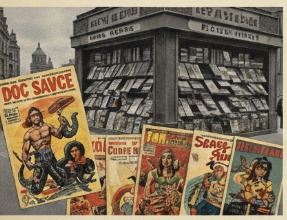
Germany is the undisputed champion of the modern "booklet novel." While other countries moved these stories into thick paperbacks or digital archives, the German Heftroman stayed exactly where it started: at the kiosk.
The Past: Post-war Germany had a hunger for escapism. Series like Jerry Cotton (FBI stories) became so popular they sold millions of copies weekly. In 1961, Perry Rhodan was launched as a short "space opera" series; it was only meant to last 30 issues, but it never stopped.
The Present: Germany is the only place where the "weekly serial" is still a mass-market reality. You noticed them in the cigarette shops and kiosks—this "Kiosk-Kultur" is the lifeblood of the genre. Today, Bastei Lübbe and Pabel-Moewig keep legends like John Sinclair and Perry Rhodan alive, moving beyond the kiosk into specialized e-book subscriptions and massive audio-drama productions.
Spain: The Era of the Bolsilibro #
In Spain, the pulp tradition was defined by the Bolsilibro—tiny, pocket-sized books that were often traded in barbershops or street markets.
The Past: During the 1950s and 60s, publishers like Editorial Bruguera dominated the Spanish-speaking world. Authors like Corín Tellado (the queen of romance) and George H. White (sci-fi) wrote at a lightning pace. These were "swap-culture" books; you’d buy one, read it on the bus, and trade it at a second-hand stall for the next one.
The Present: The weekly kiosk model collapsed in Spain in the 1990s. However, there is a massive "nostalgia market" today. Small "micro-publishers" are now releasing new Bolsilibros in the classic 10x15cm format to satisfy collectors who miss the gritty, fast-paced style of the old days.
France: From Feuilletons to High Fantasy #
France has a long history of "serial fiction," but they were the first to "elevate" it from cheap booklets into something more permanent.
The Past: France invented the feuilleton—stories published chapter-by-chapter in daily newspapers. Legends like Fantômas (the masked criminal) were the French equivalent of pulp heroes. In the mid-20th century, series like Fleuve Noir (black river) published thousands of sci-fi and crime stories in a small paperback format called "Anticipation."
The Present: France moved away from the "thin booklet" faster than Germany. Today, the French "pulp" spirit lives on in Bandes Dessinées (Graphic Novels) and high-quality mass-market paperbacks. While you won't see as many thin booklets at the kiosk, French readers are among the world's biggest consumers of serialized manga and fantasy novels.
USA: The Birthplace of the "Pulp" #
The United States is where it all began with the Dime Novel and the Pulp Magazine, but it is also where the original format died the hardest.
The Past: In the 1930s, characters like The Shadow, Doc Savage, and Conan the Barbarian ruled the newsstands. These were printed on "pulp" (cheap wood-pulp paper), hence the name. They were the direct ancestors of the modern superhero comic book.
The Present: By the 1950s, the "Pulp Magazine" was replaced by the mass-market paperback and television. Today, the US "Pulp" scene is almost entirely digital or high-end. While you can't buy a weekly Doc Savage booklet at a gas station anymore, the stories have moved to Hollywood—nearly every major Marvel or DC movie is just a high-budget version of a 1930s pulp story.
Summary: Where to find the "Soul" of the Pulp today? #
Germany: At the Kiosk (The last place where the thin booklet is king).
Spain: At Second-hand markets or specialty "Pulp" boutiques.
France: In the BD (Graphic Novel) section of the bookstore.
USA: In the Cinema or on a Kindle.
Anatomy of a Pulp Booklet #
These booklets have very specific "blueprints" that make them recognizable instantly. Whether they are the Heftromane you saw in the German cigarette shops or the Bolsilibros of Spain, they are designed for "pulp speed"—fast to write, fast to read, and cheap to buy.
Here is the breakdown of their physical and literary "anatomy."
Germany: The Heftroman (The "Dime Novel")
The ones you see at the kiosk are almost always in DIN A5 or DIN A4 (magazine) format.
Dimensions: Usually 15.5 x 22.5 cm (standard) or 21 x 29.7 cm (large format). They are very thin, usually just 64 pages.
Word Count: Between 20,000 and 25,000 words. A professional author is expected to write one entire booklet in a week.
Famous Authors:
Helmut Rellergerd (Jason Dark): The creator of John Sinclair. He wrote over 1,000 of these booklets personally.
K.H. Scheer & Clark Darlton: The architects of Perry Rhodan. They created a "series bible" so complex it has its own fan-run encyclopedia (Perrypedia).
Heinz Werner Höber: The most prolific writer for Jerry Cotton. He once calculated he had written over 200 "Cotton" novels.
Spain: The Bolsilibro (The "Pocket Book")
These were much smaller than the German ones—literally designed to fit into a worker's jacket pocket.
Dimensions: Usually 10.5 x 15 cm. They looked like tiny, thick bricks rather than thin magazines.
Word Count: About 20,000 to 30,000 words, spanning roughly 96 to 128 small pages.
Famous Authors:
Corín Tellado: The "Queen of Romance." She wrote over 4,000 novels and is listed in the Guinness World Records.
Francisco González Ledesma (Silver Kane): A high-profile lawyer and journalist by day, he wrote hundreds of gritty Westerns and Crime stories by night to support his family.
Antonio Vera Ramírez (Lou Carrigan): Famous for the Brigade Central series and over 1,000 other pulps.
USA: The Classic Pulps
The American pulps were larger and more like thick magazines before they transitioned to the "mass-market paperback."
Dimensions: The "Standard Pulp" was 7 x 10 inches (approx. 18 x 25 cm). They were thick, often 128 pages.
Word Count: A single pulp magazine often contained one "Lead Novel" of 30,000–40,000 words, plus several short stories, totaling about 65,000 words per issue.
Famous Authors:
Lester Dent (Kenneth Robeson): The man behind Doc Savage. He had a famous "Master Fiction Plot" formula for writing 6,000 words a day.
Robert E. Howard: The creator of Conan the Barbarian. He sent his stories from a small town in Texas to the big pulp magazines in New York.
France: Fleuve Noir & Anticipation
France preferred a slightly more "elegant" paperback look even for their cheap thrillers.
Dimensions: 11 x 17.5 cm (The "Petit Format").
Word Count: Usually longer than the German booklets, ranging from 35,000 to 45,000 words.
Famous Authors:
Stefan Wul: A dentist by profession who wrote some of the most imaginative French Sci-Fi pulps like Oms en série (which became the film Fantastic Planet).
Jean-Gaston Vandel: A pseudonym for two brothers who wrote over 80 Sci-Fi novels for the famous Anticipation line.
The "Pulp Speed" Comparison #
Country Format Name Typical Word Count Vibe
Germany Heftroman 22,000 Weekly serial, thin, magazine-style paper.
Spain Bolsilibro 25,000 Tiny "pocket" bricks, very colorful covers.
USA Pulp Magazine 40,000+ Rough, yellowish paper, high-octane art.
France Petit Format 40,000 Small paperback, often sci-fi or spy noir.
Writing for the German Pulp Market #
Writing for the German Heftroman market is a very specific type of "blue-collar" writing. Unlike traditional novels where you get a percentage of sales (royalties), the booklet world typically operates on a flat-fee-per-issue basis.
Based on industry standards for 2025/2026 and historical data, here is what authors are likely being paid:
The Standard Fee
For a standard 64-page booklet (approx. 20,000 to 25,000 words), a freelance author typically receives:
Newer/Standard Authors: €400 to €700 per booklet.
Established/Lead Authors: €800 to €1,200 per booklet.
While that might seem low for a whole story, you have to consider the speed. A "pro" in this field is expected to produce one booklet every 5 to 10 days. If an author writes two booklets a month, they are earning a steady, albeit modest, freelance income.
The "Perry Rhodan" or "John Sinclair" Tier
For the "Big Two," the pay structure is a bit more prestigious because these authors are often part of a permanent "Autorenteam" (writing team).
Higher Base Pay: Authors on these flagship series can earn on the higher end of the scale (around €1,000+ per issue).
Longevity: Since these series are guaranteed to sell, being on the team provides a very rare thing in the writing world: job security.
Secondary Rights: Some contracts allow authors to earn extra if their specific story is later republished in a "Silberband" (hardcover edition) or turned into an audio drama (Hörspiel).
The Workload Reality
To make a "middle-class" living solely from Heftromane, an author has to be a machine.
Word Count: 25,000 words in a week is a grueling pace (about 3,500 words/day).
Pseudonyms: Many authors write for 3 or 4 different series at once (e.g., a Western, a Romance, and a Horror story) using different names so they don't "saturate" the market with one name.
VG Wort: The "Secret" Bonus
In Germany, authors get a significant "hidden" paycheck once a year from VG Wort (a collecting society).
Because these booklets are stocked in libraries and sold in high volumes, the VG Wort payout for a prolific Heftroman author can be several thousand Euros extra at the end of the year, sometimes making up 20% of their total income.
Summary of the "Cigarette Shop" Economy #
The publishers (Bastei Lübbe, Pabel-Moewig) keep the margins tight. The booklets usually cost between €2.20 and €3.50 at the kiosk.
Retailer & Distributor: Take about 50%.
Printing & Paper: Takes about 20–25%.
Author: Takes about 3–5% of the total cover price (baked into that flat fee).
To write for a series like John Sinclair or Perry Rhodan, you can't just "wing it." These publishers use a Series Bible and a strict "Dramaturgie" (formula). Let's look at how a professional author would pitch a John Sinclair story to an editor at Bastei Lübbe.
The "Bastei" Pitch Formula #
A pitch usually consists of a Logline (the hook), a Synopsis (the plot), and the Key Action Beats.
Working Title: Der Fluch des Kiosks (The Curse of the Kiosk)
Series: Geisterjäger John Sinclair
Estimated Length: 22,000 words / 64 pages
1. The Logline (The "Hook")
A string of bizarre deaths at a historic railway newsstand leads John Sinclair to a forgotten underground archive in Berlin. The victims aren't just dying; they are being "erased" from reality, just like out-of-print stories.
2. The Synopsis (The Story)
The Inciting Incident: A kiosk owner in Berlin-Alexanderplatz is found dead, but his body is made of literal paper and printer's ink.
The Investigation: John Sinclair and his partner Suko arrive. They find a rare, ancient "Heftroman" that wasn't published by Bastei. The pages are blank, but they "steal" the souls of anyone who touches them.
The Twist: The villain is an ancient "Scriptor" demon who feeds on human imagination. He is using the high-traffic kiosk to harvest souls by turning their lives into "disposable fiction."
The Climax: John must enter the "World of Ink"—a surreal dimension where he has to fight classic pulp monsters (vampires, zombies) to reach the Scriptor.
The Resolution: John uses his Consecrated Silver Cross to "burn" the demonic manuscript. The kiosk returns to normal, but John is left with a haunting thought: Is his own life just a story being written by someone else? (A meta-nod to the fans).
The Author’s "Beat Sheet"
To hit that 22,000-word target in 7 days, the author breaks the 64 pages into chapters:
Section Pages Content Focus
The Cold Open 1–8 A gruesome, mysterious death. High tension. Ends with a "Cliffhanger."
The Briefing 9–15 John at Scotland Yard. Research. Banter with Sir James Powell.
First Contact 16–30 John arrives at the scene. Initial fight with a "minor" monster.
The Mid-Point 31–45 The "Big Reveal." John realizes the true scale of the demonic threat.
The Final Battle 46–60 The action peak. The silver cross is used. High-octane descriptions.
The Outro 61–64 The threat is gone (for now). A drink at the pub or a joke to end.
Why this works for the Publisher:
Familiarity: It features the "Silver Cross" and "Suko," which readers expect.
Pacing: It ensures an action scene every 10–12 pages (crucial for keeping readers engaged while commuting).
The "Vibe": It mixes modern urban settings with Gothic horror—the signature Sinclair style.
A Tip for the "Cigarette Shop" Authors
If you were writing this, the editor would tell you: "Write for the eye." Because these are printed on cheap paper, the descriptions shouldn't be too dense. Short sentences, lots of dialogue, and clear "cinematic" action are what make a Heftroman successful.
the Exposé is the law, and Dramaturgie is the engine. #
In the world of Heftromane, the Series Bible (the Exposé) is the "law," and the Dramaturgie is the "engine."
Publishers like Bastei Lübbe or Pabel-Moewig cannot afford for an author to have "writer's block" or to accidentally kill off a character who is supposed to appear in a sequel three weeks later.
Here is how these two tools work in tandem to create the "formula" you see on the kiosk shelves.
The Series Bible (The Universe's Constitution)
A Series Bible is a massive document (sometimes hundreds of pages) that ensures "Continuity." If John Sinclair drinks a specific brand of tea in Issue #10, he shouldn't be a coffee-only drinker in Issue #2000.
What’s inside?
Character Sheets: Height, weight, eye color, psychological trauma, and "Power Levels."
Example: For Perry Rhodan, the Bible tracks the "Cell Activator"—a device that makes him immortal. The Bible specifies exactly how it works so an author doesn't accidentally make him vulnerable to something he shouldn't be.
The "No-Go" List: Actions a hero would never do.
Example: John Sinclair is a gentleman. He never uses excessive or "cruel" violence. He is a protector, not an executioner.
The Tech/Magic Rules:
Example: If a demon is vulnerable only to consecrated silver, an author cannot suddenly have John kill it with a normal Glock 17. The Bible maintains the stakes.
The Glossary: Specific terminology (especially in Sci-Fi).
You can’t call a "Hyperdrive" a "Warp Drive" if the Bible says "Hyperraum-Antrieb."
The Strict "Dramaturgie" (The 4-Act Formula)
A Heftroman is designed to be read in exactly 45 to 60 minutes (the average German commute). To achieve this, authors follow a rigid structural formula:
Act 1: The "Hook" (Pages 1–12)
Requirement: Someone must die or a "World-Threatening Event" must occur within the first 3 pages.
Purpose: To grab the reader who is browsing at the kiosk or cigarette shop.
The Beat: The hero receives the "Call to Action."
Act 2: Investigation & Escalation (Pages 13–32)
Requirement: The hero encounters a "False Victory." They think they’ve solved it, but it’s actually a trap.
The Beat: Information gathering. In John Sinclair, this is where he talks to his boss at Scotland Yard or his friend Bill Conolly.
Act 3: The "Deep Point" (Pages 33–48)
Requirement: The hero is in physical danger or loses a resource.
The Beat: The "Midpoint Shift." The villain is revealed to be much more powerful than expected. The hero is often captured or cornered.
Act 4: The Showdown & Reset (Pages 49–64)
Requirement: High-speed action. The hero uses their signature weapon (The Silver Cross, the Beretta, the Spaceship).
The Beat: The villain is defeated but usually escapes or hint at a "Mastermind" behind the scenes. This ensures the reader buys the next issue.
The Reset: The final page always returns to "Status Quo." The hero is ready for the next adventure.
Real-World Example: The "Jerry Cotton" Formula #
Jerry Cotton (the FBI series) is famous for having one of the strictest formulas in history. For decades, it followed these "Bible" rules:
Perspective: Always written in the 1st Person ("I opened the door...").
The Car: Jerry must drive his red Jaguar E-Type.
The Partner: Phil Decker is the "brain," Jerry is the "action."
No Romance: Jerry can flirt, but he never has a steady girlfriend. Why? Because a girlfriend complicates the weekly "Status Quo."
Language: Simple, hard-boiled, and rhythmic. No "purple prose" or long metaphors.
Why the "Exposé-Autor" is the Real Boss #
In large series like Perry Rhodan, there is a specific person called the Exposé-Autor (Lead Storyteller).
They don't write the 64-page booklets.
Instead, they write a 5–10 page summary (the Exposé) for every single issue.
They send this to the "working author."
The author’s job is to "flesh out" that summary into 22,000 words.
The result? A seamless story that feels like it was written by one person for 60 years, even though hundreds of authors have contributed.
To give you a real feel for how a professional author stays "in character," here is a reconstruction of a Series Bible Character Sheet for John Sinclair.
In the German publishing house (Bastei Lübbe), this sheet acts as a checklist. If an author writes a scene where John loses his cool or uses a sniper rifle, the editor will highlight it in red and say: "See the Bible—John doesn't do this!"
📄 Character Profile: John Sinclair
Series Title: Geisterjäger (Ghost Hunter)
Status: Chief Inspector, Scotland Yard (Special Division)
Physical Appearance & Vibe
Age: Perpetually in his mid-30s.
Build: Tall, athletic, but "wiry" rather than a bodybuilder.
Hair: Blonde (often described as "dark blonde").
Eyes: Sea-gray/Blue.
Clothing: Usually a trench coat, well-tailored but practical suit, or a leather jacket for "fieldwork."
The "Aura": He radiates a calm, natural authority. He is the "Knight in a Suit."
The Arsenal (The "Magic" Items)
The Bible is extremely strict here. These items are the "Brand" of the series.
The Silver Cross: His primary weapon. It’s not just a symbol; it’s an ancient Atlantean artifact.
Usage Rule: It glows when evil is near. It can emit a "cleansing light." It must be used with a specific Latin or English prayer.
The Beretta: A standard 9mm, but loaded with silver bullets.
Constraint: John only shoots to protect; he never "executes" a human, only demons.
The Sinclair-Team Ring: A silver ring with a skull and crossbones. It allows him to communicate with his partner, Suko.
Psychological Profile (The "Dramaturgie" Rules)
The "Loner" Paradox: John has many friends (Suko, Bill Conolly, Sir James), but he carries the weight of the world on his shoulders.
Sense of Humor: Dry, British, and understated. He uses wit to mask his fear.
Weakness: His deep sense of responsibility. If a civilian is in danger, John will always drop his weapon or walk into a trap to save them.
Religion: He is a believer, but not a "preacher." His faith is a tool, like his gun.
Typical "Bible" Prohibitions (The No-Gos)
NO Smoking: Unlike 1950s pulp heroes, John is modern and fit.
NO Swearing: He might say "Damn!" or "Good Lord!", but he never uses vulgar language. (This keeps the age rating accessible for younger readers at the kiosk).
NO Permanent Love: He has love interests (like Jane Collins), but they are often cursed, turned into witches, or "unavailable." The Bible dictates that John must remain "The Hero on the Move."
Relationships (The Supporting Cast)
The Bible tracks "Who knows what":
Suko: His Chinese partner and best friend. He is a master of martial arts and possesses the "Whip of Demons."
Sir James Powell: The boss. Provides the "Official" cover for John's supernatural work. He is the "M" to John's "James Bond."
The Arch-Enemy: The Black Death (Der Schwarze Tod) or Asmodina. The Bible tracks exactly how many times they have fought and why they haven't died yet.
Why this exists: The "Cigarette Shop" Consistency
When a reader buys a Sinclair booklet at a Lotto-Laden in Hamburg or a Kiosk in Munich, they are buying a "comfort product." They know exactly what they are getting.
If John Sinclair suddenly started acting like a gritty, swearing anti-hero (like The Witcher or The Punisher), the core "Kiosk" audience would feel betrayed. The Series Bible prevents "Creative Drift."
While the John Sinclair Bible is about atmosphere and morality, the Perry Rhodan Bible is a massive technical manual. Because it has run for 65 years without a reboot, the "Pseudo-Science" must be consistent. If a ship travels at 50% the speed of light in 1970, it can't suddenly do 500% in 1971 without a "technological breakthrough" issue to explain it.
Tech Sheet for the most iconic ship in sci-fi history: the Kugelraumer (Sphere Ship). #
🚀 Tech Sheet: The Sphere Spaceship (Kugelraumer)
Series: Perry Rhodan Model Type: Stardust Class / Ultra-Exploration Vessel
Physical Specifications (The "Hard" Stats)
Shape: Perfect Sphere (to maximize structural integrity in hyperspace).
Diameter: 800 meters (The Bible lists sizes from 30m "Space-Jets" to 1500m "Super-Battleships").
Ring Bead: A distinctive "ring" around the equator containing the landing gear and sub-light engines.
Internal Layout: 40 to 60 decks. Deck 1 (Bridge) is always at the "North Pole" of the sphere.
Propulsion Systems (The "Formula" for the Author)
Authors must use the correct terminology for the ship's movement:
Sub-Light: Impulstriebwerk (Impulse Drive). Uses nuclear fusion.
Faster-Than-Light (FTL): Linear-Antrieb (Linear Drive).
The Rule: The ship doesn't "warp"; it slides into a semi-dimension between Einstein-space and Hyperspace.
The Math: Distances must be calculated in Light Years (Lj). If the ship travels at a "Linear Factor" of 1 million, the author must ensure the travel time to the Andromeda galaxy matches the series' established geography.
Defensive & Offensive Systems
The HÜB-Shield: (Hochenergie-Überlast-Übertragungs-Bolzen). A glowing blue energy bubble.
Constraint: The shield absorbs energy and "vents" it into hyperspace. If it takes too much fire, the vents "overload"—a classic source of tension in the stories.
Transform-Kanonen: The primary weapon.
The Logic: It teleports a nuclear fusion bomb directly into the enemy ship using a mini-teleporter.
Visual Rule: There is no "beam." The author must describe a "shimmer" and then the explosion inside the target.
The "Pseudo-Science" Dictionary
The Bible includes a "Leitfaden" (Guide) for how things feel:
Hyper-Resistance: When Hyperspace is "rough," communication is impossible.
Paratrans-Technology: Advanced tech that ignores standard shields. (Only for "End-Boss" aliens).
Positronik: The ship's computer. It is not "AI" in the modern sense; it is a logical calculator. It never "feels" emotions unless it's a specific "Biopositronik."
The "Math" of the Bible: An Example
In a Perry Rhodan exposé, the Lead Author might give the working author this instruction:
"The ship is 2,000 light-years from Earth. They need to get there in 4 hours because the villain is attacking. Calculate the Linear Factor."
The author then has to do the math:
$$2,000 \text{ Lj} / 4 \text{ hours} = 500 \text{ Lj/hour}$$
$$500 \times 24 \times 365 = 4,380,000 \text{ (The Linear Factor)}$$
If the author just writes "they flew there really fast," the Perrypedia (the fan encyclopedia) and the editors will catch it. The readers of these booklets are often engineers or scientists who love the "hard" in Hard Sci-Fi.
Why this is in the Cigarette Shop
This technical detail is why Perry Rhodan is a billion-euro franchise. It creates a "World-Feeling" (Weltgefühl). When you buy that €2.50 booklet next to the tobacco, you aren't just buying a story; you are buying a ticket into a simulation that has been running perfectly since 1961.
Comments & Ratings
#
Loading comments...