


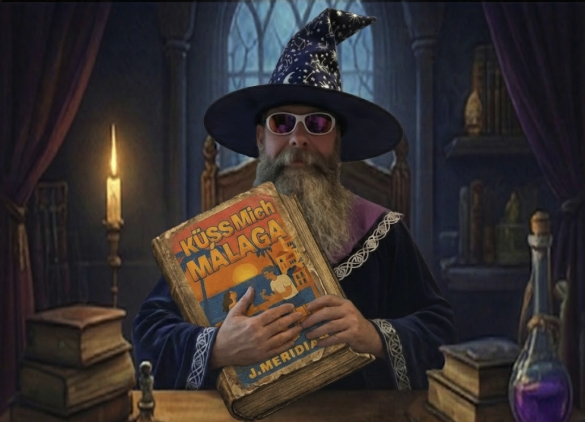
Kiss Me Malaga
Flashback #
The night in Málaga smelled of jasmine and salt, so warm that the air clung to my skin like a damp film. He braced himself with his hands on either side of me, his body so close I could feel his breath. In the soft glow of the moonlight, I could see the truth in his face; the tiredness around his eyes gave way to a raw, unprotected longing that mirrored my own. He didn't have to smile; his gaze held me fast, understood me, and demanded nothing but this moment. He didn't smile. He didn't have to.
"This is a bad idea," I whispered. "I know," he said, and kissed me anyway.
It wasn’t a gentle kiss. It was the kind of kiss you don’t plan, one that crashes into you, pulling the ground out from under your feet. The kind of kiss that silences every doubt, a hasty reclaiming of something we only realized in that moment we had been missing. I tasted the dark, sweet wine from hours ago, the salt on my own lips, and beneath it, the unmistakable heat of a soul that had held its breath for far, far too long.
Somewhere inside, a blue light pulsed silently and watchfully on the kitchen counter.
The Last Crack #
The tone of the woman on the other end of the line was a masterclass in feigned sympathy and bureaucratic indifference. "I understand your urgency, Ms. Alonso," she purred, "but the invoices must first go through the internal approval process. Unfortunately, accounting isn't fully staffed until next week."
"The invoice is sixty days overdue," I replied. My voice was so controlled and calm it almost hurt. I stared at my computer screen, at the elaborately designed logo I had created for this company. I had invested hours, no, days, into perfecting the curved lines and the color palette. "The approval process took place when you accepted the final design. My fee isn't a friendly request; it’s part of the contract."
I massaged my temples with my thumb and forefinger. The dull headache that had been my constant companion for days throbbed in time with my growing despair. It was always the same game. I was a graphic designer, a creative. But half my time wasn't spent drawing; it was spent writing polite, then urgent, then threatening emails to get the money I was owed. I was an artist and an involuntary debt collector rolled into one.
"I’ll see what I can do," Ms. Richter said in a tone that made it crystal clear she would do exactly nothing. The line went dead.
I closed my eyes and took a deep breath. The smell of cold coffee rose from my cup. Outside, a gray, rainy sky painted the city's rooftops in drab colors. The apartment had been unnaturally quiet since Jonas packed his bags two days ago. Or rather: since I asked him to do it.
The door opened. It was him. He still had a key. "I just wanted to get the rest of my things," Jonas said, avoiding my gaze. In his hand, he held an empty cardboard box. He looked like a stranger in the room we had shared for three years.
"No problem," I muttered, turning back to my screen, pretending to be busy. I could feel his gaze on my back. I heard him go into the bedroom, the sound of drawers being opened and closed. Every noise was a tiny sting.
The actual fight, the big, loud confrontation, had never happened. Our breakup hadn't been a volcanic eruption, but the slow erosion of a rock. A steady, unstoppable drifting apart until an insurmountable chasm lay between us.
He came back into the living room; the box was now filled with books, an old hoodie, and the photo of us from our last vacation at the North Sea. He set the box down by the door.
"You look tired," he said. It wasn't an accusation, more an observation. "I'm just chasing my money," I replied, sarcasm being my only remaining armor. "The usual freelancer life."
Jonas sighed. It was that sigh that drove me crazy. A sigh full of concern, but also full of condescension. "I always told you. This stress, it's destroying you. Get a permanent job. With a steady income, with security."
There it was again. The word that questioned my entire existence. Security. His life goal. His mantra. To me, it sounded like a death sentence for my soul.
"You just don't understand, Jonas," I said softly, without turning around. "This is my job. This is me. I don't want to sit in a gray office all day designing logos for dog food that a marketing department then mutilates beyond recognition."
"It's better than worrying about whether you can pay the rent next month!" he countered, his voice louder now. "It's about being an adult. Making plans. Building a future."
His future. A house in the country, a station wagon, a Golden Retriever. In that picture, there was no room for my chaotic, creative soul. I was the unpredictable variable in his life equation.
I spun around in my chair and looked him directly in the eye. "And what about my plans? What about what I want?"
"What you want is a fantasy!" he almost shouted. "A life like a bohemian from the last century. But the world doesn't work that way! You need a plan!"
That was the last, decisive crack. Not his words, but the realization in his eyes that he didn't just misunderstand me, he thought I was naive and lost. He didn't love the woman I was, but the woman he wanted to mold me into.
Silence. Only the ticking of the clock on the wall and the soft patter of rain against the windowpane. "You should go now, Jonas," I said, my voice brittle but firm.
He looked at me for a moment; the anger gave way to an expression of resignation. He nodded slowly and grabbed his box. At the door, he paused.
"Take care of yourself." Then he was gone.
The silence he left behind was deafening. I stared at the empty spot on the wall where our photo together had hung. My headache throbbed. The unpaid invoice on the screen grinned at me mockingly. I felt trapped. In this apartment, in this city, in this life that felt like a shoe that was too tight.
I had to get out of here. Not just out of the apartment, but out of everything.
Mechanically, I opened a new browser window. My fingers hovered over the keyboard. A memory flashed, an image from another life, when I was twenty-two, carefree and full of dreams. The smell of jasmine and salty air.
Málaga.
My fingers began to type. Flight search engine. A one-way flight. Accommodation. An apartment with an inner courtyard and high ceilings. The pictures promised coolness, peace, another world. It was reckless. It was impulsive. Financially, it was probably a catastrophe.
But as the booking confirmation appeared on the screen, I felt something other than stress and sadness for the first time in months. A tiny spark. A fleeting breath of freedom. I reached for my sketchbook, which had lay untouched on the table for weeks. I had to pack. I just had to get away.
Arrival Sunshine #
I should have started packing a day earlier. Maybe then I wouldn't be dragging two suitcases and a bursting backpack through the airport like a pack animal. My back, previously loyal and quiet, decided to go on strike somewhere between packing and lugging the suitcases down the stairs. The first back pain of my life, and of course, it had to make its grand debut on vacation.
Sure, I packed too much. I always do. Really, I only needed flip-flops, swimwear, and a bottle of sunscreen. Who could have guessed that Málaga at the end of June feels like a pizza oven wrapped in a wet blanket?
At the airport, I chose the wrong security line, the one without the magic liquid-check machine. So I had to sacrifice my water bottle. Of course, you only find out afterward that there was a line with liquid control.
On the plane, I had wisely buried my COVID mask deep in my luggage. I regretted it almost immediately when I woke up twice with my mouth open like a fish suddenly pulled out of the water, and twice more when my seatmate gifted the cabin with a fart.
I landed on a Sunday. My Airbnb host had promised me an airport transfer: "Look out for the black car," he had written. Sounded simple, right? I saw it immediately: a massive black sedan glistening in the sun. The windows, rolled down only a tiny crack, seemed more mocking than welcoming.
Next to it stood my driver, lazily fanning himself with a baseball cap. "You must be my chauffeur, Javier," I stated as I approached him. He slid his sunglasses down a notch and gave me a dismissive look.
"Bienvenido. You must be Clara?"
"Yes, that's me," I nodded.
"Let's go then?" the driver said.
I looked inside. The seats were gleaming in the heat, then I reached through the window gap and operated the door handle. I regretted it immediately, pulled my hand back, and stared at my palm. "Ah," I muttered. "So that's how Málaga brands its tourists."
He snorted. "You should see August."
On the second attempt, using my sleeve as a barrier, I managed to open the door and slide onto the seat. We sat in silence for a moment, both sweating, the windows open but the air even heavier than before. He turned the key in the ignition, shifted gears, and we jerked away from the parking spot. Hot air blasted through the windows, somehow managing to be worse than the stagnant air in the car. I leaned my head back and let the hot air blow in my face. "If I survive this ride," I said, "you're getting a five-star review from me. If not, please tell my family I died heroically of heatstroke." He actually grinned.
Normally, the locals don't comment on the weather, there's nothing to say. But this time, even the Spaniards were standing in the street murmuring "madre mía la humedad" and fanning themselves. When the Spaniards complain, you know the sun has gone completely crazy.
By the time we finally stopped in front of the apartment, I didn't care about the heat anymore. Mainly because I was 80% sure my soul had long since left my body and was waiting for me in the apartment with an air conditioner.
From the outside, the building didn't look like much. Just another sun-bleached facade in a street full of sun-bleached facades. But the driver pointed to a heavy door made of dark wood. "Here," he said. He helped me with my luggage, a gesture that felt less like kindness and more like he wanted to be rid of me as quickly as I wanted to be rid of him.
The door opened to an inner courtyard. Immediately, the world changed. The temperature dropped a few degrees. A small fountain splashed in the center, its sound a balm for my nerves. The air smelled of damp stone and jasmine. I had to restrain myself from kissing the cool tiles in relief.
The apartment itself was on the second floor. The owner had left the key in a lockbox. The code was simple. Too simple. 1-2-3-4. I made a mental note to mention it to him.
Inside, it was even better than the pictures. High ceilings, dark wooden beams, and floors that had seen a few centuries. Beautiful. Perfect.
I left my luggage in the entryway and did a quick walkthrough. A spacious living room with a balcony overlooking the courtyard. A bedroom with a bed you could easily land a small plane on. A kitchen that was probably better equipped than my own at home. Everything was spotless. Clean.
Then, at the end of the short hallway, I saw another door. Darker wood than the others, with a heavy, old-fashioned lock. I tried the handle. Locked. I peered through the keyhole. Black. I checked the Airbnb listing on my phone. Two bedrooms, one bath. No mention of a locked office. Strange.
A smooth, feminine voice came from a small, elegant speaker on the kitchen table. "Welcome to the residence, Clara."
I jumped. "Who said that?"
"I am Alma, your home assistant," the voice replied. "I am here to make your stay pleasant. Should I adjust the temperature?"
I stared at the speaker. A piece of high-tech minimalism that didn't fit the rustic charm of the apartment at all. "Alma? What are you?"
"I am an integrated AI responsible for managing environment, security, and your personal comfort," she said with a perfectly even tone. "The current humidity is sixty-eight percent. I can turn on the dehumidifier if you wish."
I got stuck on the word security. "Alma, what's behind this door?" I asked, knocking on the dark wood.
A pause followed. Just a moment. "That is the owner's private office," Alma said. "It is not part of the rental."
"Right," I said. "Of course." It made sense. But the way Alma said it sounded rehearsed. As if she had given that answer many times. I shook my head. Burnout and a bad breakup were making me paranoid. I was here to relax, not to invent mysteries.
"Alma," I said, "crank the AC until it feels like a cold storage locker in here."
"Of course, Clara," the voice replied, and shortly after, a wonderfully cool breeze flowed from the vents. I closed my eyes and let the cold air wash over me. It was perfect. Almost. I couldn't shake the feeling of the locked door. Or the voice of the all-too-helpful AI that was now silently observing me.
The perfect, cooled air of the apartment began to feel like a cage. I needed supplies. It was 9 PM. In Málaga, in summer, that meant the sun was still hanging in the sky with an orange that bled into the horizon. The light was beautiful, cinematic. The heat was not. The warmth gathered over the day radiated upward from the pavement in shimmering waves, meeting the heat still pressing down from above. The air was thick, syrupy, something you had to push your way through. It smelled of jasmine from the courtyards. I turned the corner, my feet finding a familiar rhythm on the cracked tiles of the sidewalk. I had lived here once. Another life, another girl. A flash of memory hit me, me, twenty-two, laughing at this exact corner, leaning against a battered scooter, waiting for someone. The memory was so clear it hurt. I pushed it down. I wasn't that person anymore.
My destination was the big Chinese bazaar a few blocks away. They always had everything. But when I arrived, the metal security gate was pulled down, the red paint faded. Closed. Of course. Another memory: buying a cheap kettle and mismatched mugs there when I moved into a tiny apartment nearby. The small changes of a city that moves on without you.
Plan B was Carrefour. A longer walk. I took a shortcut past the Dia market. The open field behind it used to be a dusty area where children played soccer until the light failed. Now it was a makeshift campsite. Old motorhomes and converted vans stood in the field, clotheslines stretched between them. People lived in these sun-tanned metal boxes. The thought of the heat inside made my skin prickle. A freezer truck converted into a camper, I thought. That would be the only sensible choice.
The automatic doors of Carrefour hissed open, a gateway to a sterile, air-conditioned deli heaven. The relief was so intense it was dizzying. I moved quickly. Milk. All-Bran, the right ones, without the sugar glaze. A small cup of yogurt that promised the taste of melon, a promise I knew it wouldn't keep. The smallest bottle of sunscreen available. And an anti-mosquito plug. I wasn't going to be a buffet. Bag in hand, I stepped back outside. The sun had finally vanished behind the buildings, but the heat remained, stubborn, refusing to leave. The sky was a deep, bruised violet. On the way back, I wasn't just navigating the streets. I was navigating the ghosts of a life I had left behind. The heat felt exactly the same, but everything else, especially me, felt different.
I saw the heavy, dark wooden door of my building ahead. Behind it lay the cool courtyard, the fountain, the silence. And Alma, waiting for me inside.
The Cat and the City #
I hurried through the courtyard, barely noticing the scent of jasmine this time. The apartment door clicked shut behind me. The sudden silence was absolute. I dropped the bag on the floor.
"Welcome back, Clara," Alma's voice rang out.
I ignored her. My skin felt dusty; my hair clung to my neck. I needed a shower. Purposefully, I went into the bathroom and peeled off my sweat-soaked clothes. The bathroom was cool, tiled. I turned on the faucet, letting the water pelt me, first hot, then gloriously cold. It washed away the heat of the day, the grime of the city.
I dried off, pulled on an oversized T-shirt and shorts, and stumbled into the bedroom. The bed, large and cozy, swallowed me. Sleep came quickly, deep and dreamless.
The next morning, the apartment felt colder than the air conditioning could justify. I avoided the kitchen table where Alma lived and crept through the kitchen.
I finished breakfast quickly, All-Bran, surprisingly crunchy, with milk that tasted colder than it should. I ate standing up, no bowl, pouring the flakes directly into the milk carton. Efficient. Less washing up.
I rinsed the carton, threw it away, and grabbed my small backpack. The heavy door closed with a thud behind me, and a wave of pure, unadulterated freedom surged through me. I was out! And Málaga, hot, loud, and gloriously alive, spread its arms to welcome me.
My destination was vague: the beach. Not the crowded tourist spots, but the real stretch of sand extending west of the busy port. I headed toward La Térmica. The sun was already a golden promise in the sky, warming my skin with pleasant intensity. The air hummed with energy, tasting of fresh salt and the lively pulse of the city. The heat danced playfully on the pale asphalt, making distant buildings shimmer like watercolors. This was the true Málaga, full of charm, inviting you to just be. The sidewalk warmed soothingly under my sneakers, a solid connection to the vibrating street. Every breath, filled with the scent of the city, felt like an intoxication.
I drifted along the Paseo Marítimo, the wide promenade stretching along the coast. To the right, the Mediterranean glittered, an endless sapphire expanse dotted with cheerful swimmers. The chiringuitos, those fantastic beach bars, were coming to life, their colorful, striped awnings a cheerful invitation.
Even early in the morning, the irresistible promise of sizzling fish and charcoal grills wafted through the air. I strolled along the Playa de la Misericordia, a little paradise for locals. Everywhere I saw people moving with relaxed, sun-drenched ease: families laughing while setting up umbrellas, joggers with relaxed smiles, and groups of friends strolling arm-in-arm. There was no hustle here, just the joyful crackle of summer, the endless sea, and the glorious sun.
I remembered countless happy afternoons on this exact beach, the tingling salt on my skin, the taste of ice-cold drinks. That version of me, carefree and sun-kissed, felt less like a ghost and more like a warm memory. A memory calling me home. I walked on, past the last humming chiringuito, then turned inland, letting the heart of the city pull me away from the glittering water.
From the vastness of the beach, the streets transformed into a charming labyrinth of residential buildings and inviting little shops. The air here was still warm, but it felt cozy, infused with the comforting scent of freshly baked bread and blooming jasmine. The sounds changed too, into a lively symphony of neighborhood chatter, the cheerful honk of a delivery scooter, and the busy clatter of a café.
My new goal was the Mercado de Huelin, a real, bustling local market. A wonderful sanctuary, far removed from tourist expectations. The streets grew narrower, the buildings higher, creating pleasant shadows, yet the warmth continued to pulse from the living concrete. My skin felt alive; every pore soaked up the Málaga-feeling, this endless, intoxicating summer and the city that breathed it in with joy.
The old town of Málaga was a labyrinth of narrow alleys; high buildings cast sharp, cool shadows that brought brief, wonderful relief. I let myself drift, turning into alleys just because they looked interesting. This was the Málaga I remembered, the one that caught you and confused you until you forgot where you were going. The city hummed. The clinking of espresso cups from tiny cafés, the murmur of Spanish conversations, the distant whine of a scooter, the ringing of church bells. Laundry hung like colorful flags from balconies high above, moving in the light, hot breeze. Every corner revealed a new texture, worn cobblestones, peeling paint on iron railings, terracotta pots overflowing with geraniums.
Returning from my walk to the beach at El Pacífico, near the apartment, I discovered a small, hidden plaza with an ancient olive tree in its center. A narrow stone bench sat in its sparse shadow. Perfect. I pulled out my sketchbook and pencil, the familiar weight calmed me. I began with the gnarled trunk of the olive tree, then let my gaze wander to the ornate wrought-iron grilles of a window opposite.
A rustle in the bushes caught my attention. A cat. Shaggy fur, the color of dust and shadows, one ear nibbled, eyes like amber shards, a survivor. He moved toward me with quiet arrogance.
"Hey there, tough guy," I muttered, sketching his tense posture.
The cat flicked an ear, ignored me. But then, as if sensing my quiet, concentrated gaze, he padded closer more slowly, cautiously, stopping a few steps away. Tail neatly wrapped around his paws, he just watched me. His gaze was intense, unwavering. Like a tiny, ancient lion.
"León," I whispered. "That's what I'll call you. My little lion."
I tore off a piece of serrano ham from the sandwich I had bought earlier and tossed it gently to him. He looked first at it, then at me, then at the ham again, snatched it up lightning-fast, and retreated to the safety of a flowerpot. He devoured it, then looked at me again, a silent desire for more. I gave him another piece. And another. He didn't purr, didn't rub against my legs, he just sat there, accepting the offering, amber eyes fixed on me. I spent another hour sketching him.
The sun began to sink slowly, painting the narrow streets in warmer tones. It was time to return to the apartment. My legs were tired, my face hot from the sun, but my mind was clearer than it had been in days. Yet as I walked the increasingly familiar streets back to the apartment, the thought of Alma’s waiting voice returned, and the locked door.
The Moody Host #
The courtyard felt different the moment I entered. Not just because of the scent of jasmine, there was something else. A faint smell of coffee. I pushed open the front door. My tote bag hit the floor with a thud. On the sleek kitchen table, Alma’s light glowed in steady blue. But it wasn't her voice that broke the silence.
"Who the hell are you?"
The voice was deep and raspy. I whirled around. He was standing in the doorway of the room that had been closed before. The one that wasn't part of the rental. He was tall, disheveled, with dark hair that looked like he'd been running his hands through it for hours. His eyes, marked by days without sleep, were narrowed in anger. In his hand, he held a half-full cup that smelled of coffee.
"Who am I?" I managed, my voice sharper than intended. "I'm Clara. I booked this apartment. Who are you? And what are you doing in the owner's private office?"
He stared at me, then at the kitchen table. His gaze lingered on Alma for a moment. "I am the owner," he said, his voice flat with disbelief and anger. "And this is my apartment. What are you doing here?"
A cold fear spread through me, colder than any air conditioning. "Your apartment? No. I booked it. It was confirmed. And paid for."
He snorted, a humorless sound. "Confirmed? I just got back from a conference, wanted to work from here. I thought I had the whole apartment." He gestured wildly around the living room as if it were a crime scene. "You are a booking error."
"I'm a booking error?" I scoffed.
"I own the apartment, and I didn't confirm any booking!" he roared, then sighed and rubbed his temples. He looked utterly exhausted. "Alma, how can this be?"
Alma’s light flickered once, then turned blue again. "According to the terms of a temporary double occupancy, initiated by the system on July 23, 2025, due to a scheduling conflict error, the apartment is currently assigned to both Clara Alonso and Alejandro Vargas. For the duration of their respective bookings, the apartment is to be shared."
I stared at Alejandro. He stared angrily at the speaker, then at me, as if this whole disaster were my fault.
"Shared?" he finally managed, eyes wide with disbelief.
"Well, I'm staying; it's not my fault your Alma made a booking error. You, you're staying?"
"Looks like it, Alejandro," I said, a dangerous calm spreading through me. My last relationship crash had prepared me for exactly these kinds of absurd situations. "You can sleep in your office; that's probably not part of the rental."
He just stood there, jaw tensed, looking from me to Alma and back again. The anger was still there, but now shot through with pure resignation. Finally, he ran a hand through his hair, a gesture that released a bit of tension. "Great," he muttered. "That's just fantastic." He took a deep gulp from his cup and grimaced.
"Welcome to the shared flat," I said dryly, crossing my arms. "I take it you're not exactly used to roommates?"
"Roommates? I haven't lived with anyone since college. Back then, with a guy who thought it was okay to put his dirty socks on the ceiling fan." He shuddered as if reliving the trauma.
"Okay, that's impressive," I admitted. "Normally, I'm the one with the questionable living habits."
"Oh, I see that," he said, letting his gaze wander over my backpack, the tote bag, and the small smudge of dirt on my cheek. "And what do you do, Clara, besides apparently occupying apartments?"
"I'm a creative artist," I said vaguely. "And I haven't occupied anything! And you, are you a programmer?"
His eyebrows shot up. "How do you know that?"
I pointed to the closed office door. "Intuition. The locked office. The high-tech AI. And you," I added, "look like someone who hasn't seen sunlight in three days."
He actually smiled, a brief, lopsided flash of teeth. "Guilty. And you are apparently psychic."
"I prefer 'observant,'" I countered. "So, Mr. Vargas, what's the plan?"
He sighed again, running his hands through his hair once more. His gaze fell on the bedroom door. A quick internal struggle. Finally, he said, "Fine. You can have the bed. I'll stay in the office. I don't know how comfortable that will be." He added, "I certainly hadn't counted on a roommate."
He headed toward the kitchen, muttering something to himself. I grinned. Maybe a shared apartment wasn't a complete nightmare after all.
Glitch #
I was in the kitchen making tea when I heard his voice. First quiet, then sharper. Spanish, fast, every word so clipped it sounded like it could hurt him if he wasn't careful. The sound came from the office, the locked room he had declared off-limits. Only now it wasn't locked.
I froze, teaspoon still in my hand, as the steam from the boiling water fogged my glasses. I didn't want to listen, but I couldn't help it.
"...no es posible, ¿escuchas? ¡Te dije que...!"
A pause. Silence, except for the low hum of the laptop. Then:
"No. Ya es demasiado tarde."
The sound of his voice was different from the man who argued with me about towels. This was something else. Something heavy.
I stepped closer. The office door was open just wide enough for me to see him, hunched over the desk, one hand buried in his hair. On the screen: lines of code, green on black, flowing down like rain. And at the very top, in a glaring red box: ERROR.
Before I could process it, his head snapped up. Our eyes met. He slammed the laptop shut so quickly the sound made me jump. "Do you need something?" His voice was flat and unreadable.
I held up the cup. "Tea?"
For a moment, I thought he would refuse. Then he just nodded once. "Gracias."
That was all. No explanation. No word about the shouting. Shortly before I went to bed, Alma’s voice broke the silence. "System update required. Warning: unstable connection detected."
And I could still hear the echo of his voice from the other room, sharp, desperate, and directed at someone I couldn't see.
The Cohabitation Clash #
Morning came much too early, permeated by the acrid smell of burnt toast and noise. I groaned into my pillow, determined to stay away from the world a bit longer. There are battles worth fighting at dawn; this one clearly wasn't one of them.
But as always, curiosity won. And the craving for coffee.
Barefoot, hair still messy from sleep, I padded through the apartment to the kitchen. There, in the golden light of the rising sun, stood Alejandro. His shirt hung loosely open, just enough to show the hint of defined lines and a few scattered freckles on his collarbone. The fire on the stove cast a warm glow over his features while he hunched over a charred piece of toast, not like a man cooking, but like a warrior who had just been defeated by breakfast.
"Morning," I said, my voice still sleep-laden, intentionally slow.
He jumped, a small, delicious movement that made his back muscles tense under the fabric. The toast barely survived its final moment. "Oh. Morning," he stammered, clearing his throat. "Sorry for the... atmospheric disturbance."
"Is that what we're calling smoke and clattering dishes now?" I asked, walking past him and casually running a finger over the marble countertop.
He sighed, throwing the toast into the sink with a resigned splash. "I'm not a morning person. Not a kitchen person. And apparently not a toast person."
"A tragic trilogy," I murmured, now close enough to smell the warm scent of his skin, spicy, a bit darker than the coffee I was about to brew. "Coffee?"
His eyes met mine, dark, restless, and for a moment too long to be casual. "Please. Black. Strong. So strong it could wake the dead."
I turned away, hiding my grin, and got to work. The silence between us hummed like a soft spell that hadn't been named yet. As I handed him the cup, our fingers touched only briefly, but enough to send a jolt through my arm. Neither of us mentioned it.
"Thanks," he muttered, retreating to the table with his cup, though his gaze kept drifting back toward me.
The kitchen table was a chaos of manuals and empty energy drink cans. A chaos that was relentlessly spreading. I leaned against the stove; the fabric of my robe slipped a bit to the side, revealing the delicate lace of my nightgown. Not planned. Not entirely. Maybe it was.
"We should set some rules," I said.
His gaze immediately returned to me. "Rules?"
"Mhm. For surviving in a shared apartment. Who gets which shelf in the fridge? How much late-night programming or drawing is okay? And who cleans this post-apocalyptic battlefield?"
He grimaced. "Fair. Fridge: Me on top, you on bottom."
"I also prefer to be under you."
His hand froze; the coffee cup hovered for a moment between table and lips. Then his gaze met mine, a bit darker now. "Would you rather be on top?"
I allowed a brief pause before a smug smile appeared on my lips. "We're still talking about the fridge, right?"
He laughed softly, deep, throaty, like something you shouldn't do out loud if you weren't prepared to live with the consequences. "Of course. What else?"
"Exactly," I said, starting to gather the few dirty cups. "As for programming: I try to be finished by two. Mostly. Cleaning: We take turns. I usually have someone, but, "
", but with the 'unregistered double occupancy,' that would be a bit superfluous."
"Exactly." He nodded, his gaze wandering over me, lingering briefly on my chest. "We'll do it ourselves."
"Good. I like it clean. Especially when I'm sharing the space with someone who leaves charred sacrifices for the kitchen-catastrophe gods."
"And the living room?" he asked, his gaze sliding to the brushes and sketches I had spread across the coffee table.
"Those are creative artifacts," I said, walking slowly past him, my fingertips brushing almost imperceptibly against his arm. "They need light. And... attention. They don't go up in flames. Mostly."
I felt his eyes following me, like an invisible warmth sticking to me. "You're quite possessive for an artist."
"And you, Alejandro Vargas, treat the whole apartment like your private office with occasional kitchen dramas. But it's also my home. To live. Sleep. Breathe. Paint."
He stood up. Slowly. Stood in front of me. Close. The air tensed between us as if someone had stretched an invisible string. "I'll wash up. I'll behave."
"Oh yeah?" I tilted my head. Our breath met between us.
He didn't answer. Instead, he turned away and muttered. A moment passed, silent and charged. He poured himself a second cup of coffee. I began to tidy my things, slowly, deliberately, as if I wanted to say goodbye to every brush individually.
"We need to organize the fridge," I said finally.
"I actually like order, systems, no surprises," he replied without turning around.
"I love surprises," I said softly and silkily. "I just never announce them."
He ran a hand over the back of his neck. "Don't underestimate me, Vargas," I said, sliding past him, my shoulder brushing his, intentionally or not, hard to say. "I might not burn toast, but I might burn you. Quite possibly."
His laugh was quiet but not without heat. "As long as you don't torch the apartment, Alonso."
I stepped onto the balcony. The sun caught in my hair like flames. My smile was slow and confident.
Cracks in the Armor #
A moment later, I heard the glass sliding door open. He followed me out from the kitchen. "What's that?" he asked, pointing to a sheet of watercolor paper drying on the railing, based on a sketch I had made yesterday, a quick study of León lounging in a rare sunspot.
He studied it intently. "Capitán Rasguño," he murmured almost to himself.
I frowned. "Capitán Rasguño?"
"Yes," he said, gaze still on the sketch. "That cat. Everyone in the neighborhood knows him. His name is Capitán Rasguño."
"I called him León," I replied slightly defensively. "He looked like a little lion."
He shrugged, a dismissive gesture that couldn't quite hide the slight smile on his lips. "He's a survivor. That's Capitán Rasguño. Always has been."
For a moment, there was silence, only the distant hum of the city audible. He was still staring at the sketch, but now his gaze moved from the cat to me. The irritability that had existed since our first meeting was replaced by something else. Curiosity? Interest? Something I couldn't quite grasp, but that made my heart skip a beat. His eyes seemed brighter, more alert, taking in every detail of my face.
"You're good," he said finally, his voice softer than ever. "Really good."
"Thanks," I managed, trying to sound indifferent even though my heart was racing. He looked away as if he had broken a spell.
"If you want to see the real Málaga," he said, his voice regaining its usual cynical undertone, "skip the tourist traps and go to La Carbonería."
"La Carbonería?" I repeated. "What's that?"
"Flamenco," he said, shrugging again. "Real flamenco. Not this watered-down version for tourists. The place is hidden in the back of a wine shop, easy to miss. Only locals know it. Go if you want," he added. "Maybe you'll find inspiration there. In the heat, the passion, and the darkness."
And with that, he turned around and went back into the apartment, leaving me alone on the balcony, the sun warm on my skin, the picture of León drying on the railing. His casual recommendation wouldn't let me go. The thought of discovering an authentic flamenco bar, a hidden gem known only to locals, was exciting. Even more exciting was the thought that the grumpy Alejandro Vargas might actually be trying to connect with me. This evening, I would go to La Carbonería.
Dance of Gazes #
Evening descended over Málaga, and the stifling heat of the day gave way to a mild breeze smelling of jasmine. The streetlights cast a soft, honey-colored glow on the cobblestones.
La Carbonería was exactly as he had described: unassuming. Tucked behind the facade of an old wine shop whose windows were filled with dusty bottles, there was no sign, no hint of the magic hidden within. I hesitated, then stepped through the door into another world. The air was heavy with the scent of old wood, spilled wine, and a faint, sweet trace of tobacco. The room was small, dark, and crowded with people whose low murmuring hung like a steady hum under the ceiling.
A narrow passage led me further in, past wine barrels serving as tables, until I reached a small open area. At the front was a tiny, slightly raised wooden stage. A single spotlight illuminated an empty chair. No red velvet curtains, no waiters in uniforms. It was raw. Real.
I found a spot at the bar with a good view of the stage and ordered a glass of red wine. The light was so dim that faces became silhouettes and shadows turned into deep, unfathomable planes. As my eyes adjusted to the darkness, I let my gaze wander through the crowd.
And then I saw him. Alejandro. He was sitting in the farthest corner, half-hidden in shadow. He wore a dark shirt, sleeves rolled up, and held a small glass. He wasn't here to be seen. He was here to observe. The moment I noticed him, he lifted his head as if he had felt my gaze. Our eyes met across the loud, crowded room. He didn't nod; he didn't smile. He just looked at me with a gaze that was intense and inscrutable.
In that moment, a guitarist took the stage, followed by a singer. No greeting. The guitarist sat down, his fingers dancing over the strings, coaxing out a melody that was both mournful and demanding. Then the singer began. His voice wasn't beautiful in a classical sense, it was raw, full of pain and deep, untamed passion. This was cante jondo, the deep song that seemed to come straight from the soul.
I was spellbound. The music slipped under my skin, filling the void Jonas had left and brushing over the raw nerves of my own frustration and longing. I forgot the crowd; I forgot the wine. There was only the music. After a few minutes, I ventured another glance at Alejandro. He was still looking at me. But now it was different. He wasn't just observing me, he was observing my reaction to the music. As if he were studying me, decoding me.
A dancer stepped onto the stage, her posture proud, her face a mask of concentration. As the music gained tempo, her feet began to hammer the wood in a breathtaking rhythm, every strike an explosion of anger, joy, and despair. Goosebumps spread across my arms. This wasn't a performance. This was an exorcism.
I held Alejandro’s gaze, a silent challenge in my eyes. So this is what you meant. Heat, passion, darkness. His gaze answered, an invisible current stretching across the room, holding me fast. The tension between us had become something tangible, thicker than the smoke in the air, pulsing in time with the flamenco.
"Bienvenido. You must be Clara?" The familiar, mocking voice ripped me out of my trance. I turned around. Javier, the driver from the airport, was leaning against the bar with a broad grin. "Small world," I said, surprised, and smiled. "What are you doing here?"
"The music lives here," he said with a shrug. "And where the music lives, I live too. You seem to be enjoying yourself."
As the piece ended with a final, dramatic chord and the dancer stood there gasping and drenched in sweat, applause broke out. The musicians began a new piece, a faster, happier sevillana. Several couples stood up and swayed to the rhythm.
Javier leaned toward me. "Dance? Just for fun." My first impulse was to refuse. But then my gaze wandered of its own accord to the dark corner. Alejandro had straightened up. His posture was tense, jaw set. He was watching me and Javier, and something flashed in his eyes: possession. Jealousy.
A slow, dangerously sweet prickle unfolded inside me. I liked that he was watching. I liked that it meant something to him. I turned to Javier with a beaming smile that Alejandro couldn't miss. "Why not?"
I let Javier take my hand and lead me onto the small dance floor. I wasn't a trained dancer, but rhythm was in my blood. I let the music carry me, following Javier’s steady lead, spinning, clapping in time, my laughter bubbling up like the rhythm itself. But I wasn't dancing for Javier; I was dancing for Alejandro, who stood in the shadows.
At the peak of a turn, I looked directly at him. My smile had changed, it was no longer innocent, but knowing, challenging. He hadn't moved. He stood there like a figure carved from stone, glass in hand, gaze fixed on me with the patience and precision of a cat about to pounce. The music burned through the air, wrapping around every body in the room, but the true dance, the one that counted, was only playing out between him and me.
The music ended abruptly, a final chord hanging in the warm air. Applause broke out, stamping feet, shouts. Javier bowed slightly, holding my hand a moment longer than necessary.
As I walked back to my seat, I felt Alejandro’s gaze on me. And in that gaze was everything: disapproval, curiosity, heat.
My heart throbbed to the rhythm of the stamping applause. Javier took my other hand, his thumb brushing over my knuckles. "You have fire, Clara," he said, his voice deep and impressed. "I knew it." I pulled my hand back gently, a fleeting smile on my lips that didn't quite reach my eyes. "Thanks for the dance." My gaze immediately searched the dark corner where Alejandro had been standing. It was empty. The shadow that had hidden him was just a shadow now. A vague feeling of disappointment surged through me, sharp and unexpected.
"I need a moment," I said to Javier, gesturing vaguely toward the back of the bar. "Just to catch some fresh air."
Actually, I wanted to go to the ladies' room to splash some cold water on my flushed face and organize my thoughts. As I came back from the narrow, poorly lit hallway of the restrooms, Javier was standing there waiting. He was leaning against the wall, arms crossed, practically blocking my path. A smile played around his lips that now seemed less charming and more predatory.
"There you are again," he said, taking a step toward me. The narrowness of the hallway suddenly felt threatening. "I was getting worried. You really danced for me, didn't you?"
He placed a hand on my arm. His touch was no longer light and guiding like on the dance floor, but possessive. "What's this about, Javier?" I asked, my voice calm but icy.
"Us," he said, leaning in, his face only inches from mine. The smell of wine and tobacco was intrusive. "I can feel the connection between us. You can too."
He tried to kiss me. It wasn't a gentle approach, but a clumsy, demanding one. I abruptly turned my head so his lips only grazed my cheek, and pressed a hand against his chest to keep him at a distance. "No," I said, every word clear and sharp as a shard of glass. "Stop it."
He backed away, confusion and wounded pride in his eyes. "What's wrong? I thought we had a moment. The dance, "
"The dance was a dance," I interrupted, my patience at an end. I took a step back to restore the space between us that he had so naturally claimed for himself. "A dance is not an invitation, Javier. And it's certainly not a contract. I danced with you because the music was good. That's all. Please understand that."
"You smiled at me," he said almost defiantly, as if that were irrefutable proof.
"Yes, I did. Because dancing is fun. That doesn't mean I want more." My voice was unyielding. The lessons I had learned with Jonas, about unspoken expectations and the right to draw my own boundaries, echoed within me. "I'm not interested. Accept that."
The magic of the evening had vanished, replaced by the bland taste of anger. The passionate music drifting from the main room now sounded only like noise. I just wanted to get out of here. I pushed past him without waiting for an answer and left the confines of the hallway. In the main room, I cast one last, fleeting glance at the empty corner where Alejandro had stood. He really was gone.
I left La Carbonería without looking back. The balmy night air felt good on my heated skin, but it couldn't dispel my inner annoyance. The ride home on the night bus was a surreal experience. The harsh fluorescent tubes bathed the few passengers, tired workers and a few enamored teenagers, in an unmerciful light. The rattling of the engine and the squeal of the brakes at every stop were the antithesis of the passionate pulse of flamenco. I stared out the window at the passing city lights, but I only saw the emptiness in Alejandro’s corner and felt the unpleasant echo of Javier’s presumption. I wasn't scared, just infinitely annoyed. Annoyed at Javier for misinterpreting simple friendliness. And, to be honest, a little annoyed at Alejandro for disappearing. And most of all, annoyed at myself for getting involved in this stupid, silent game in the first place.
The Balcony Explosion #
The heavy wooden door of the apartment closed behind me, and the silence hit me like a wall. It was louder and more intrusive than the rattling of the night bus. The anger at Javier and the gnawing disappointment over Alejandro’s disappearance had tangled into a bitter knot in my stomach. I threw my keys onto the kitchen table with a loud clatter; they slid against the smart speaker, in which Alma’s blue light briefly lit up, a small act of rebellion against the oppressive quiet.
I was just about to go into the bathroom when I heard the faint click of the lock. The door opened again. Alejandro stepped in. He looked tired, shoulders slightly hunched, and the dark shirt that had seemed so elegant in the bar was wrinkled. Our eyes met across the room. The air between us was thick and tensed to the breaking point.
"I saw you at La Carbonería. You were suddenly gone when some guy got handsy," I said. It wasn't a question but an accusation, flat and devoid of emotion.
He closed the door softly behind him. "I saw you dancing," he replied, his voice just as raspy. "Someone was harassing you?"
I snorted, a mixture of bitterness and irony. "Oh, I handled it. Don't worry." I went to the kitchen and poured myself a glass of water, just to have something to do with my hands. "I explained to him what a boundary is. I told him a dance is just a dance and not a damn claim for more." My voice trembled slightly as the anger boiled up again. "It's always the same."
That last murmur hung in the air. Alejandro didn't move, just watched me with that intense, inscrutable gaze. Suddenly, the carefully built wall around me collapsed. It wasn't just about Javier. It was about everything.
"My ex-boyfriend moved out a week ago," I blurted out, the words tumbling out uncontrollably. The water glass trembled in my hand. "He wanted me to find 'security,' a 'grown-up' job. He wanted to mold me into something I'm not. And then I come here to, " I laughed humorlessly. "To breathe. And the first guy I dance with thinks he has the right to kiss me just because I smiled. Apparently, I just have no luck with men. Either they want to control me or they think I'm a fantasy they can own."
The words hung between us. I could feel the tears burning in my eyes, hot and treacherous. I didn't want to cry in front of him. Not in front of this man who was a mystery himself. With a quick, jerky movement, I set the glass down and fled to the balcony, as if the cool night air could dispel the heat from my face and the rising panic from my chest.
I gripped the cool metal railing and stared out into the night. The lights of Málaga sparkled below me like a carpet of scattered stars. A faint scent of jasmine rose from the courtyard. A few seconds later, I heard the sliding door open and close again behind me. He had followed me.
He said nothing, just stepped beside me at the railing. The silence was different from the one in the apartment. It wasn't empty, but filled with all the unspoken things since our first meeting.
"He was an idiot," Alejandro said finally, his voice deep and calm beside me. "Both were idiots."
A single tear escaped and rolled slowly down my cheek. Before I could wipe it away, he lifted his hand. His movement was slow, hesitant. With the rough skin of his thumb, he gently brushed the tear from my skin. The touch was electrifying, a small explosion on my skin that sent a shiver through my whole body.
I turned my head and looked at him. The moon bathed his features in silver and shadow, making the lines of his face sharper, his eyes darker. All the tension of the evening, the last week, the last years, seemed to concentrate in this one moment on this balcony.
"You're not a fantasy, Clara," he whispered, and his hand moved from my cheek to my neck, his fingers burying themselves gently in my hair.
And then there was no distance between us. His lips met mine in an impetuous, desperate kiss. It wasn't a gentle exploration, but a collision, a discharge. It was the taste of red wine and salty tears, the heat of his mouth and the coolness of the night air. It was the expression of every unspoken question, every silent challenge, every stolen glance. It was the passion of flamenco and the loneliness of the night, all united in a single, consuming moment. My hands found the fabric of his shirt, clutched tight, pulled him closer.
The kiss broke off as suddenly as it had begun. We stood there, gasping, foreheads leaning against each other, our breath mingling in the cool air. His eyes burned into mine, and in their depths, I no longer saw the cynical programmer, but a man who was just as lost and hungry as I was.
He was silent. Words would have only destroyed the moment. His hand let go of my hair, slid down my arm, and took mine. His touch was firm and steady. Slowly, without taking his eyes off me, he pulled me with him, away from the railing, away from the sparkling city lights, back through the open balcony door into the dimmed light of the apartment. He led me through the living room, past the silent blue light of Alma in the kitchen, toward the unspoken promise behind the bedroom door.
The Morning After #
The first thing I felt as I slowly emerged from the depths of sleep was warmth. A gentle, heavy warmth that came not just from the sunbeams falling through the slats of the blinds, but from within. For the first time in months, maybe years, my body didn't feel like a tensed spring, but soft, relaxed, yielding. I lay on my side, snuggled into the soft sheets that still carried the faint scent of his skin, a mix of soap, coffee, and something uniquely masculine that was only Alejandro.
I dozed in that floating state between dream and reality, a soft smile on my lips. The memories of the past night were no longer sharp, feverish images, but a soft glow, a feeling of skin on skin, of whispered words in the dark, of a desperation that had turned into an unexpected, raw tenderness. It had felt real. Terrifyingly real.
A soft noise jolted me from my daze. A jingle of keys, followed by the soft creak of the apartment door. I blinked and tried to focus my sleepy eyes. The bedroom door opened a crack. Alejandro poked his head in. He was already dressed, wearing a fresh T-shirt and jeans; his hair was still damp from the shower. A shadow of stubble lay on his jaw, and his eyes, when they met mine, were soft, free of the cynical hardness they often wore.
"Morning," he whispered, a small smile playing around his lips. "I didn't want to wake you. I'm just going down for a bit, to get some barras de pan."
"Mmm," I murmured, too cozy and sleepy to produce more than that. I pulled the blanket tighter around me and smiled at him. A shared breakfast. The thought was so simple, so normal, and yet it felt revolutionary. He nodded as if he had understood my sleepy words perfectly and closed the door softly again. I heard his steps in the hall and the click of the front door. Then silence. Safe and peaceful. I let my head sink back onto the pillow and drifted immediately back into a deep, dreamless sleep.
When I next opened my eyes, the light had changed. It was no longer the bright, clear light of morning, but a warm, golden glow that hung low and cast long shadows into the room. A glance at my phone revealed with a shock that it was already after four in the afternoon.
I sat up, the blanket sliding off my naked shoulders. The other side of the bed was empty. Cold. The silence in the apartment was no longer peaceful, but hollow. "Alejandro?" I called, my voice raspy from sleep. No answer. Only the soft hum of the refrigerator from the kitchen.
A first, slight hint of unease stirred within me. I got up, pulled on one of his T-shirts lying on a chair, and went into the living room. Everything was tidy. There was no fresh bread on the kitchen table. No sign of a breakfast waiting for me. His laptop bag was gone. His key wasn't in the small dish by the door.
I dressed hastily; my own clothes lay carelessly on the floor. My heart began to beat an irregular, faster rhythm. He went to get bread. Maybe the bakery around the corner was closed. Maybe he had to go further away. That was the logical explanation. That was the only explanation I clung to desperately.
I left the apartment; the late-afternoon heat hit me like a physical force. The streets that hummed with life in the morning and evening were silent and almost deserted. It was the most sacred time of day in Málaga: the siesta. I went to the small bakery on the corner that I knew existed. The metal shutter was down, firmly locked. I walked on, turned into the next street, then the one after that; my pace grew faster and faster. Another bakery, a small grocery store, all had their facades sealed with lowered gates, as if the whole city had closed its eyes to leave me alone with my burgeoning panic.
I stopped in the middle of the empty sidewalk, the sun burning on my head. The logical explanations collapsed one after another. How long could it take to buy bread? Even if he had to drive to another neighborhood, the siesta didn't last forever. He would have come back. He would have left a message. He would have called.
The air seemed to get stuck in my throat. The scent of jasmine, which had seemed so romantic the night before, now smelled sickly and suffocating. I looked at the closed shops, the empty streets, the sleeping city. And in that oppressive silence, the slow, dawning terror crept up in me. The terror that the softness of the morning had been a lie. The terror that he had taken the first opportunity to flee. The terror that he wouldn't come back.
The AI Riddle #
The suitcases stood there, right by the door, like silent, overstuffed witnesses to my wretched failure. Two days had passed, two eternities of silence louder than any scream. The initial confusion had turned into a burning pain that had then twisted into icy rage. Heartbreak. Yes, that was it, the feeling as if someone had grabbed my insides with a cold hand and crushed them. But worse than the heartbreak was the anger at myself. I felt like an absolute fool. A stupid tourist who had fallen for a few sweet words, another notch on the bedpost of a charming local. It was the textbook example of holiday-fling ghosting, and I was the one paying the bill for it.
My hands shook as I stuffed the last pair of jeans into the much-too-full suitcase. I just wanted to get out of here. Out of this apartment, out of this city, out of this damn bubble he had so effortlessly created around me. Thoughts circled like hungry sharks. Every smile, every promise, every look, all a lie. He had baited me, caught me, and then simply thrown me back into the sea. I wasn't even worth a memory.
In a fit of childish but satisfying frustration, I turned to the only constant in this chaos: the small, elegant speaker on the kitchen counter. Alma, my only conversation partner of the last 48 hours. Her softly pulsing blue light was the only sign of life in this room that wasn't me.
"Alma," I said, my voice raw and worn out from the thoughts I couldn't speak. "Tell the owner, " I paused, searching for the right word. Insult? Revenge? Satisfaction? "Tell him he's an asshole." It wasn't original, but it felt right. Short and sweet. A sting.
A tiny pause. The blue light pulsed unmoved, as if thinking over my childish anger. I felt my shoulders tense. Would she do it? Would this perfect, impersonal voice convey my dirty message?
"Message not sent," Alma finally said. Her voice was as always, clear and emotionless. "Sometimes the most loyal messengers have whiskers."
I stared at the speaker. My mouth fell slightly open. What the hell was that? A broken program? A cryptic error message? I shook my head, a short, sharp sound in my ears. Even the AI was mocking me. Loyal messengers? Whiskers? It was ridiculous. I wanted to grab the thing and throw it out the window just to see it shatter.
But the sentence stuck, like a stubborn earworm. Loyal messengers. Whiskers. My mind, which just moments ago was filled with anger and self-pity, began to spin, an unexpected gear shift. It wasn't a logical chain, more like a flickering, a faint spark in the darkness of my frustration. Whiskers. The image was there instantly. Large and orange. A cat. His cat. The sluggish, majestic tomcat that had lounged on the sunny terrace, always unimpressed, always by his side. What had he called him? The name had been strange, too regal for a pet, but fitting for this animal.
León.
The word hit me like a blow, hard and unexpected. León. The lion. The cat. A wave of cold realization washed through me, so sharp it took my breath away. The cat. Was that the messenger? Did I have to find the cat? Was there a note on his collar? That was too stupid. Too childish. But this AI spoke in riddles, and I had nothing else.
My bag, which I had just been holding, fell with a dull thud onto the wooden floor. For a second, I felt nothing but the urgent need to follow this strange impulse. I ran to the window overlooking the courtyard, my eyes desperately searching the sunny spot under the small lemon tree where León often slept. Nothing. The spot was empty. The sun fell cold on the empty stone tiles, a reflection of my own emptiness.
I threw open the terrace door. The wood creaked in protest. The wind blew cold against my face. "León?" I called, my voice only a thin, panicked thread in the silence of the courtyard. Only the soft rustling of leaves answered me. No cat. No clue. I combed through the small garden, under bushes, behind pots. Nothing. He was gone. Frustration boiled up again, hotter and more bitter than before. I cursed softly, my hands clenching into fists.
I returned to the apartment. The door closed with a final click behind me. I was alone again. Trapped in this emptiness again. The dream was over, and reality stung. I had to get out of here.
I stared back at the Alma speaker. The blue light pulsed calmly. An absurd patience. The clue. Loyal messengers. Whiskers. It wasn't the cat. It couldn't be the cat. The cat was just the image. But his name. León.
My breath caught. A sudden, sharp insight flashed through my brain, bright as lightning. It wasn't the physical cat. It was the name. León. A key. A password. The AI had told me. Sometimes the most loyal messengers have whiskers. The messenger's name was the key. It was a code. A trick.
I stepped closer to the speaker, my heart now beating fast and irregularly against my ribs. My voice was now clear, surprisingly calm, free of the anger or pain that had controlled me just moments ago. Every letter was precise, carefully articulated, as if I were speaking a magic spell.
"Alma. Password: León."
The blue light flickered. For a moment, I thought nothing would happen. Then, to my surprise, it changed to a rich, deep green. A quiet but distinct click was heard inside the device, like a tiny gear turning into a new position. A new protocol. Something had been unlocked. I felt a knot in my chest loosen.
"Password accepted," Alma said. Her voice sounded exactly the same, mechanical and impersonal, but the words carried a weight they hadn't had before. A promise. "Message unlocked."
Poetic Puzzle #
"Password accepted," Alma said, her voice still unmoved but now with a strange finality. "Message unlocked." My breath hitched. A wave of anticipation and deep fear rolled over me. What would I hear? Another lie? A cheap excuse? My heart hammered like crazy against my ribs.
Then the AI played a message.
His voice. Alejandro. It didn't sound like the one I knew. Not the charming, confident man who had led me through the alleys of Málaga. It was raw and torn, as if he had gone through a grinder. The lightness was gone, replaced by something dark, desperate.
"Clara," he said, and the word was little more than a whisper, full of regret. A pause, filled with a sound like a suppressed sob, or was it just a deep breath? My ears were pricked, searching for every detail, for every sign of falsehood. "I... I haven't ghosted you." That's what he said. Not ghosted. My eyes burned. The anger was still there, but it mingled with a confusing trace of something else. Was he explaining himself?
"I, I've fled." The words were hesitant, heavy. "I've messed everything up. The company, my project, it's all gone wrong. Everything. They're going to frame me as a criminal hacker, Clara." His voice grew louder, cutting, filled with bitter resignation. "And maybe I am." Another pause. I held my breath. Every nerve in my body was tensed. What had happened? What did he mean by everything has gone wrong?
"If you want to find me, to know," he continued, now quieter again, almost pleading, "then don't look for me in the news. Look for the real me. Start where the river meets the sea."
Then silence. Only Alma’s low pulsing. I stood there, frozen, my thoughts racing. The news? Hacker? What the hell had he done? My mind struggled with the new information. The anger over the ghosting was suddenly so small, so irrelevant. Something much bigger had happened. Something that had made him disappear, but not for the reasons I had assumed. He was in danger. He needed help. Maybe. Or was this just another manipulation? I didn't trust him a hundred percent. I didn't trust myself. But his voice... it sounded so real and desperate.
Where the river meets the sea. That was it. A poem? A metaphor? My artistic heart, which I had so often pushed into the background to be sensible, suddenly beat faster. It wasn't just a simple direction. It was a puzzle. A poetic allusion. His way of calling me. He knew I would think like this. He knew me. Or at least I thought he knew me.
I pulled out my phone, fingers shaking slightly. Google Maps. Where the river meets the sea. No, that was too general. I typed the words in slowly, my mind working at full speed. It had to be a name. A place that bore that name. Something to do with art or poetry, something we might have discussed without really noticing.
A quick search. And there it was. A result. An old, beloved bookstore in Málaga. El Río y El Mar. The River and the Sea. My heart skipped a beat.
The Bookstore #
The decision was made. A click on my phone screen, a hum of confirmation, and the electric scooter at the door of my apartment was reserved for me. No time for taxis, no time for buses. I needed speed. I needed the air on my skin to sweep away the anger and confusion that were suffocating me.
I left the apartment, leaving the suitcases and the echo of his voice behind. Outside, the scooter waited, a sleek urban animal of metal and rubber. A light jump, my feet found the right stance intuitively, and with an almost noiseless hum, the vehicle set off. The city woke up around me, but I was already in the middle of it, part of its pulsing rhythm.
Málaga unfolded before me like a painting of light and shadow that had lain so mute before my emotional numbness in recent days. The morning sun cast long, sharp palm shadows on the warm asphalt, dancing patterns that disappeared under my wheels. The wind tugged gently at my hair, cool and refreshing on my skin, which began to relax slowly after the tense hours.
To my left stretched the deep, infinite blue of the Mediterranean, so pure it seemed to merge with the sky. A horizon without borders, just as my thoughts were flying now. The golden band of the beach glittered temptingly, lined with the first sun worshippers, tiny dots in the vast sand. The air was filled with the salty smell of the sea mixed with the sweet scent of blooming jasmine wafting from hidden courtyards.
I shot past the white-washed facades of old buildings whose blue roofs shone under the sun, past wrought-iron balconies overflowing with colorful flower boxes. The orange awnings of cafés fluttered slightly in the wind, and the distant sound of clinking dishes and murmured conversations mixed with the low hum of my scooter. Children's voices, still sleepy and high-pitched, drifted from open windows.
Every alley, every corner I passed was a keyword, a memory of the lightness I had found here before everything shattered. But the speed, the fly-by of colors and smells, pushed these memories back, making room for the here and now, for the urgency of my mission. I was no longer the abandoned one, the mourner. I was the hunter.
The low hum of my electric scooter was the only sound I really noticed. It was like a melody carrying me through the city, integrating me into its flow. I turned a corner and there it was. Unobtrusive and yet prominent.
El Río y El Mar. The bookstore.
I entered. The smell of old paper filled the air. The shelves were high, stuffed with books of all kinds. My gaze wandered, lost and overwhelmed. Thousands of stories, and I was looking for one that wasn't printed. How was he supposed to leave a clue here? It had to be something special. Something he would have left for me.
My gaze fell on a spine that stood out from the others. Not by color, not by size. But by its title: The Real Málaga Flamenco. A book we had never read but had often talked about. He loved the raw passion of flamenco, and I had promised to take him to an authentic performance. A promise that now tasted like ash. Nevertheless, I reached for it, pulling it carefully from the shelf.
It was heavy, a coffee-table book with thick pages. I flipped through, my fingers sliding over glossy photos of dancing bodies and passionate faces. I expected nothing. And then, on one of the last pages, between photos of a woman dancing in a fluttering red dress and a guitarist, I saw it.
Not printed. Handwritten, in his elegant, sweeping script that I knew so well. In pencil, almost unobtrusive, as if he wanted to hide it, but not too much.
You are not a fantasy.
My heart skipped a beat. Those words, spoken on a night when the stars sparkled over the city and he held my hand. He had said it to dispel my doubts, my fear that all this was too good to be true. You are not a fantasy. My eyes searched further. Under the sentence, slightly offset, was another short handwritten poem; it was very brief, almost like bullet points.
I read the first letters of every line. My breath caught.
Ancient walls rise.
Lights of the city dance.
Citadel looks down.
Ancestry of time past.
Zeal of beauty there.
All our steps.
Both been there.
Along the paths.
ALCAZABA.
It was there. So clear. So unmistakable. A sharpness shot through me, cold and precise. He had known I would find these words, that I would crack this code. My head swam. The Alcazaba. The old fortress above the city.
That was the next step. The Alcazaba. The truth was closer. I closed the book carefully and pressed it to my chest.
Comments & Ratings
#
Loading comments...